
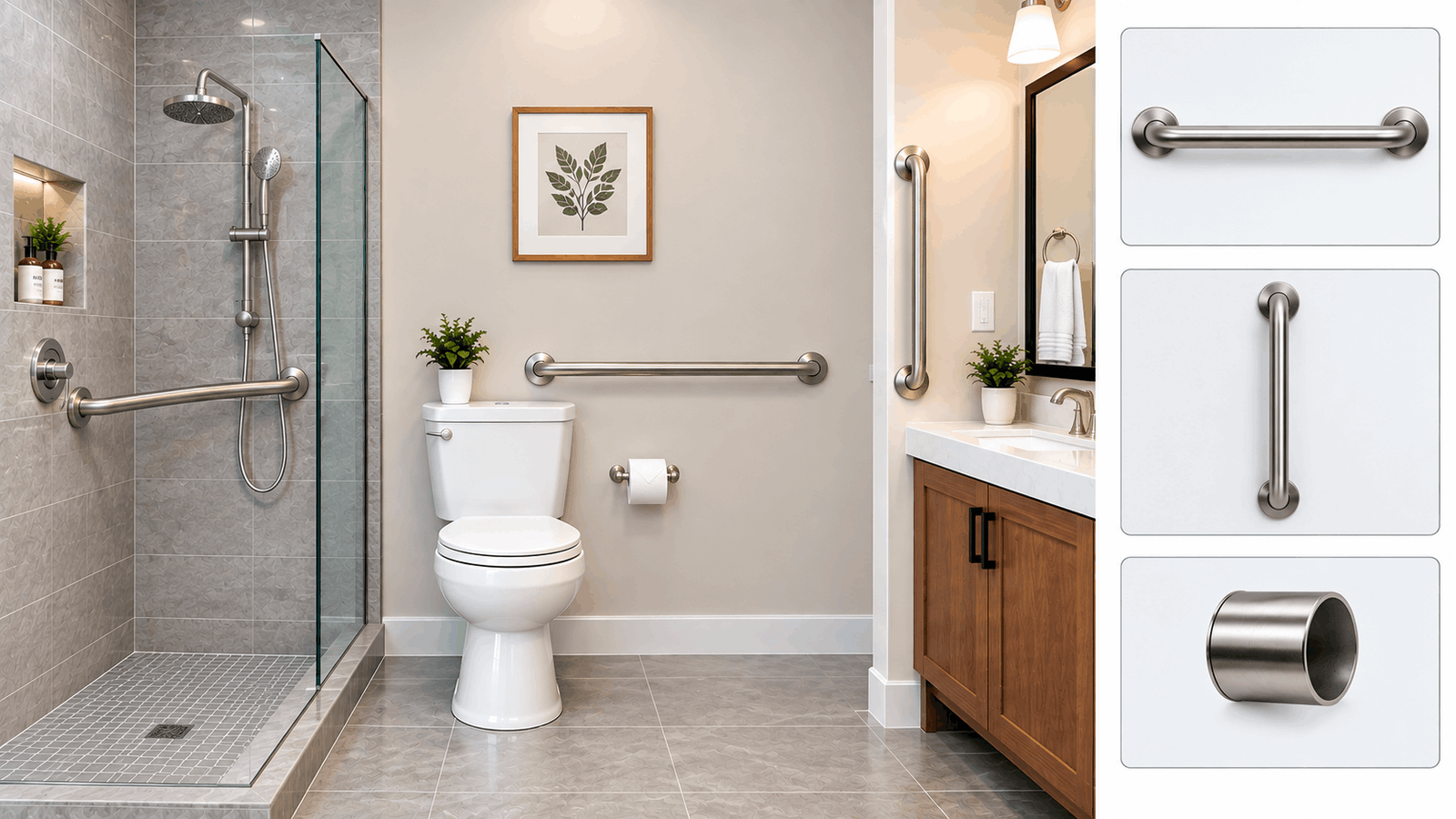
You’ve got a drill in one hand and a stud finder in the other, and now you’re stuck on the one number that actually matters: how high does this thing go? Get it wrong and you’ve either drilled through tile for nothing or installed a bar that doesn’t actually help anyone.
Quick Answer: The standard height for a bathroom grab bar is 33 to 36 inches above the finished floor, measured to the top of the bar. This range applies to horizontal bars near the toilet, tub, and shower. Vertical bars mount higher, between 39 and 41 inches, and exact placement shifts depending on the fixture.
Table of Contents
What You Need to Know
- The general rule is 33–36 inches for horizontal grab bars, per ADA Standards for Accessible Design (Section 609).
- Toilet bars, shower bars, and vertical bars each have their own spec — they’re not all the same number.
- Height is measured from the floor to the top of the bar, not the centre.
- ADA minimums aren’t automatically the safest height for your household — a code minimum and a good fit for your specific bathroom aren’t always the same thing.
- Obstructions like toilet tanks or window sills can force you to adjust from the standard range.
What Is the Standard Grab Bar Height?
A horizontal grab bar mounted 33 to 36 inches above the floor meets ADA.gov guidelines for the vast majority of bathroom installations. This range shows up in toilet-area bars, tub bars, and shower bars alike — it’s the number you’ll see repeated across nearly every building code reference.
Here’s the detail most guides skip: that measurement runs from the finished floor to the top edge of the bar, not its centreline. A bar with a 1¼-inch diameter mounted so its top sits at 34 inches will have its centre around 33.4 inches. On a project where every half-inch matters for compliance, that distinction is worth getting right the first time.
Grab Bar Height Chart by Bar Type
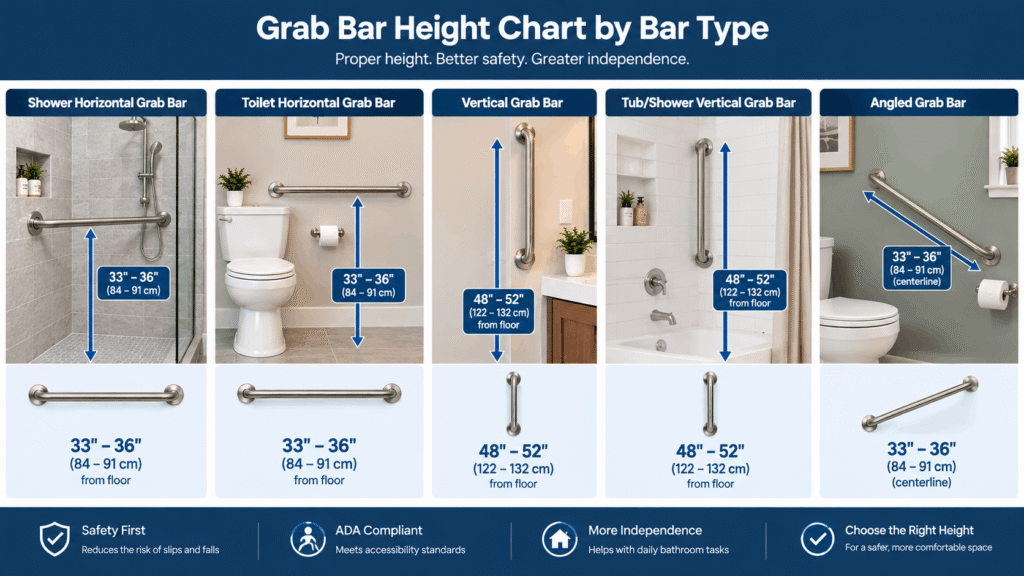
Different bars in the same bathroom don’t share one height. Here’s every common type side by side.
Bar Location Standard Height (Floor to Top) Notes Toilet, side wall 33–36 inches Bar extends min. 42 inches from the back wall Toilet, back wall 33–36 inches Bar min. 36 inches long Shower/tub, horizontal 33–36 inches Mounted on side or back wall Shower/tub, vertical 39–41 inches Assists standing/sitting transitions Diagonal bar top no higher than 42 inches Common in walk-in showers General wall-mounted bar 33–36 inches Standard reference point for most installs
Save or screenshot this chart — it covers every bar type you’ll encounter in a standard bathroom, so you don’t have to hunt through separate pages for each one.
Grab Bar Height for a Toilet
Toilet-area grab bars mount at 33 to 36 inches above the floor, but the two bars around a toilet aren’t identical. The back-wall bar needs to be at least 36 inches long, positioned so it extends at least 12 inches from the toilet’s centreline towards the closest side wall. The side-wall bar runs longer — a minimum of 42 inches — and needs to reach at least 54 inches out from the back wall.
Toilet paper dispensers get pulled into this spec too: they belong below the grab bar, at a minimum height of 19 inches, so they don’t interfere with a user’s grip. For the full breakdown of exact distances and clearances around the toilet, the ADA Grab Bars in Bathroom: The Complete Overview covers every measurement in one place.
Grab Bar Height for a Shower or Tub
Shower and tub grab bars follow the same 33–36 inch horizontal range, but a second, lower bar is common along the tub rim. Many installations add a bar 8 to 10 inches above the rim of the tub, in addition to the standard horizontal bar 33 to 36 inches up the wall — the lower bar assists with entering and exiting, while the higher one supports standing.
Vertical bars in showers jump to 39–41 inches and typically get placed near the shower entrance or besides a built-in seat, where a user needs a straight-up-and-down grip to stand rather than a horizontal one to steady themselves. For placement specific to walk-in configurations, see Walk-In Shower Grab Bar Placement: Where Each Bar Goes.
How Is Grab Bar Height Measured?
Every height figure in this guide is measured from the finished floor to the top edge of the grab bar — not its centreline, and not the bottom. This detail comes directly from the ADA Standards for Accessible Design, which also require a minimum of 1.5 inches of clearance between the wall and the bar and at least 12 inches of clear space above it.
Get this measurement point wrong, and a bar that looks compliant on a tape measure can actually sit an inch or more outside code — enough to matter on an inspection and enough to change how comfortably it’s reached.
What If There’s an Obstruction at Standard Height?
Toilet tanks, window sills, and tile ledges routinely sit right where a 33–36 inch bar wants to go, and none of the standard guides address what to do about it. When a fixed obstruction blocks the exact range, code allows shifting the bar as needed to clear it — the priority is keeping the bar’s functional reach and grip clearance intact, even if the exact inch count moves slightly outside the textbook range.
A tank that runs unusually tall is the most common culprit. In that case, the back-wall bar typically gets mounted at the higher end of the range, close to 36 inches, to clear the tank lid with room to grip comfortably.
ADA Minimum vs. Best Practice for Home Safety
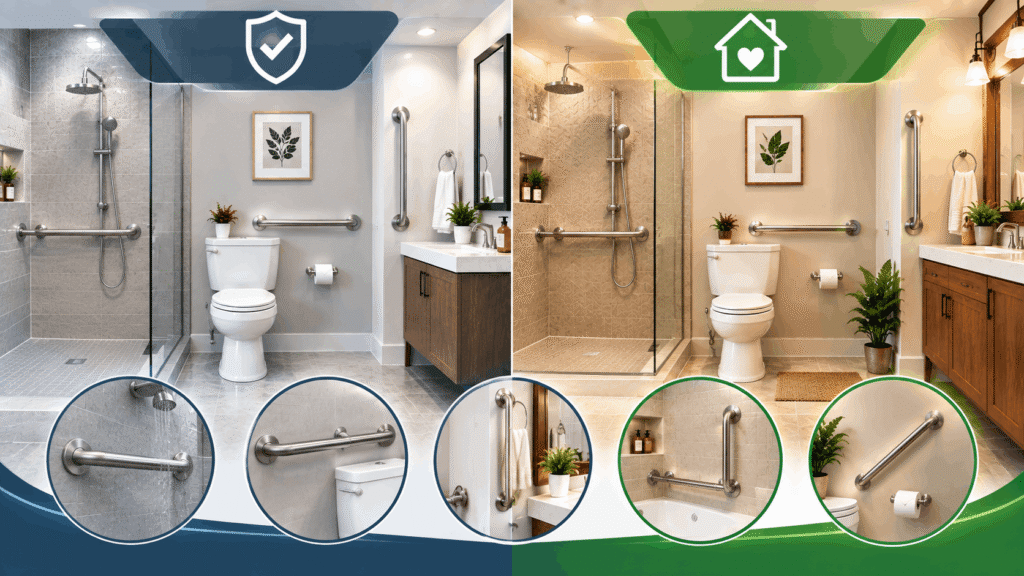
ADA height standards were written as legal minimums for public accommodations, not as a safety optimum for every household bathroom. That distinction gets lost in most guides, which treat “ADA compliant” and “safest for my situation” as the same thing. They’re related, but not identical.
A taller user, someone recovering from hip surgery, or a household with a wheelchair user may all need a height adjusted from the standard range to fit their actual reach and grip strength. Organisations like the National Institute on Ageing recommend involving an occupational therapist or contractor familiar with ageing-in-place modifications when the standard range doesn’t match the household’s specific needs — a five-minute consultation is cheaper than redrilling tile.
Common Mistakes to Avoid
- Measuring to the wrong point. Confusing the centreline with the top-of-bar measurement throws off compliance by up to an inch.
- Installing one height for every bar. Toilets, showers, and vertical bars each have their own range — copying one number across all of them is the single most repeated error.
- Mounting into drywall instead of studs. Height only matters if the bar can actually hold weight; a bar screwed into sheetrock alone can fail regardless of how correctly it’s positioned.
- Ignoring the obstruction rule. Forcing a bar to the textbook height around a tank or sill, rather than adjusting for the obstruction, can leave a bar with an unsafe, cramped grip zone.
FAQ
What is the standard height for a grab bar on a bathroom wall?
The standard height for a horizontal grab bar mounted on a bathroom wall is 33 to 36 inches above the finished floor, measured to the top of the bar. This applies to bars near the toilet, tub, and shower. Vertical bars are the exception, mounting higher at 39 to 41 inches.
What is the grab bar height for a handicapped toilet?
Grab bars near an ADA-compliant toilet mount at 33 to 36 inches above the floor. The back-wall bar must be at least 36 inches long, and the side-wall bar at least 42 inches long, extending a minimum of 54 inches from the back wall.
What is the shower grab bar height for elderly users?
Shower grab bars for elderly users typically follow the 33–36 inch ADA range for horizontal bars, sometimes paired with a second bar 8 to 10 inches above the tub rim for entry and exit. Individual needs may call for adjusting this height with guidance from an occupational therapist.
Where can I see a toilet grab bar placement diagram?
A full visual breakdown of toilet grab bar placement, including exact distances from the centreline and side wall, is available in Where to Put Grab Bars in a Bathroom: A Zone-by-Zone Guide, which maps out every zone in the bathroom.
Should a grab bar be mounted higher for a tall person?
Yes. The 33–36 inch range is a general standard, not a fixed rule for every body type. A taller household member may need the bar closer to the top of that range, or slightly above it, to reach comfortably without bending.
Can I install a grab bar at a different height than ADA specifies?
Yes, for a private residence. ADA standards are legally required for public accommodations but serve as a guideline, not a mandate, in a private home. Many households adjust height based on the specific user’s reach, mobility, and the household’s own layout.
What to Do Next
Getting the height right is half the job — placement and full dimensions are the other half. The ADA Grab Bar Dimensions: The Complete Chart breaks down every measurement beyond height, and the Zone-by-Zone Placement Guide shows exactly where each bar goes room by room.