
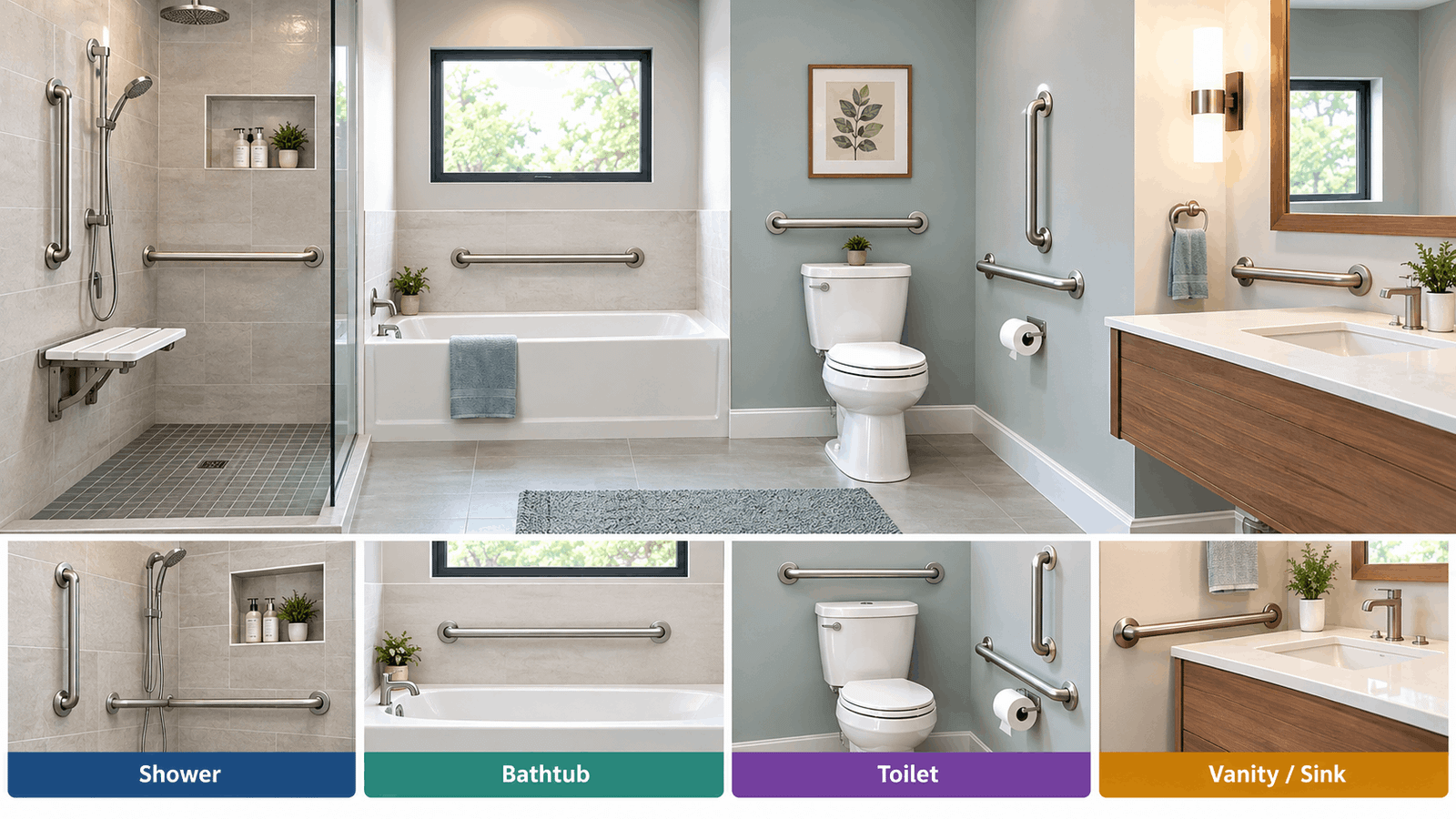
You’re standing in the bathroom trying to picture where a grab bar would actually help—maybe after a close call getting out of the tub, maybe before your dad moves in, maybe just because you’re finally renovating. You don’t need a lecture on why falls happen. You need to know exactly where the bars go.
Quick Answer: Grab bars belong in four bathroom zones: inside the shower or tub (vertical bar at the entry, horizontal bar along the long wall), beside the toilet, and near the sink if you lean on it for balance. Mount most bars 33 to 36 inches above the floor, anchored into wall studs—not drywall alone.
Table of Contents
What You Need to Know
- Every bathroom with a shower or tub needs at least two grab bars: one for entry/exit and one for standing support.
- The standard mounting height is 33″–36″ from the floor, measured to the top of the bar.
- Grab bars must anchor into studs or rated wall anchors—drywall alone won’t hold body weight in a fall.
- Vertical bars help with entry and exit; horizontal bars help with standing and balance.
- Toilet-area bars follow different length rules than shower bars—a shorter bar there won’t give real support.
Where Do Grab Bars Go in the Shower?
A shower needs three grab bars in most layouts: a vertical bar at the entry, a horizontal bar on the long wall, and a shorter bar on the back wall. The entry bar is the one people reach for most, because stepping over a threshold onto a wet floor is where most bathroom falls start.
The horizontal bar on the long wall runs at 33″–36″ and gives you something to hold while you’re standing under the water, shifting your weight, or bending to pick up a dropped bottle of shampoo. The back-wall bar matters more in larger walk-in showers, especially if there’s a built-in bench—it’s what you’d reach for turning around or sitting down.
If your shower has a built-in seat, add a bar within arm’s reach of it. Standing up from a wet seated position is its own fall risk, separate from entry and exit. For a shower-specific breakdown by layout, our walk-in shower grab bar placement guide covers entry points, corner showers, and bench placement in more depth.
Where Do Grab Bars Go in the Tub?
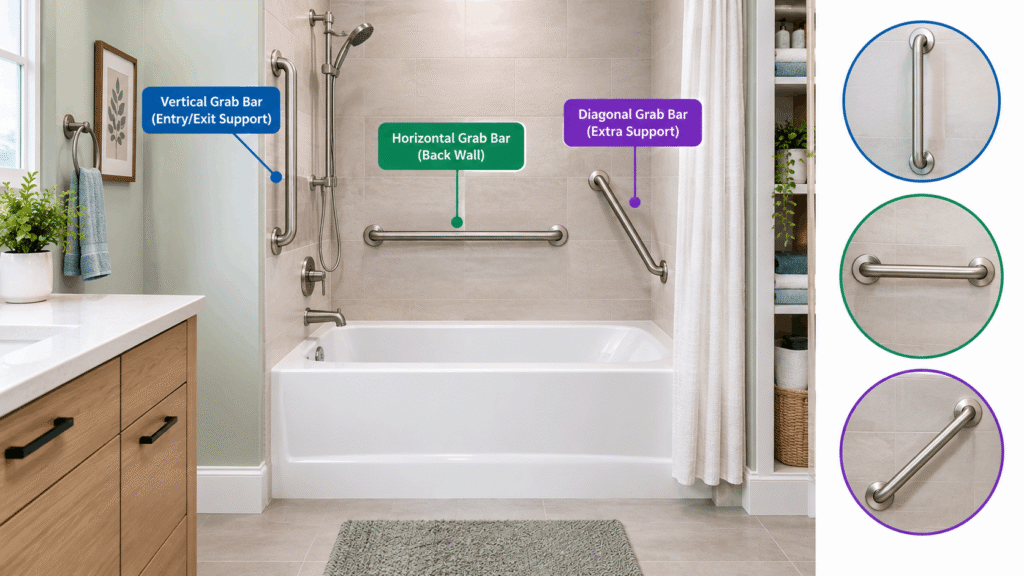
Tub placement splits into two jobs: a bar outside the tub for stepping over the wall and a bar inside for standing or sitting. Mount a vertical bar just outside the tub, near the edge you step over, so you have something to hold before your foot ever leaves the floor.
Inside the tub, a horizontal bar along the long wall at 33″–36″ supports you while standing to shower or rinse. If you bathe seated, a second bar closer to the faucet end helps with lowering down and pushing back up—this is the motion where a single bar in the wrong spot does the least good.
One placement question comes up constantly: freestanding tubs with no adjacent wall to anchor into. In that case, a floor-mounted grab bar or a tub-clamp bar is the safer option, since there’s no stud to screw into. Our ADA grab bar dimensions chart has the exact spacing for wall-mounted setups if your tub does have an adjacent wall.
Where Do Grab Bars Go by the Toilet?
A toilet needs two bars: a longer one on the side wall and a shorter one on the rear wall, both around 33″–36″ high. The side-wall bar should run at least 42 inches long, starting no more than 12 inches from the rear wall. That length matters—a short decorative bar won’t reach far enough forward to catch you as you lower or rise.
The rear-wall bar runs at least 36 inches, centered so it extends on both sides of the toilet’s centerline. If there’s no side wall available—a common problem in small powder rooms—a floor-mounted or fold-down bar on the open side fills the gap.
Sitting down and standing up is one of the highest-repetition movements in a bathroom, which is part of why toilet-area falls are so common among people recovering from surgery or joint replacement.
Where Do Grab Bars Go by the Sink?
A sink-area bar is optional and only needed if you lean on the counter or sink edge for balance while grooming. Pedestal sinks and wall-mounted sinks with no cabinet underneath are the cases where this matters most, since there’s nothing solid to grip if you lose your footing.
A short vertical or horizontal bar beside the sink, mounted into a stud, gives you something rated to hold weight instead of a fixture that was never designed to.
Bathroom Grab Bar Placement Reference Table
Zone Bar Type Height Range Placement Notes Shower entry vertical 33″–36″ (bottom of bar near knee height, extending up) At the threshold, on the wall, you brace against stepping in the long shower wall. Horizontal 33″–36″ Full length of the usable wall, away from controls Tub exterior vertical 33″–36″ At the edge you step over the tub interior horizontal 33″–36″. Along the long wall, near the faucet end, if seated bathing Toilet side wall Horizontal 33″–36″ 42″ minimum length, starting within 12″ of rear wall Toilet rear wall Horizontal 33″–36″ 36″ minimum length, centered on the toilet Sink area (optional) Vertical or horizontal 33″–36″ Only where no cabinet or solid counter edge exists
Save or screenshot this reference table—it covers every zone in a standard bathroom in one place, so you don’t have to cross-reference three different pages while you’re standing there with a stud finder.
What Height Should a Grab Bar Be Mounted?
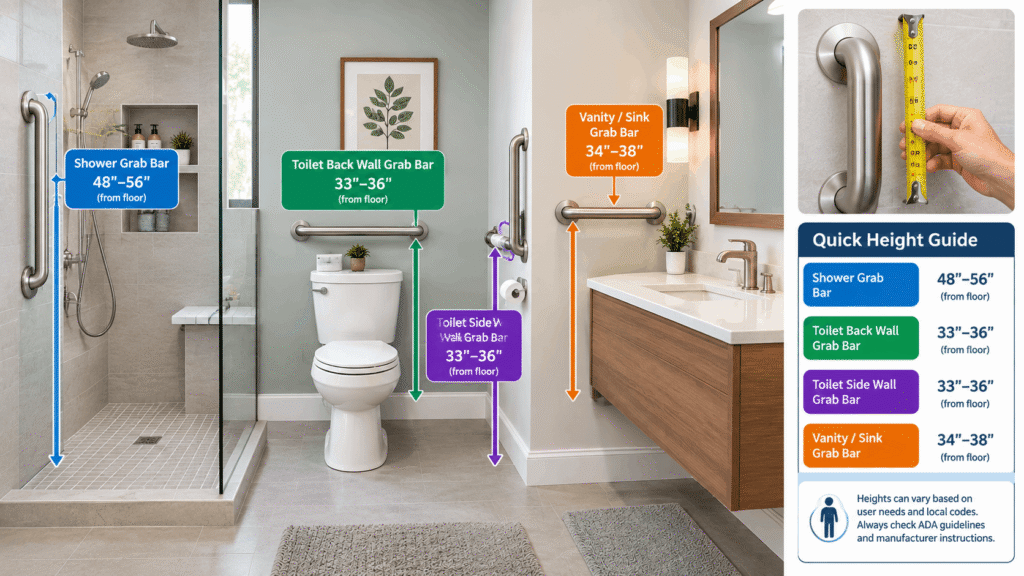
Most grab bars go 33 to 36 inches above the floor, measured to the top of the gripping surface—the range set by the U.S. Access Board’s ADA Standards. Residential bathrooms aren’t legally required to hit this exact number, but it’s the most tested reference available, and it’s the height professional installers default to.
That said, 33″–36″ is a starting point, not a rule carved in stone for your specific household. A taller household member, or someone who uses a shower seat, may need a bar closer to 36 inches. A shorter or seated user may do better closer to 33. If you’re installing for one specific person, measure their actual reach before you drill.
Do Grab Bars Need to Go Into a Stud?
Yes—a grab bar screwed only into drywall will not hold body weight in a real fall, no matter how many screws you use. Studs in most homes sit 16 inches apart, center to center, and a stud finder will locate them before you drill a single hole.
If a stud doesn’t line up where you need the bar, a rated wall anchor built for grab bars — not a standard drywall anchor — can hold the load instead. This is also the moment to skip suction-cup bars entirely: they’re marketed as a quick fix, but they’re not rated to catch a falling adult, and they can release under pressure at the exact moment you need them most.
Vertical vs. Horizontal: Which Goes Where
Vertical bars support the motion of entering, exiting, and changing direction; horizontal bars support standing still and shifting weight. Neither one replaces the other—most bathrooms need both, in different spots.
Vertical Bars, Horizontal Bars Best for stepping over a tub wall or threshold Best for standing steady while showering Support changing direction. Support longer periods of standing. Placed at entry/exit points Placed along walls you’re facing while stationary
An angled bar splits the difference and works well next to a toilet or shower seat, since your hand position changes as you move from sitting to standing.
Common Placement Mistakes to Avoid
- Mounting into drywall only. The single most common failure point—always anchor into a stud or a rated anchor system.
- Installing just one bar. One bar covers one motion. A bathroom that only handles entry or only handles standing leaves the other movement unsupported.
- Using a towel bar as a grab bar. Towel bars aren’t weight-rated and will pull out of the wall under real load.
- Guessing at height instead of measuring for the actual user. A bar mounted for an average adult may sit wrong for a shorter, taller, or seated user.
- Skipping the toilet area. Shower and tub bars get the attention; toilet-area falls are just as common and often overlooked.
Placement for Elderly Family Members or Caregivers
If you’re placing bars for an aging parent or a family member recovering from surgery, the same four zones apply—but the priority order often shifts. Toilet-area bars and a bar near the bed-to-bathroom path tend to matter more here than shower styling. Our room-by-room guide to grab bar placement for elderly family members walks through prioritizing rooms when you can’t install everywhere at once, plus placement notes specific to walkers and wheelchairs.
[CONTENT GAP: no existing article covers freestanding-tub or no-stud-wall grab bar solutions in depth—worth planning as a follow-up piece.]
Frequently Asked Questions
Where do you put grab bars on a bathroom wall?
Grab bars go on load-bearing anchor points—ideally directly into a wall stud, which is typically 16 inches from the next stud. Common wall locations are the shower entry wall, the long wall inside the shower or tub, and the side and rear walls beside the toilet.
Where should grab bars be placed for elderly family members?
The same four zones apply—shower, tub, toilet, and sink if needed—but for elderly users, prioritize the toilet area and the path between the bed and bathroom first, since those see the most repeated, fatigued movement.
What do grab bars in a shower actually look like in place?
A typical setup shows one vertical bar mounted at the entry wall and one horizontal bar running along the longest wall at 33″–36″ high, positioned away from the shower controls so it doesn’t interfere with reaching the faucet.
Where do grab bars go in a walk-in shower specifically?
Walk-in showers usually get an entry bar, a long horizontal wall bar, and a rear bar near any built-in bench. Layouts vary more here than in a standard tub-shower combo, so our dedicated walk-in shower placement guide breaks it down by shower shape.
How many grab bars does a bathroom need?
Most bathrooms with a shower or tub need at least two to three bars for that fixture alone, plus two more beside the toilet if space allows. A sink-area bar is optional and depends on the sink style.
What height should a grab bar be mounted at?
33 to 36 inches above the floor, measured to the top of the bar, is the standard reference used in both ADA guidance and most professional installations—adjustable based on the height of the person using it.
What to Do Next
If you want the exact ADA measurements behind every number in this guide, our full ADA grab bar dimensions chart has the complete spec sheet. If your bathroom has a walk-in shower specifically, our walk-in shower placement guide goes deeper on shape-specific layouts. And if you’re placing bars for an aging parent rather than yourself, our elderly-focused room-by-room guide covers what to prioritize first.