
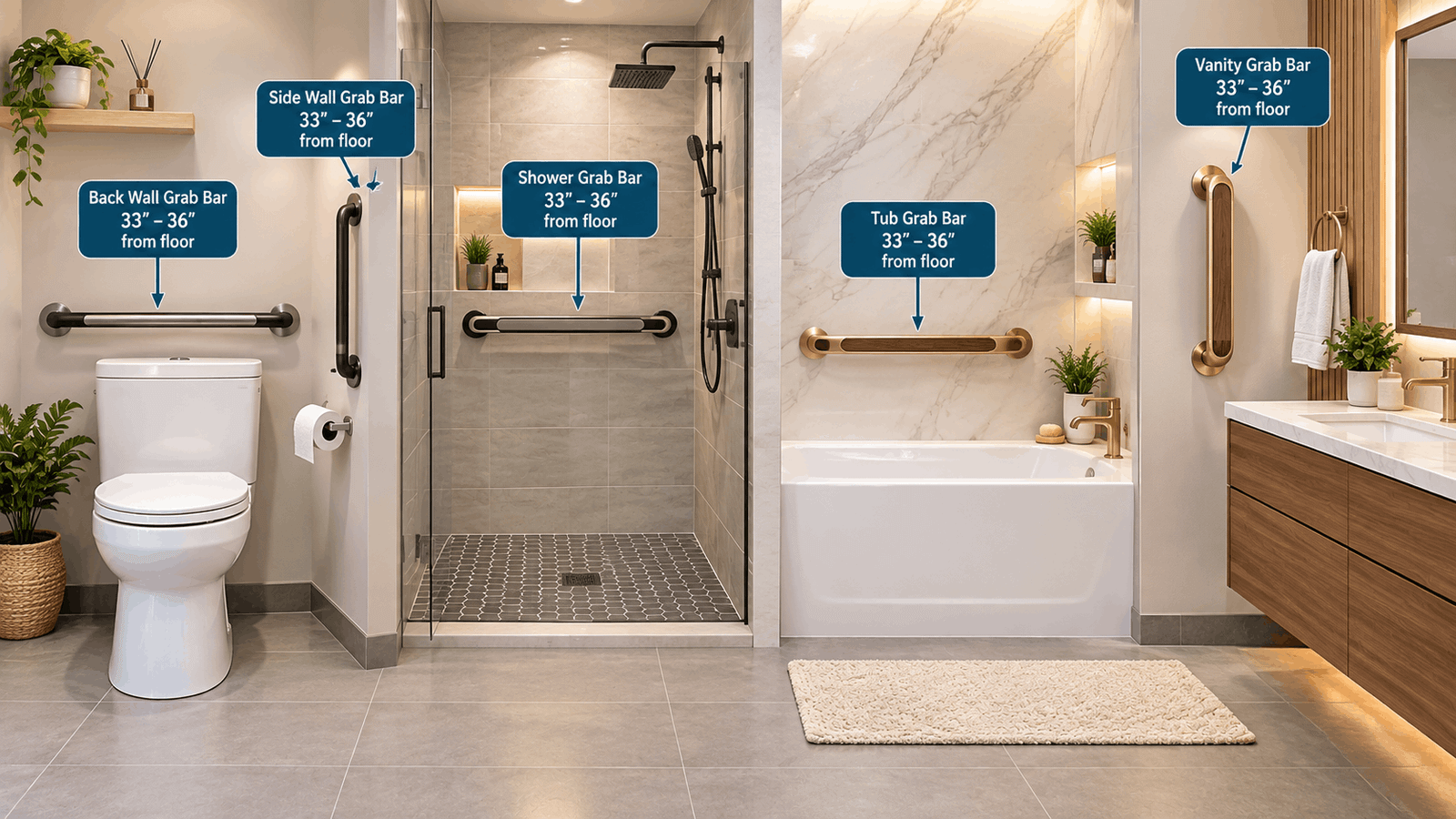
You’ve got a pencil mark on the shower wall and a level in your hand, and you’re second-guessing the number you wrote down. Get the height right the first time—it changes depending on whether you’re mounting near the toilet, the shower, or the tub.
Quick Answer: ADA guidelines set grab bar height at 33 to 36 inches above the floor, measured to the top of the gripping surface, at the toilet, shower, and bathtub. The tub’s upper back-wall bar sits 8 to 10 inches above the rim instead. Vertical grab bars have no ADA height requirement—only an 18-inch minimum length.
Table of Contents
What You Need to Know
- Horizontal grab bars at the toilet, shower, and tub all mount at 33–36 inches, measured to the top of the gripping surface.
- A tub with a two-bar back-wall setup needs a second bar 8–10 inches above the rim—not at 33–36 inches.
- ADA sets no height for vertical grab bars—codes only require an 18-inch minimum length.
- Toilet and shower/tub seats are built around a 17–19 inch height, which is why the standard grab bar range lines up with them.
- The code number is a starting point, not a rule for everybody—a taller, shorter, or wheelchair-using person may need a different height entirely.
Grab Bar Height Chart, by Location
The height changes depending on which fixture the bar sits near, and getting it wrong by even a couple of inches can make a bar useless in the exact moment someone reaches for it. No single height works everywhere in the bathroom—the toilet, shower, and tub each have their own range, and the tub actually needs two bars at two different heights.
Location Height Above Floor Measured to Toilet—Rear Wall Bar 33″–36″ Top of gripping surface Toilet—side wall bar 33″–36″ Top of gripping surface Shower—horizontal bar(s) 33″–36″ Top of gripping surface Tub—lower back-wall bar 33″–36″ Top of gripping surface Tub—upper back-wall bar 8″–10″ above the tub rim Top of gripping surface Vertical bar (transfer shower/tub) No ADA height set; 18″ minimum length (ICC A117.1)—toilet/shower/tub seat (reference) 17″–19″ Finished floor
Save or screenshot this height chart—it covers every fixture in a standard bathroom, so you won’t need to look up a separate number for each bar you install.
Toilet grab bars
The rear-wall bar behind the toilet needs to run at least 36 inches long, mount at 33–36 inches, and extend at least 12 inches past the toilet’s centerline on one side and 24 inches on the other. A side-wall bar runs a minimum of 42 inches, starting within 12 inches of the rear wall and reaching at least 54 inches out from it. If you just want the single headline number for a toilet install without the rest of the chart, What Is the Standard Height for a Grab Bar in a Bathroom covers exactly that.
Shower grab bars
The same 33–36 inch range applies to every horizontal bar in a shower, but how many bars you need depends on the shower type—a roll-in shower needs bars on three walls, and a transfer shower needs two. Separate bars must sit within 6 inches of adjacent walls and all land at the same height. For the exact wall-by-wall layout, Where to Place Grab Bars in a Walk-In Shower breaks down each zone.
Tub grab bars need two heights, not one.
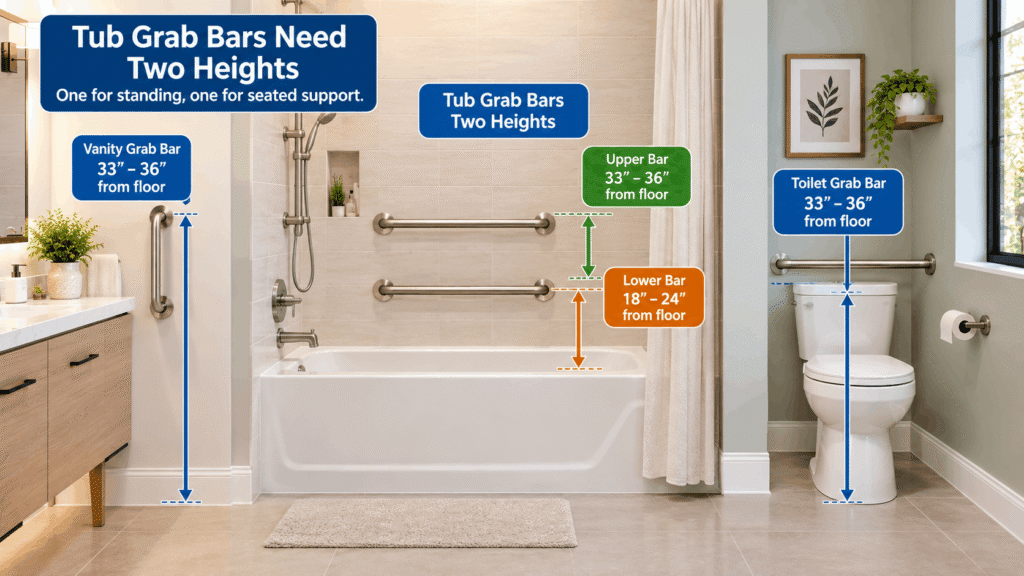
A bathtub back wall needs two bars because sitting in the tub and stepping over the rim are two different movements that need support at two different points. The lower bar sits at 33–36 inches for in-tub stability; the upper bar sits 8–10 inches above the rim for entry and exit. Each bar runs at least 24 inches long, positioned within 24 inches of the head-end wall and within 12 inches of the control-end wall.
Vertical grab bars—the height nobody agrees on
Here’s the detail most grab bar articles get wrong: ADA does not set a height for vertical grab bars at all. The only code-adjacent number is an 18-inch minimum length, from the ICC A117.1 standard that many building codes reference for transfer showers and tubs. The “39 to 41 inches” figure floating around some retailer sites is a manufacturer convention, not a code requirement. For exact positioning, where does a vertical grab bar go in a bathroom, and where does a vertical grab bar go in a bathroom? Where does it go, and how deep does it go? Where to mount one?
Where “Height” Is Actually Measured From
Every number above is measured to one specific point: the top of the grab bar’s gripping surface, not its centerline and not the bracket underneath it. A bar centered at 34 inches with a fat 2-inch-diameter grip can put the top surface outside the compliant range, even though the midpoint looks right on paper. According to the U.S. Access Board’s Chapter 6: Bathing Rooms guide, this measurement point is consistent across every fixture—toilet, shower, and tub bars are all measured the same way, which is why the chart above uses “top of gripping surface” instead of a centerline figure.
Does ADA Height Apply to a Private Home?
No—ADA Standards govern public and commercial buildings, not private residences, per the U.S. Access Board’s own guidance. Nobody inspects your home bathroom for ADA compliance, but the 33–36 inch range exists because it’s been tested and refined for decades, which is exactly why it’s still the right starting point even where it isn’t legally required. One exception: if you’re doing a permitted remodel, your local building department may reference the ICC A117.1 code, which does carry some binding requirements—including that 18-inch vertical bar minimum.
Adjusting Height for the Actual Person Using It
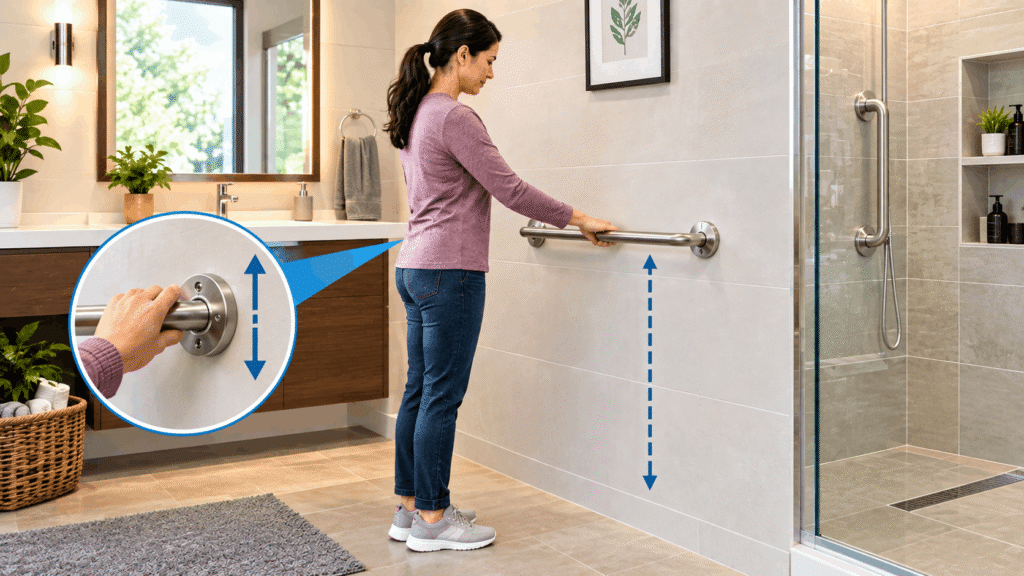
The 33–36 inch range is built around an average-height adult, and the person actually using your bathroom may not be one. A 2025 study published in JMIR Rehabilitation and Assistive Technology found a measurable correlation between a person’s height and where they instinctively reach for a vertical grab bar (r=0.67)—the taller the user, the higher they naturally grasp, which is exactly why a fixed code number can leave a shorter or taller household member reaching wrong.
A quick way to check the fit before you drill:
- Have the person stand where the bar will go. Ask them to walk through the actual motion—sitting on the toilet, stepping over the tub rim, lowering into the shower—without any bar installed.
- Watch where their hand naturally lands. That instinctive reach point tells you more about the right height than a tape measure does.
- Compare it to the 33–36 inch range. If it lands more than an inch or two outside that window, mount to match the person, not the code minimum.
If you’d rather have this chart saved somewhere other than your browser history, BathReviewHub’s newsletter sends a printable version of it straight to your inbox.
Height Mistakes That Make a Grab Bar Unsafe
Getting the number right doesn’t matter if what’s behind the wall can’t hold weight. A grab bar mounted at a textbook-perfect 34 inches into drywall alone will still fail—code-rated bars must withstand 250 pounds of force in any direction, and standard drywall anchors don’t come close to that.
Other height-adjacent mistakes worth checking for:
- Towel bars used as grab bars. They’re built to hold a towel, not body weight, and typically anchor into drywall only.
- Suction-cup bars treated as fall protection. These are rated for minor balance assistance, not for catching a fall.
- Mismatched heights on multiple bars in one shower. If separate bars aren’t at the same height, a user has to relearn the reach point every time they move.
- Bars mounted over tile without hitting a stud or blocking. The height can be perfect, and the bar still pulls out of the wall under load.
FAQ
What’s the height for grab bars on a bathroom wall?
Horizontal grab bars mount at 33 to 36 inches above the finished floor, measured to the top of the gripping surface, according to the U.S. Access Board’s ADA guide. This range applies at the toilet, in the shower, and on a tub’s lower back-wall bar. A tub’s upper back-wall bar is the exception, sitting 8 to 10 inches above the rim instead.
What is the ADA grab bar height for showers?
Every horizontal bar in a shower—whether it’s a roll-in or transfer configuration—mounts at 33 to 36 inches above the floor. Separate bars must be positioned within 6 inches of adjacent walls and installed at the same height as each other. The bar type and wall placement change based on shower layout, but the height stays constant across configurations.
What’s the right shower grab bar height for elderly users?
The 33–36 inch code range is a solid starting point, but an occupational therapist or caregiver can fine-tune it by watching how the person actually moves through the shower. A 2025 JMIR study found grasp height correlates with a user’s own body height, so shorter or taller elderly users often benefit from adjusting a few inches within or just outside the standard range.
What is the correct vertical grab bar height?
There isn’t one fixed number—ADA doesn’t specify a height for vertical grab bars at all. The ICC A117.1 code, referenced by many building codes, only requires an 18-inch minimum length at transfer showers and tubs, leaving exact vertical positioning up to the installer and the person using it.
Is grab bar height different for a bathtub than a shower?
Mostly no—a tub’s lower back-wall bar and a shower’s horizontal bars both sit at 33 to 36 inches. The difference is the tub’s second bar: a two-bar tub setup adds an upper bar 8 to 10 inches above the rim to support the step-over motion, which showers without a curb don’t need.
How far should a grab bar sit from the wall?
Grab bars need a 1.5-inch clearance from the wall, per the U.S. Access Board’s guide—enough space for a secure hand grip without room for an arm to slip through and get trapped. This clearance applies regardless of which fixture the bar is mounted near.
When to Bring in a Professional
This chart covers the code-based starting point, not a full safety assessment for a specific person or bathroom. If you’re installing for someone recovering from surgery, living with a specific mobility condition, or navigating a non-standard bathroom layout, a Certified Aging-in-Place Specialist (CAPS) or occupational therapist can assess the actual movements involved and adjust placement accordingly—height is only half the equation; stud location and wall reinforcement matter just as much.
What to Do Next
Once the height is settled, the next question is usually exact placement within your specific layout. Where to Place Grab Bars in a Walk-In Shower walks through zone-by-zone positioning for showers, and Vertical Grab Bar Placement: Where It Goes and How High covers the vertical bar question this chart only partially answers.