
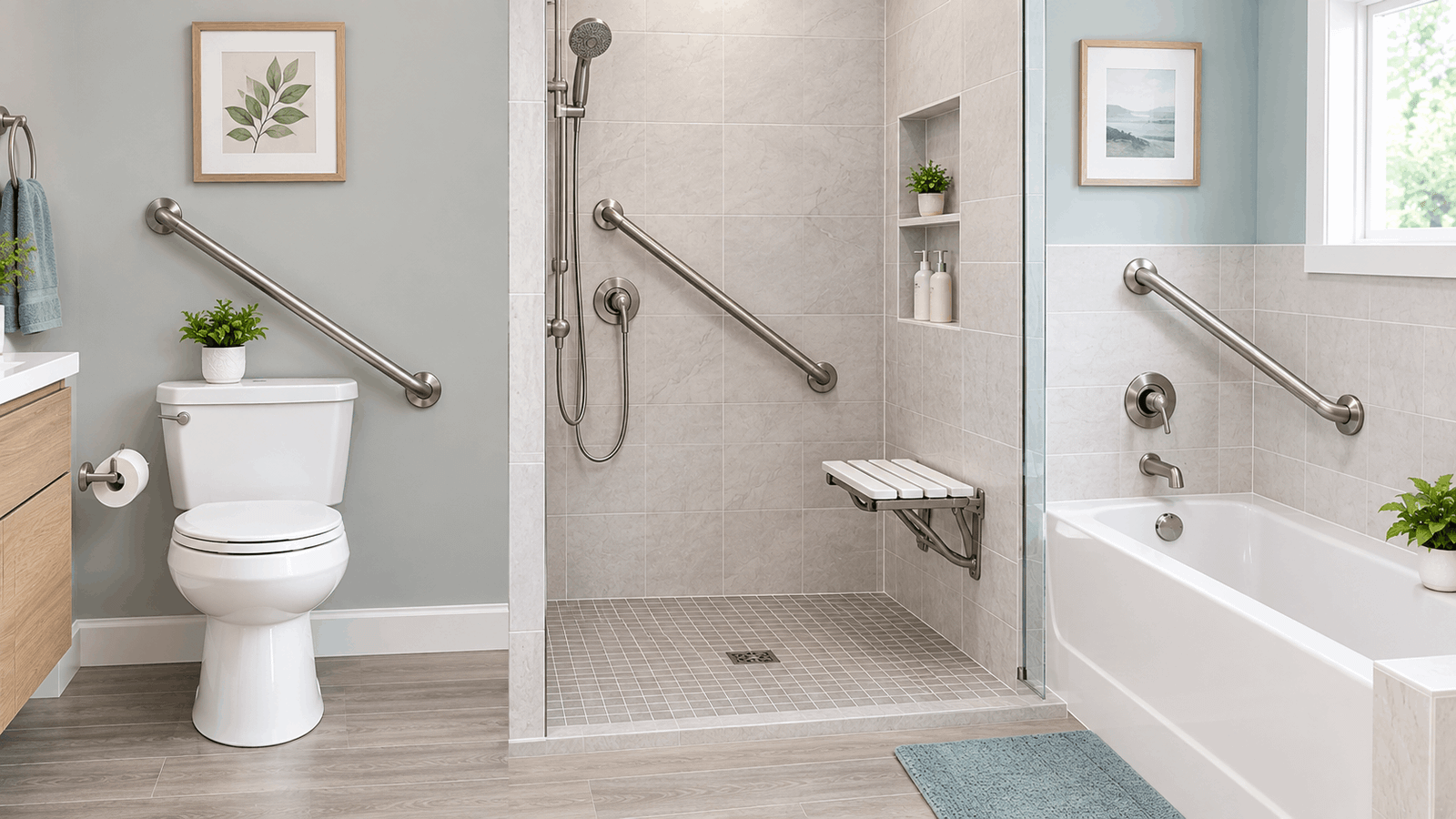
You’re looking at a product page full of “90°,” “120°,” “left-hand,” and “right-hand,” and nothing says which angled grab bar fits your shower. This guide sorts it out: what each angle does, how to pick the hand, where each bar goes, and what the wall behind it has to handle.
Quick Answer: An angled grab bar is two grab bar sections joined at an angle, usually 90°, 120° or 135°, mounted where you change direction, such as a shower entry, tub edge or toilet corner. Pick the angle by the wall layout, pick the left or right hand by which side you reach, and anchor it into studs or blocking.
Table of Contents
What You Need to Know
- Angled bars give you two gripping directions in one rail. Straight bars give you one.
- The common angles are 90° (L-shaped), 120°, and 135°. Inside-corner bars wrap two walls.
- Left-hand vs. right-hand naming varies by manufacturer, so check the product diagram before you order.
- The wall matters as much as the bar. Tile, drywall, and fiberglass alone won’t hold a person’s weight.
- The ADA applies to public and commercial spaces, not automatically to private homes.
What Is an Angled Grab Bar?
An angled grab bar is a bathroom support rail bent into two sections, so it supports you in more than one direction.
An angled grab bar is a wall-mounted support rail with two sections joined at a set angle, most often 90°, 120°, or 135°. It gives you a second gripping direction, so you can pull up with the vertical section and steady yourself with the horizontal one while standing, turning, or stepping in a shower.
A straight bar supports one motion; an angled bar supports the change between motions. That is why you see angled bars at shower entries and beside toilets, where people stand, turn, and sit in quick succession.
For the basics of the product category, see what a grab bar is and what it does.
Angled vs. Straight vs. L-Shaped: Which Angle Do You Need?
Match the angle to how your body moves at that spot: 90° for a sharp turn, 120° or 135° for a gentler sweep, and an inside-corner bar where two walls meet.
“Angled” covers several shapes, and sellers use the word loosely. Some stores lump L-shaped, angled, and corner bars into one category. Others separate 90°, 120°, and 135° bars.
Bar type: Typical use, common catalog sizes (leg A × leg B) Watch for a 90° L-shaped (left or right hand). Beside shower controls, at a tub end wall, next to a toilet 24″ × 16″, 32″ × 16″ Hand direction must match your wall. 120° angled bar Gentler turns where a sharp 90° feels awkward 12″ × 12″, plus 16″ × 16″ and 24″ × 24″ with a center post Short legs mean fewer grip points. 135° angled bar Shallow bends and a wider sweep of hand travel Few stocked sizes in the catalogs reviewed Check availability before planning the layout. Inside-corner bar Where two walls meet, such as a shower corner 34″ × 18″, 42″ × 20″ Needs solid backing on both walls
Sizes above come from manufacturer catalogs and change by brand. Treat them as common options, not standards.
Save or screenshot this angled grab bar selector table. It covers choosing the angle before you shop.
A center post on a 120° bar adds a third mounting point to the middle of the bar. That helps spread the load across a larger part of the wall.
Left-Hand or Right-Hand Angled Grab Bar: How Do You Choose?
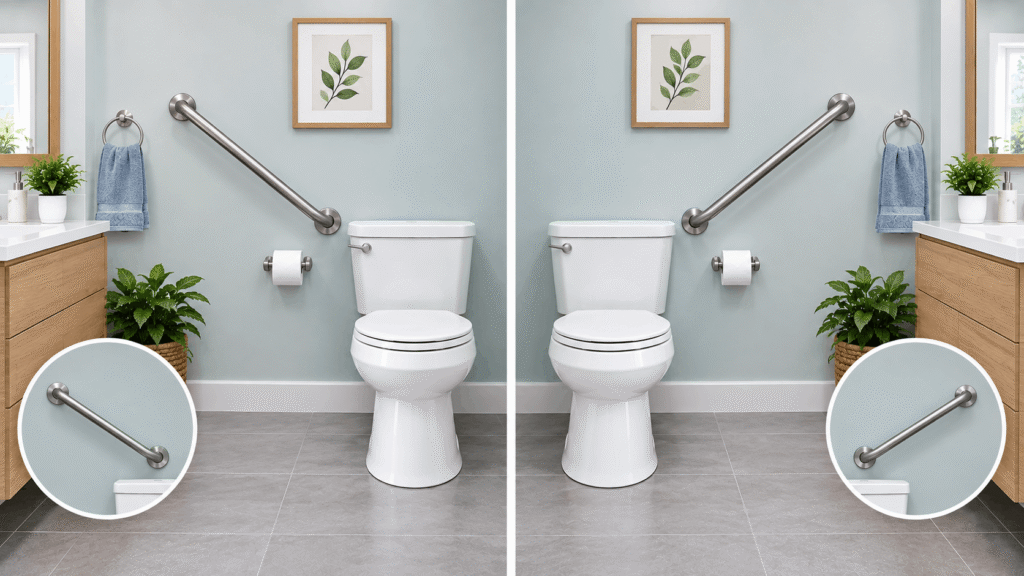
Choose the hand that puts the longer, higher section where your reaching arm naturally lands as you stand or enter.
Hand naming is not universal, so the product diagram beats the product title. A common approach is to face the wall where the bar will go and note which side the horizontal leg extends toward. Confirm that against the manufacturer’s drawing, because some brands label the opposite way.
A simple decision path:
- Stand where you will use the bar. For a shower, stand at the entry facing the wall.
- Note your reaching side. Which hand reaches the wall first when you step in or stand up?
- Match the long leg to that reach. The bar should meet your hand without twisting your torso.
- Check the diagram. Compare your sketch to the manufacturer’s left/right drawing before you buy.
If two people with different dominant sides share the bathroom, a straight bar or a second bar on the opposite wall may serve both better than one angled bar.
Where Do You Put an Angled Grab Bar?
Put angled grab bars where you transition: at the shower entry, at the tub’s exit edge, and beside the toilet, with the lower leg at a reachable height.
Placement follows movement, not wall space. Start with where you stand up, step over, or turn, then pick the wall that gives your hand something to hold at that moment.
Location Where the bar goes Why shower on the wall beside the entry or controls? Steadies you as you step in and turn Tub On the end wall or the wall at the exit edge Supports the step over the rim toilet On the side wall or at the corner Helps with sitting and standing Shower corner: an inside-corner bar across two walls One rail serves both walls.
For a room-by-room layout, see where to install grab bars. For toilet spots in stalls, see the best locations for grab bars in a bathroom stall.
Mounting heights
A horizontal grab bar section generally sits 33 to 36 inches above the floor. That range comes from the 2010 ADA Standards. For angled bars, the vertical section’s height depends on the bar’s size. Our grab bar height chart by location and code covers the numbers.
Are Angled Grab Bars ADA Compliant?
Angled bars can meet ADA requirements when they follow the same gripping, clearance, and strength rules as any other grab bar, but the ADA does not require an angled bar anywhere.
The ADA governs public and commercial spaces; a private home isn’t automatically covered. If you are outfitting a business, school, or medical facility, the rules apply. If you are outfitting your own bathroom, they work as a useful benchmark.
According to the U.S. Access Board’s 2010 ADA Standards for Grab Bars (section 609), the key numbers are
Requirement: Figure gripping diameter 1-1/4″ to 1-1/2″ space between bar and wall 1-1/2″ height to top of gripping surface: 33″ to 36″ The force the bar must withstand is 250 pounds at any point.
Confirm the current text on the Access Board site before you specify a bar for a commercial project.
How Much Weight Can an Angled Grab Bar Hold?
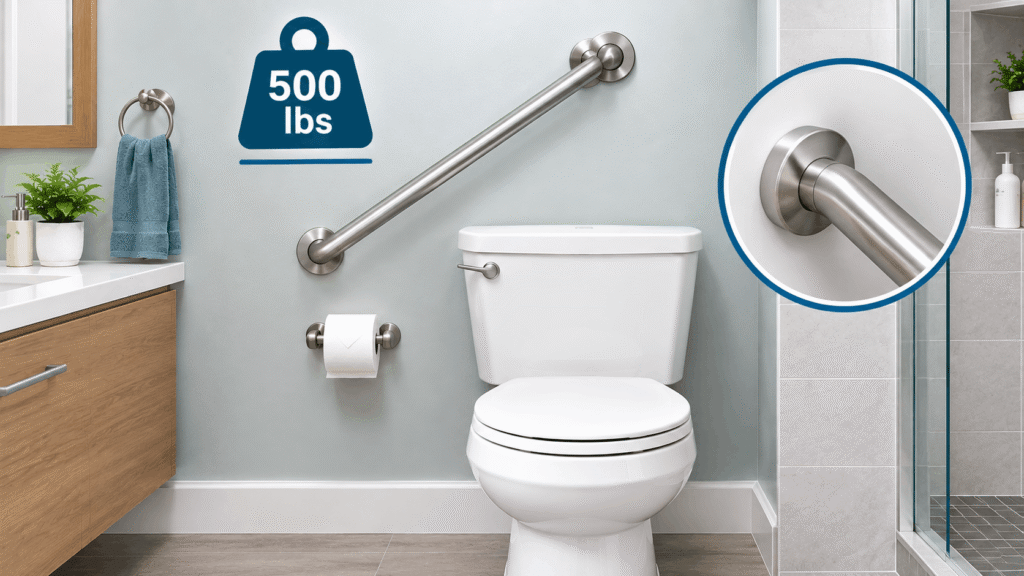
An angled grab bar is only as strong as its weakest link: the bar, the fasteners, or the wall behind it.
The ADA’s 250-pound force requirement tests the whole installation, not just the steel. A rated bar screwed into bare drywall can fail even though the bar itself is fine. Tile, drywall, plaster, and fiberglass shower surrounds can’t carry a person’s weight alone.
“Heavy-duty” is a marketing term; the ADA doesn’t define a heavy-duty category. Check the manufacturer’s rated load on the spec sheet instead. ASTM F446 is the consumer safety specification for grab bars and accessories installed in the bathing area, and some manufacturers cite it.
Three things decide whether a bar holds:
- Backing. Fasten into wall studs or solid wood blocking behind the wall.
- Fasteners. Use the hardware the manufacturer specifies, not whatever is in a drawer.
- Mounting type. Concealed-flange bars hide the screws, but they still need the same backing.
Call a professional if you can’t locate studs, the wall is fiberglass or a tile-over-backer assembly you haven’t opened, or the bar will carry a heavier user.
Common Mistakes With Angled Grab Bars
Most mistakes come from buying before measuring the movement.
- Ordering the wrong hand. Compare the product diagram to your wall, not the name on the listing.
- Mounting into drywall or tile only. Without studs or blocking, the bar can pull out under load.
- Treating “angled” as one product. A 90° bar and a 135° bar behave differently.
- Choosing a diameter by looks. Stay within the 1-1/4″ to 1-1/2″ range for a secure grip.
- Skipping the clearance. Leave about 1-1/2″ between bar and wall so a hand fits.
- Placing it where you won’t reach it. Stand in the spot, reach, and mark the wall before drilling.
Want the selector table as a one-page printable checklist for your bathroom plan? Join the newsletter and we’ll send it. [EMAIL CAPTURE: printable angled grab bar selector checklist]
Choosing and Buying an Angled Grab Bar
Buy after you know the angle, hand, and wall, then look for stainless steel, a stated load rating, and the right diameter.
Once you have those three answers, a stainless steel 90° bar in 1 1/2″ diameter with a concealed flange fits many shower and toilet corners. [AFFILIATE LINK: 1-1/2″ stainless steel 90° angled grab bar]
For a side-by-side view of options, see [CONTENT GAP: best angled grab bars roundup].
FAQ
What are the best angled grab bars?
The best angled grab bars are stainless steel, sized 1-1/4″ to 1-1/2″ in diameter, with a stated load rating, concealed or sturdy exposed flanges, and the correct left or right hand for your wall. Rank them by how well they fit your layout and anchoring, not by brand alone.
What are heavy-duty angled grab bars?
Heavy-duty angled grab bars are bars a manufacturer rates for a higher load than a standard bar. The ADA doesn’t define a “heavy-duty” category, so read the spec sheet for the rated load. Pair any bar with studs or solid blocking, because the wall often limits strength before the steel does.
Are angled grab bars good for bathrooms?
Yes, angled grab bars suit bathrooms where you change direction, such as shower entries, tub edges, and toilet corners. They provide two gripping directions in one rail. Where you only need a single pulling direction, a straight bar can work just as well.
Where should angled grab bars be placed?
Place angled grab bars where you turn, step, or stand: beside the shower entry, at the tub’s exit edge, and next to the toilet. Mount the horizontal section 33″ to 36″ above the floor if you follow the ADA benchmark. Test your reach before drilling.
Are angled grab bars ADA compliant?
Angled grab bars can be ADA compliant if they meet the same standards as other grab bars: a 1-1/4″ to 1-1/2″ gripping diameter, 1-1/2″ wall clearance, and a 250-pound force rating. The ADA doesn’t require angled bars, and it doesn’t automatically apply to private homes.
How do I know if I need a left-hand or right-hand angled grab bar?
Face the wall where the bar will go, decide which side you reach with, and match the bar’s long leg to that reach. Manufacturers label hand direction differently, so check the product drawing before ordering. If two users reach from opposite sides, consider a straight bar or two bars.
Do I need studs or blocking to install an angled grab bar?
Yes. Anchor an angled grab bar into wall studs or solid wood blocking behind the wall surface. Drywall, tile, and fiberglass alone can’t carry a person’s weight. If you can’t locate solid backing, have a qualified installer open the wall and add blocking first.
What to Do Next
- Plan the layout: use our room-by-room guide to where grab bars go to mark each wall.
- Check the numbers: see grab bar heights by location and code before you drill.
- Compare products: read [CONTENT GAP: best angled grab bars roundup] once your angle, hand, and wall are settled.