
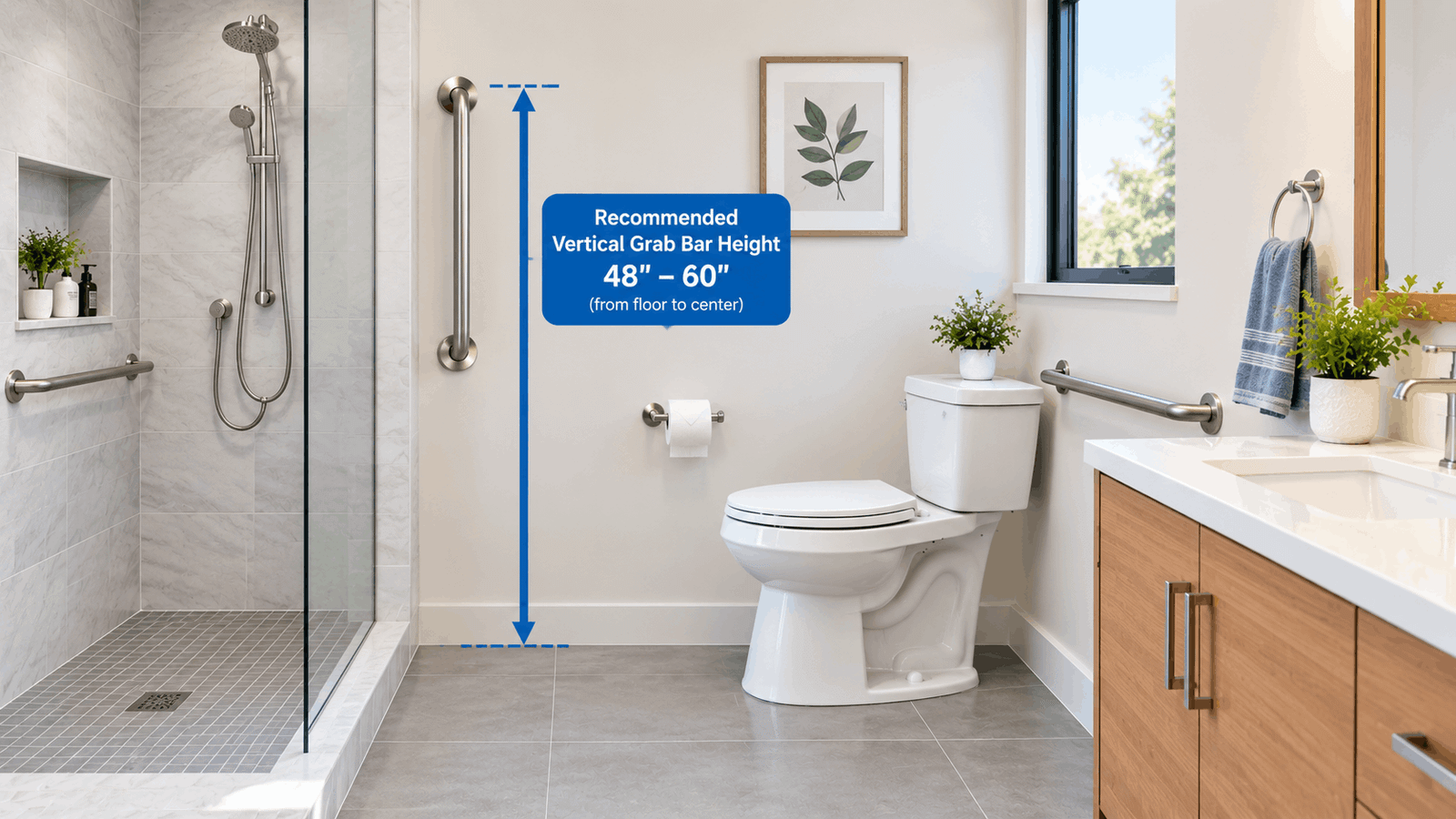
Vertical grab bar in hand, tape measure out, and you’re not sure if the number you found online applies to your bathroom or a commercial one. That mismatch is common—this page breaks the height down by exactly where the bar is going.
Quick Answer: Vertical grab bar height depends on location. At a toilet, ICC/ANSI A117.1 requires the bar’s bottom edge 39–41 inches above the floor. In a shower or tub, vertical bars are typically mounted with the bottom 36–41 inches up. The ADA itself sets no vertical grab bar height requirement.
Table of Contents
What You Need to Know
- The ADA does not specify a vertical grab bar height at all—that surprises most people searching this exact term.
- ICC/ANSI A117.1 does specify it, and that’s the code most inspectors actually check against.
- Toilet-side vertical bars: bottom edge 39″–41″ above the floor, minimum 18″ long.
- Shower/tub vertical bars: bottom edge typically 36″–41″ above the floor, depending on the code edition and manufacturer.
- Residential (home, non-ADA-triggered) installs often follow a looser 36″–42″ range under state residential codes.
Vertical Grab Bar Height by Location & Code (Chart)
There isn’t one universal number here—the correct height changes based on where the bar is mounted and which code applies to your project.
Location Governing Code Bottom of Bar Minimum Length Note Toilet (side wall) ICC/ANSI A117.1 §604.5.1 39″–41″ 18″ ADA doesn’t require this bar at all. Shower/tub (control wall) ICC/ANSI A117.1 ~36″–41″ Varies by code edition Manufacturers commonly cite 36″–41″ to the bar’s centerline. Residential bathtub/shower state residential code (IRC-based) 36″–42″ 18″ Applies to homes in states that adopted this provision
Save or screenshot this chart—it covers every common vertical grab bar location in one place, so you don’t have to cross-reference three different documents mid-installation.
Does the ADA Require a Vertical Grab Bar Height?
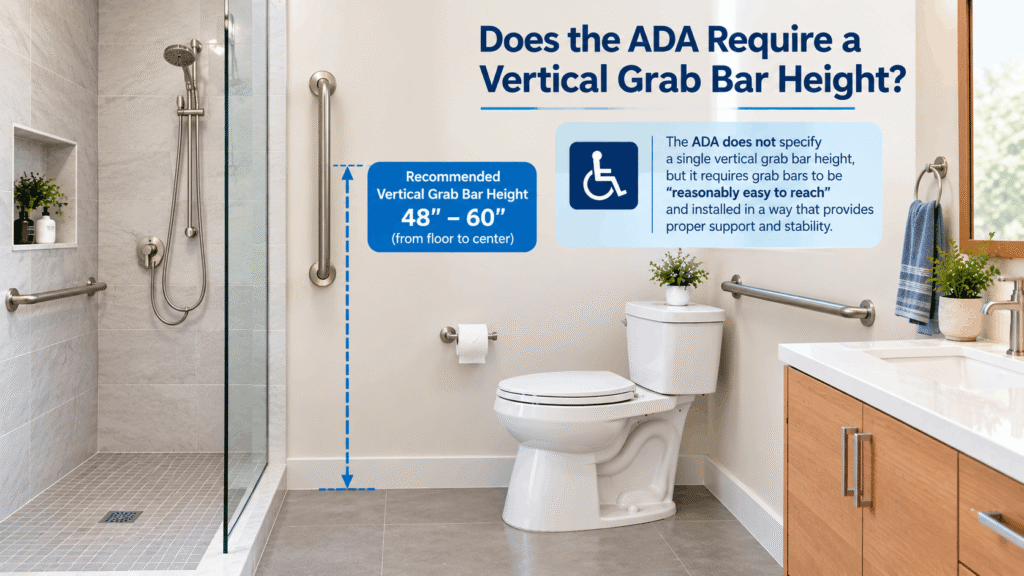
No. The ADA’s 2010 Standards for Accessible Design specify horizontal grab bar height (33″–36″ above the floor) but say nothing about vertical bars.
Vertical grab bars are a separate requirement that comes from a different rulebook: ICC/ANSI A117.1, the accessibility standard most state and local building codes actually incorporate. Where a project is required to meet both the ADA and the local building code, the more stringent of the two typically governs—which in practice usually means the ICC/ANSI A117. 1 vertical bar shows up anyway, even though the ADA itself never asked for it.
This is why two “official-sounding” sources can give you two different answers for the same bathroom: one is quoting the ADA, and one is quoting the building code.
Vertical Grab Bar Height at a Toilet
A toilet-side vertical grab bar’s bottom edge sits 39″–41″ above the finished floor, per ICC/ANSI A117.1 §604.5.1.
That same section sets two more numbers you’ll need at the same time:
- The bar must be at least 18 inches long.
- Its centerline must fall 39″–41″ from the rear wall, mounted along the side wall.
This bar is typically installed in addition to the standard horizontal side-wall bar near a toilet, not instead of it—the vertical bar gives extra support during the sit-to-stand transition, which is the moment most toilet-area falls happen.
Vertical Grab Bar Height in a Shower or Tub
In a shower or tub, the bottom of a vertical grab bar is typically mounted 36″–41″ above the floor, with the bar extending upward from there to give a full-height handhold during entry and exit.
The exact number shifts depending on which code edition your jurisdiction has adopted and, in a shower stall, whether it’s a transfer-type shower (no built-in seat, smaller footprint) or a roll-in shower. A transfer shower specifically requires a vertical bar on the control wall, positioned a few inches above the horizontal bar on that same wall.
For a full breakdown of where every bar goes inside a walk-in shower—not just the vertical one—see Where to Place Grab Bars in a Walk-In Shower (Zone-by-Zone).
How High Should a Vertical Grab Bar Be for Home (Non-Commercial) Installs?
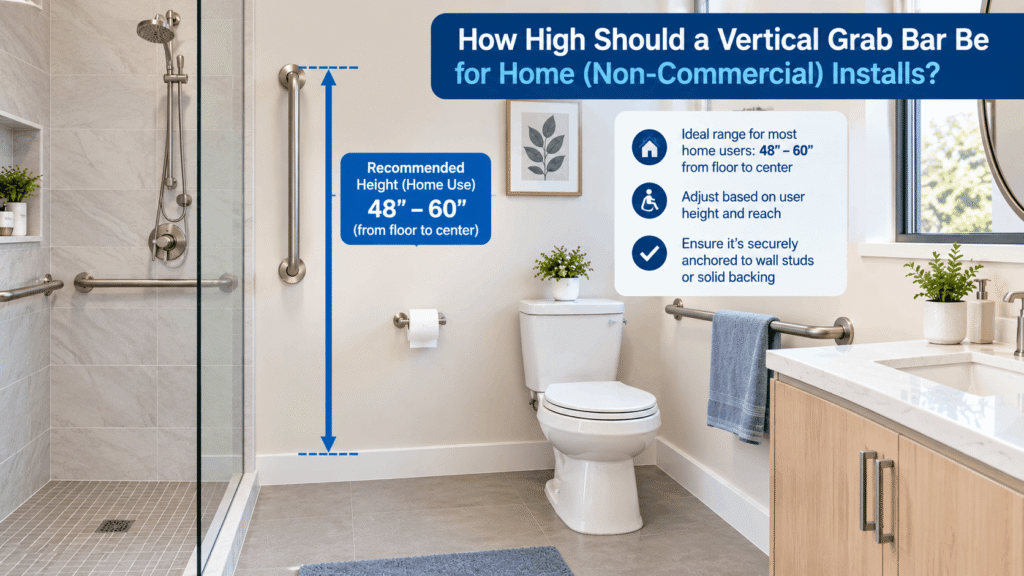
If you’re retrofitting a private home rather than a public or commercial restroom, you’re not automatically bound by ADA or even ICC/ANSI A117.1 numbers—those apply where a building is legally required to be accessible. Many states’ residential codes instead set a bottom-of-bar range of 36″–42″ for bathtub and shower vertical bars.
That said, following the accessibility-code range even in a home install isn’t a bad idea—it’s simply a tighter, more tested window than the wider residential range. The number that actually matters most for a home install is the user’s own height and reach, not the code minimum. A 5’2″ user and a 6’2″ user shouldn’t use the identical mounting height even though both fall “within code.”
Vertical Grab Bar Length Requirements
Every vertical grab bar covered above has a companion length requirement—18 inches minimum at a toilet under ICC/ANSI A117.1, with shower/tub minimums varying by code edition.
Height and length get measured and installed together, so getting the height right and the length wrong still fails inspection. For the exact placement of both dimensions relative to walls, thresholds, and fixtures, see Where Does a Vertical Grab Bar Go in a Bathroom?
Common Mistakes
Installers most often get vertical grab bar height wrong in one of these three ways:
- Mounting to the middle of the code range instead of checking the local inspector’s preference. A range like 39″–41″ gives two inches of legal room, but some inspectors want the number closer to one edge—ask before you drill.
- Using ADA horizontal-bar height (33″–36″) for a vertical bar. These are two different bars with two different rules; the horizontal number doesn’t transfer.
- Skipping the stud check. Height means nothing if the anchor point can’t hold roughly 250 pounds of force, the load rating most codes reference for grab bar mounting hardware.
When to Call a Professional Installer
Mounting height is only useful once it’s paired with correct wall-anchor placement, and that’s where a licensed contractor earns their fee. If you’re not confident locating studs behind tile or drywall, or your bathroom needs to pass a formal inspection, bring in a licensed installer or contractor rather than relying on toggle anchors alone—a grab bar that pulls loose under load defeats the entire purpose of installing one.
FAQ
What is the vertical grab bar height in inches?
It depends on location. At a toilet, ICC/ANSI A117.1 sets the bottom of the bar at 39–41 inches. In a shower or tub, the typical range is 36–41 inches to the bottom of the bar, and residential codes sometimes allow up to 42 inches.
What is the vertical grab bar height in a shower?
Shower vertical bars are generally mounted with the bottom edge 36 to 41 inches above the shower floor. The precise figure depends on whether the code edition your area follows treats it as a transfer-shower control-wall bar or a general shower bar.
Does ADA specify vertical grab bar height in a shower?
No. The ADA’s 2010 Standards address horizontal grab bar height (33–36 inches) but do not set a vertical grab bar height requirement for showers. That number comes from ICC/ANSI A117.1 instead.
What is the vertical grab bar height in a tub?
For bathtubs, vertical grab bars are typically installed with the bottom of the bar 36 to 41 inches above the floor, mounted on the control-end wall so a user can hold it while stepping over the tub wall.
Is a vertical grab bar required by law?
The ADA doesn’t require one. ICC/ANSI A117.1, which many state and local building codes have adopted, does require it in specific locations like toilet compartments and transfer showers. Check your local building code to confirm which standard applies to your project.
Can I install a vertical grab bar at a different height than code specifies?
In a private home with no accessibility requirement triggering ADA or ICC/ANSI A117.1 compliance, you can adjust height to fit the user. In any project legally required to meet those codes, the specified range must be followed for the installation to pass inspection.
What to Do Next
- See every grab bar height in one place, not just the vertical one, in What Height Should Grab Bars Be? A Chart for Every Bathroom Spot
- Confirm exact placement zones in Where to Place Grab Bars in a Walk-In Shower (Zone-by-Zone)
- Double-check the length and rear-wall distance in Where Does a Vertical Grab Bar Go in a Bathroom?