
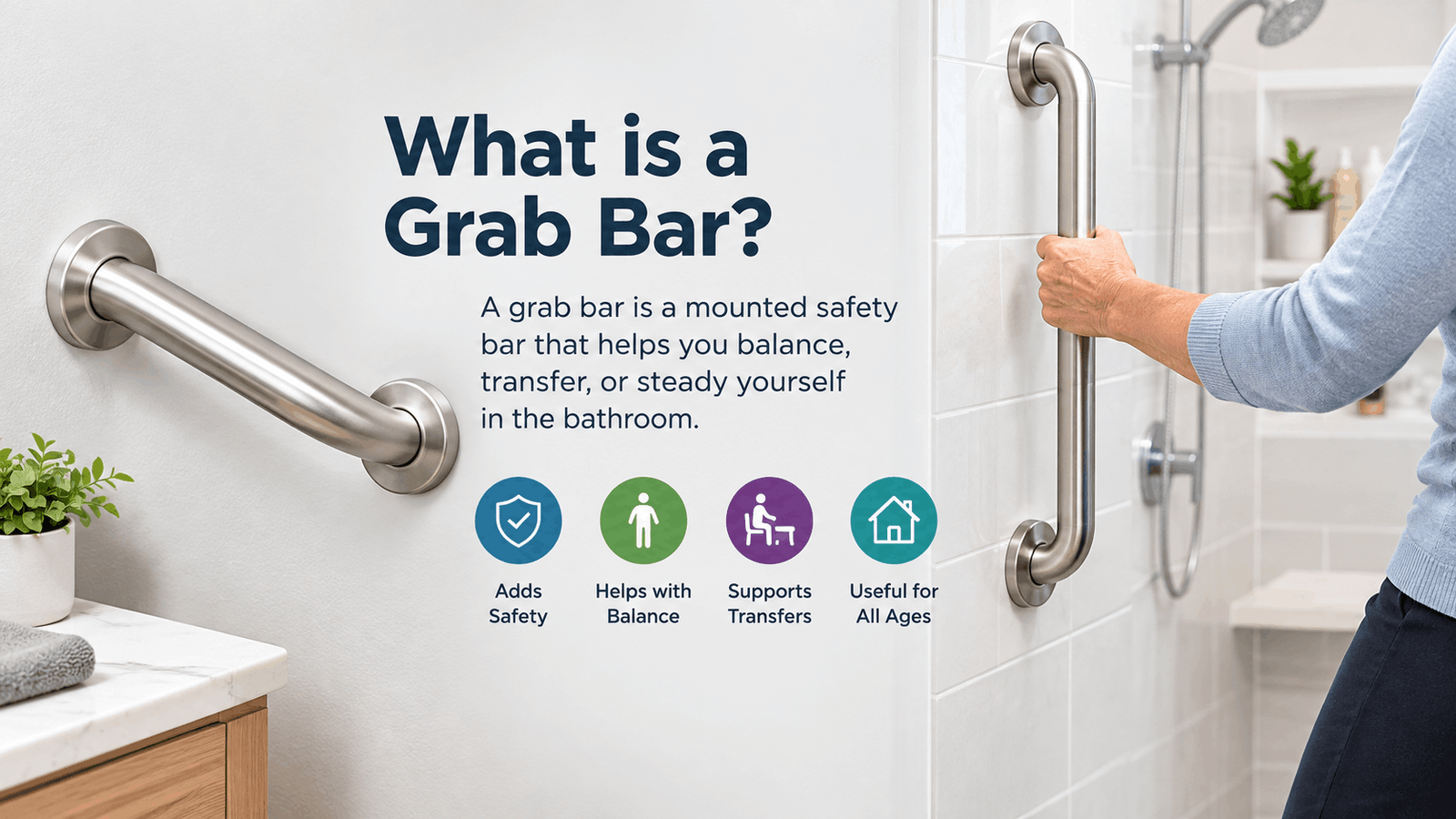
You saw the term “grab bar” on a contractor’s estimate, a rental listing, or a hospital discharge sheet, and now you need the plain-English version before you agree to anything. A grab bar is simpler than the name makes it sound, and by the end of this page you’ll know exactly what one is, what it does, and whether you actually need one in your bathroom.
Quick Answer: A grab bar is a permanently anchored safety bar, usually 12 to 42 inches long, mounted near a toilet, shower, or tub to give you a secure handhold for balance and support. Properly anchored into wall studs, a grab bar can hold over 250 pounds—well beyond what a towel bar is built for.
Table of Contents
What You Need to Know:
- A grab bar is a wall-anchored safety bar for balance and support—not a towel bar, which isn’t rated for body weight.
- Grab bars go far beyond elderly care: surgery recovery, pregnancy, temporary injuries, and general household safety all count.
- The accessibility reference height is 33 to 36 inches off the floor—a public-building standard, not a home requirement.
- A properly anchored grab bar should hold 250+ pounds; one mounted only into drywall won’t.
- Suction-cup bars are fine for light travel use, but they aren’t a substitute for a wall-anchored bar.
What Is a Grab Bar, Exactly?
A grab bar is a fixed safety bar, mounted directly into wall studs or blocking, designed to bear body weight while someone balances, steadies themselves, or transfers in or out of a fixture. The defining feature isn’t the shape or the material—it’s the anchoring: a grab bar has to be secured into structural framing, not just drywall, or it won’t hold real weight in a fall.
Grab bars come in straight, angled, and L-shaped configurations, generally 12 to 42 inches long. These dimensions and the 33-to-36-inch mounting range come from ADA.gov‘s 2010 Standards for Accessible Design—a public-accessibility code, not a legal requirement for private homes, though following it is still good practice.
What Are Grab Bars Used For?
A grab bar is used to prevent falls, support a sit-to-stand transfer, and give you something stable to hold during everyday moves like stepping over a tub wall. A grab bar’s real job during a slip isn’t to stop a fall already in progress—it’s to give the body something to catch onto before momentum builds, which is why placement matters as much as the bar itself.
That covers the four main use cases: fall prevention, transferring in and out of a tub or shower, sitting down or standing up from a toilet, and general balance while the floor is wet.
Where Are Grab Bars Installed?
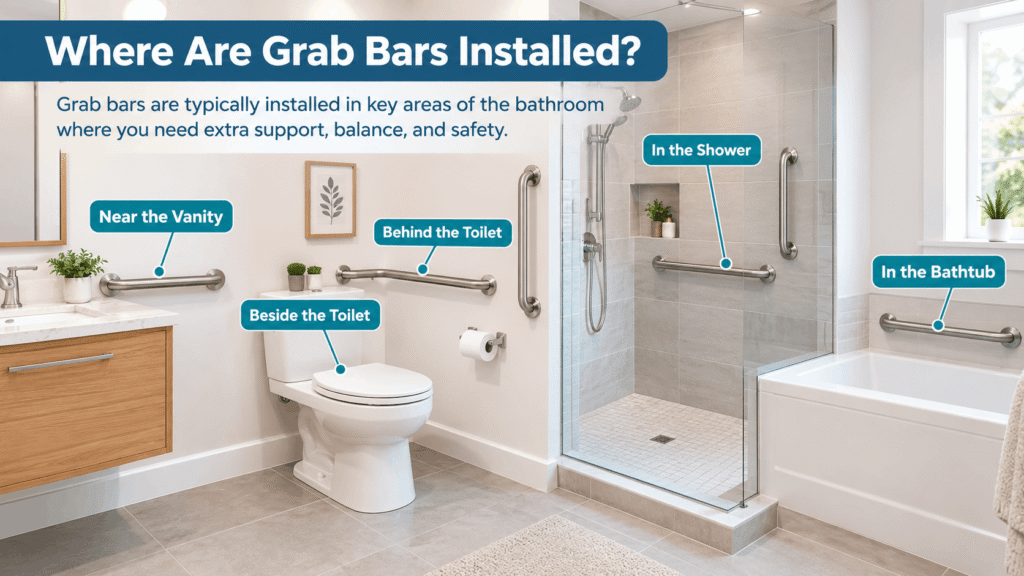
Grab bars go in bathrooms most often—beside the toilet, inside the shower, and along the tub wall—though bedrooms and hallways sometimes get one for general mobility support. A 2009 study published in the journal Human Factors found that horizontal bars give a stronger, more reliable grip during an actual fall than vertical ones, which is why most bathroom installs default to horizontal even when a vertical bar is added alongside it.
The exact placement inside each zone is its own topic. For the full zone-by-zone breakdown, see Grab Bar Placement for Bathroom: Shower, Tub & Toilet Zones, or Where to Place Grab Bars in a Walk-In Shower if that’s your specific setup.
Who Actually Needs a Grab Bar? (Not Just Seniors)
Grab bars are strongly associated with elderly users, and for good reason—according to the CDC, more than one in four adults age 65 and older falls each year. But the hardware itself doesn’t care who’s using it.
A grab bar installed for general household safety works exactly the same as one installed for an 80-year-old—the hardware doesn’t check ID; it just needs to hold the weight put on it. People recovering from surgery, managing a broken ankle or sprained wrist, pregnant and dealing with shifting balance, or simply wanting a safer bathroom all benefit from the same bar.
Grab Bar vs. Towel Bar vs. Handrail: What’s the Difference?
A grab bar is built and anchored to bear body weight; a towel bar is not, and a wall-mounted handrail serves a similar structural purpose but runs along a walking path instead of at a single fixture. The single most common bathroom safety mistake is grabbing a towel bar during a slip and expecting grab-bar strength it was never built to provide.
Feature Grab Bar Towel Bar Wall-Mounted Handrail Purpose Weight-bearing support and balance Hanging and drying towels Directional support along a path Typical weight rating of 250+ lbs when anchored into studs A few pounds—not rated for body weight Similar to a grab bar, longer format Mounting requirement: Anchored into studs or blocking Often just drywall anchors Anchored into studs or blocking Typical location: beside a toilet, inside a shower or tub Near a sink or open bathroom wall Hallways, stairs, long bathroom walls ADA relevance covered under Section 609 Not covered by ADA; covered under a separate section
Save or screenshot this comparison table—it covers the exact difference between a grab bar, a towel bar, and a handrail so you don’t buy the wrong one for the job.
What Are Grab Bars Made Of?
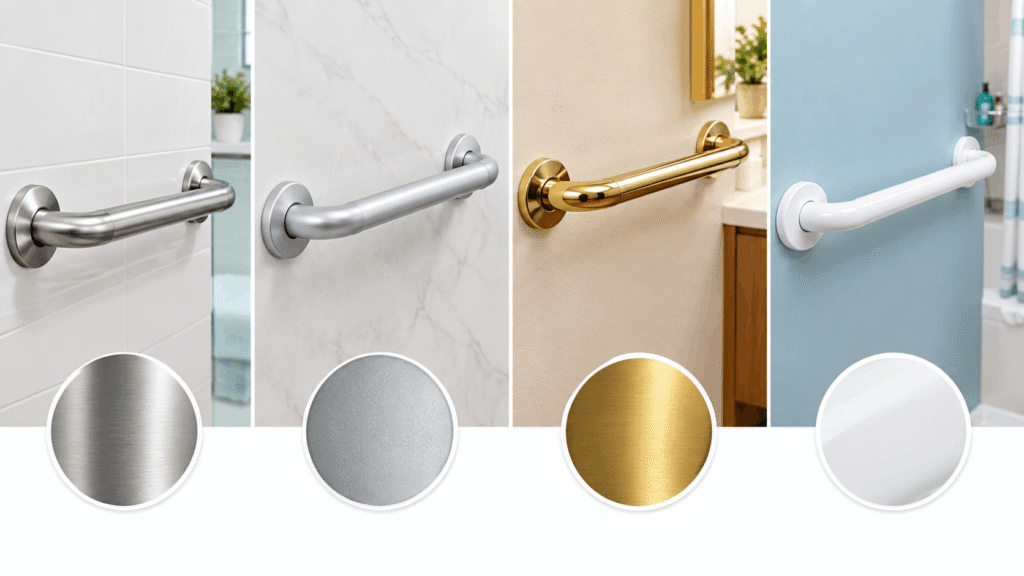
Grab bars are typically made from stainless steel, powder- or epoxy-coated steel, nylon-coated metal, or ABS plastic—materials chosen specifically because they hold up to constant moisture. Stainless steel remains the standard choice for wet areas because it resists corrosion without a protective coating that can eventually chip or peel.
How High Should a Grab Bar Be Mounted? (Short Answer)
The standard reference height is 33 to 36 inches from the floor to the top of the bar, per ADA.gov‘s 2010 Standards. That 33-to-36-inch range assumes a fixed, standardized reach—it’s a starting point, not a rule that overrides what actually works for the person using it.
For the full breakdown by fixture, since a toilet, shower, and tub each have slightly different placement logic, see How High Should Grab Bars Be? Heights for Every Fixture.
Are Suction Grab Bars Actually Safe?
Suction-cup grab bars work fine for light steadying or travel use, but they aren’t a substitute for a wall-anchored bar. A suction-cup bar can release without warning as its seal wears or the surface gets soapy, which is exactly the moment you’d be relying on it hardest.
Common Mistakes People Make With Grab Bars
The same few mistakes show up again and again, and most of them come down to skipping the anchoring step. Mounting into drywall alone is the single most common installation mistake, and it’s invisible until the exact moment someone puts their full weight on the bar.
- Mounting into drywall only, instead of a stud or a load-rated anchor (molly) built for structural weight.
- Assuming a towel bar or soap-dish edge will hold weight during a slip.
- Treating a suction-cup bar as permanent, wall-anchored support.
- Skipping a grab bar because it seems like “an elderly thing,” even when a household member has a temporary or less obvious mobility need.
- Copying someone else’s mounting height instead of measuring for the actual person using it.
FAQ
What is a grab bar used for?
A grab bar is used to give you a stable, weight-bearing handhold near a toilet, shower, or bathtub so you can catch your balance, steady yourself while standing or sitting, or support your weight during a transfer in or out of a fixture. Unlike a towel bar, a grab bar is anchored into wall studs specifically so it can bear real body weight in a fall, not just hold a towel.
What is a grab bar for a bathroom?
In a bathroom specifically, a grab bar is installed beside the toilet, inside the shower, or along the tub wall to reduce the risk of slipping on wet, hard surfaces and to help with sitting, standing, and stepping over a tub edge. Bathrooms combine water, tile, and tight turning space, which is exactly why grab bars are concentrated there rather than spread evenly through a house.
Are bathroom grab bars just for elderly people?
No—grab bars are strongly associated with elderly users because older adults have a higher fall risk, but the hardware itself works the same for anyone. People recovering from surgery, managing a temporary injury, pregnant, or simply wanting a safer bathroom all benefit from the exact same bar, mounted at a height that fits their own body rather than a generic standard.
What’s the best bathroom grab bar for an elderly user?
The “best” grab bar for an elderly user isn’t a specific model—it’s one anchored into a wall stud or blocking (not drywall alone), rated to hold at least 250 pounds, and mounted at a height that matches that person’s actual reach and mobility rather than a generic standard. Stainless steel and powder-coated steel are the most common durable, moisture-resistant materials.
What’s the difference between a grab bar and a towel bar?
A grab bar is anchored into a wall stud or blocking and built to bear real body weight — often 250 pounds or more — while a towel bar is typically mounted with light drywall anchors and rated only to hold a towel. Leaning on a towel bar during a slip is a common and preventable mistake, since it looks similar to a grab bar but isn’t built the same way.
How much weight can a grab bar hold?
A grab bar that’s properly anchored into a wall stud or blocking should meet or exceed 250 pounds of load-bearing capacity, the benchmark referenced in ADA grab bar testing standards. A grab bar mounted only into drywall, without hitting solid framing, will not reliably hold that weight regardless of what the packaging claims—the anchoring matters more than the bar itself.
What to Do Next
If you’re ready to move from “what is it” to “where does it go,” the next steps are: Grab Bar Placement for Bathroom: Shower, Tub & Toilet Zones for a zone-by-zone breakdown, Where to Place Grab Bars in a Walk-In Shower if that’s your setup, and How High Should Grab Bars Be? Heights for Every Fixture for exact mounting heights.