
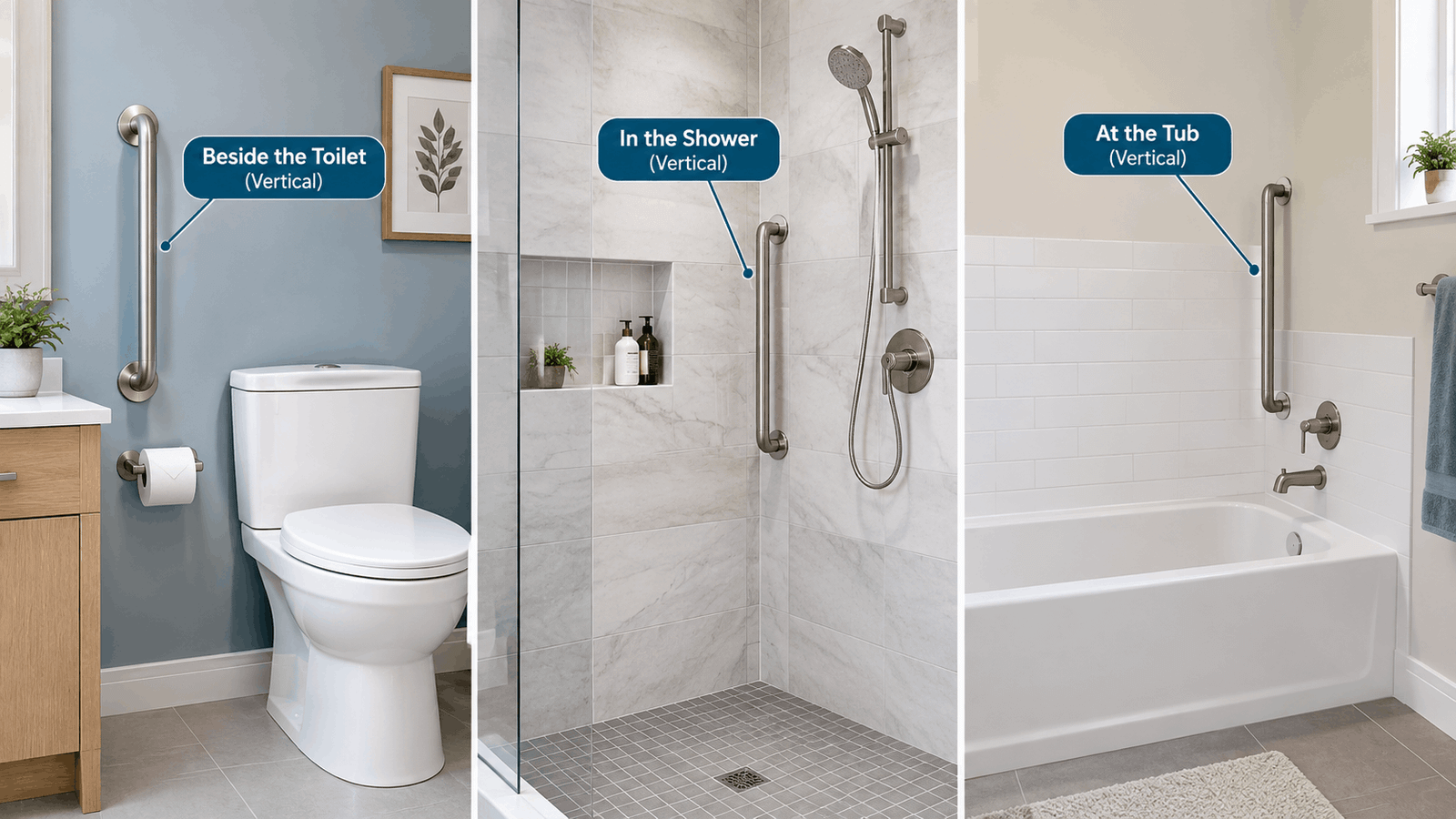
Your contractor just flagged a vertical grab bar, or your permit reviewer sent back a comment about one—and now you need to know exactly where it goes before the next inspection. The location isn’t guesswork: one code body skips it entirely, another one spells it out to the inch.
Quick Answer: A vertical grab bar isn’t required by the ADA, but it is required by the ICC/ANSI A117.1 building code, mounted on the toilet’s side wall—18 inches long minimum, with the bottom 39–41 inches above the floor and its centerline 39–41 inches from the rear wall. Many installers also add one at the shower or tub entry for extra stability.
Table of Contents
What You Need to Know:
- The ADA doesn’t require a vertical grab bar. The ICC/ANSI A117.1 code does, and most states enforce it through their building code.
- At the toilet, it mounts on the side wall: 18″ minimum length, bottom 39–41″ high, centerline 39–41″ from the rear wall.
- California’s building code doesn’t carry that same 18″ vertical-bar provision—confirm with your local building department before you drill.
- Showers and tubs have no universal vertical-bar mandate, but one at the entry wall meaningfully cuts fall risk during entry and exit.
- Mixing up the two 39–41″ measurements—height off the floor versus distance from the rear wall—is one of the most common reasons these bars fail inspection.
Is a Vertical Grab Bar Actually Required?
No, not under federal law. The U.S. Access Board’s 2010 ADA Standards only call for horizontal grab bars near the toilet and in the shower or tub—Chapter 6 never mentions a vertical bar. You can confirm this directly on the Access Board’s ADA Chapter 6 page.
The vertical bar comes from a different source: the ICC/ANSI A117.1 standard, maintained by the International Code Council. Most states adopt ICC/ANSI A117.1 into their building codes, which is why a vertical bar shows up on inspection checklists even though the ADA itself never asked for one.
A vertical grab bar is a support bar mounted straight up and down on a wall, used to steady a person while they stand up, sit down, or step over a tub wall. A horizontal bar does a different job—it supports someone who’s already upright and needs to hold steady.
Vertical Grab Bar Location & Spec Reference
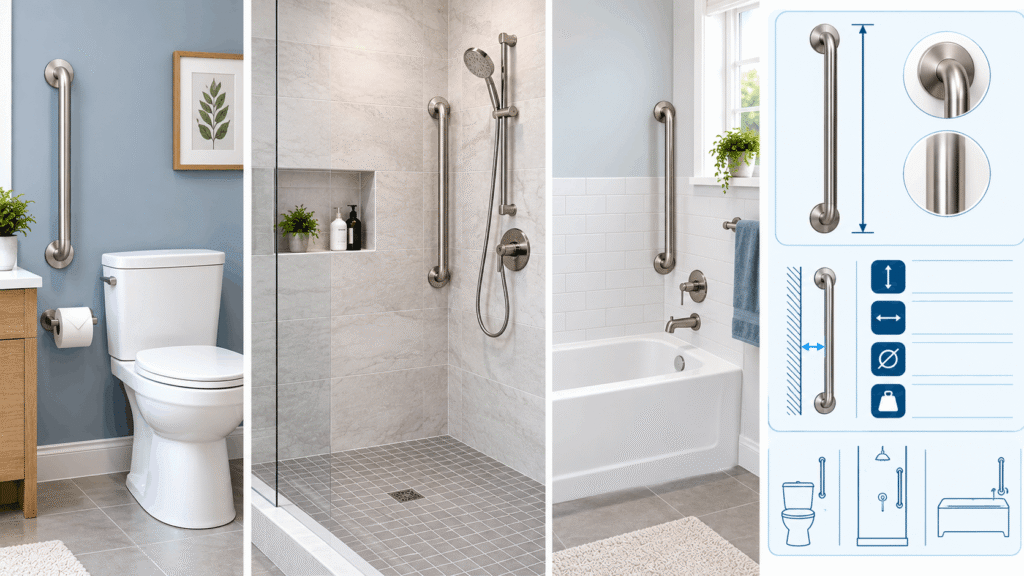
Here’s every location a vertical grab bar shows up in a residential bathroom, with the code that governs each one.
Location Governing Code Required? Height (bottom of bar) Length of Distance From Wall to Toilet Side Wall ICC/ANSI A117.1 Yes, in states that adopt ICC/ANSI 39″–41″ 18″ minimum Centerline 39″–41″ from rear wall Shower entry/control wall industry practice Recommended, not mandated, 3″–6″ above the adjacent horizontal bar Manufacturer length: At the entry, the control-side wall Tub entry wall Industry practice recommended, not mandated Varies by fixture Manufacturer length at the point of entry California bathrooms CBC 11B (state amendment) Doesn’t carry the 18″ ICC/ANSI provision—confirm with the local building department.
Save or screenshot this reference table—it covers every vertical grab bar location in a typical bathroom, with the exact code driving each one.
Vertical Grab Bar Location by Fixture
The toilet is where the code gets specific. Showers and tubs are where judgment and manufacturer guidance take over.
Next to the Toilet
This is the one location, ICC/ANSI A117.1, with actual dimensions. The bar goes on the side wall, 18 inches minimum in length, with the bottom edge 39–41 inches above the floor and the centerline 39–41 inches from the rear wall. Those two 39–41″ figures measure different things—mixing them up is a common inspection-fail cause, covered below.
At the Shower Entry
No model code mandates a vertical bar here, but most installers add one anyway. It typically sits 3–6 inches above the adjacent horizontal bar, on the wall nearest the entry or the shower controls, so a hand can grip it the moment a foot crosses the threshold.
At the Tub Entry
Same logic as the shower: not required, widely recommended. The bar mounts on the wall you’d naturally reach for while stepping over the tub wall, positioned by fixture height rather than a fixed code number.
Does California Require a Vertical Grab Bar?
Not the same way most states do. California enforces its own building code, CBC 11B, and the accessibility provisions there don’t carry the 18-inch vertical grab bar requirement the way ICC/ANSI A117.1 does elsewhere.
California’s Division of the State Architect documents these code differences directly—you can review their access code change summary for the specifics. If you’re building or remodeling in California, don’t assume the generic ICC/ANSI vertical-bar spec applies—confirm the current CBC 11B language with your local building department before installation.
Vertical vs. Diagonal vs. Horizontal: Which Do You Actually Need?
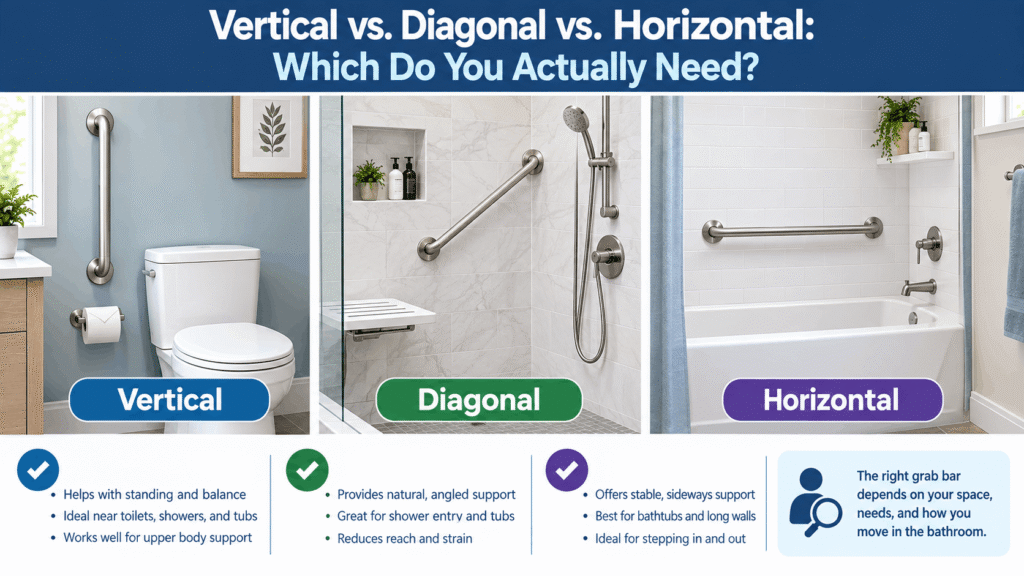
Bar Type: Best For Trade-off Vertical standing up, sitting down, stepping over a tub wall Doesn’t help much during extended standing Horizontal balance while standing or showering Fixed height only works for one grip position: diagonal (angled). A single bar that supports both sitting-to-standing and standing balance Costs more; not addressed by ICC/ANSI’s vertical-bar spec
A diagonal bar is a legitimate substitute for a vertical one in many layouts, since the hand position changes along its length instead of locking to one height. It’s not a code requirement anywhere in this article’s scope—it’s a design choice worth discussing with whoever installs your bars.
Common Mistakes That Fail Inspection
The single most common error is confusing the two 39–41″ measurements—the height off the floor and the distance from the rear wall are both 39–41 inches under ICC/ANSI A117.1, and installers who dimension only one of them often get flagged.
Other frequent mistakes:
- Mounting into drywall alone, with no stud or blocking behind the bar
- Assuming the ADA requires a vertical bar, then being surprised when a state inspector cites a different code
- Applying the generic ICC/ANSI spec in California without checking CBC 11B first
- Placing the toilet-side bar’s length under the 18″ minimum to avoid hitting a fixture or door swing
FAQ
What are the exact dimensions for a vertical grab bar’s location?
Next to a toilet under ICC/ANSI A117.1, the bar is 18 inches minimum in length, with the bottom edge 39–41 inches above the floor and its centerline 39–41 inches from the rear wall. Shower and tub entry placements aren’t dimensioned the same way — those follow manufacturer guidance and fixture layout rather than a fixed code number.
What are the vertical grab bar requirements?
The requirement comes from ICC/ANSI A117.1, not the ADA. Where a state adopts that standard into its building code, a vertical bar is required at the toilet side wall with specific length and mounting dimensions. Showers and tubs don’t carry the same mandate—a vertical bar there is common practice, not a universal code requirement.
Where does a vertical grab bar go in a California bathroom?
California enforces CBC 11B, which doesn’t carry the 18-inch ICC/ANSI vertical bar provision the same way most other states do. If you’re working in California, don’t assume the generic ICC/ANSI spec applies — check current CBC 11B language with your local building department before finalizing placement.
Does the ADA require a vertical grab bar location in a bathroom?
No. The U.S. Access Board’s 2010 ADA Standards specify horizontal grab bars near the toilet and in the shower or tub, but Chapter 6 never mentions a vertical bar. Any vertical-bar requirement you run into comes from a different code—usually ICC/ANSI A117.1 as adopted by your state.
Does a shower need a vertical grab bar?
Not under a universal code mandate. Most bathroom designers add one anyway, mounted near the shower entry or control wall, because it gives a hand something to grip at the exact moment someone steps in or out—statistically the highest-risk moment for a bathroom fall.
What’s the difference between a vertical and a diagonal grab bar?
A vertical bar supports one motion well—standing up, sitting down, or stepping over a tub wall. A diagonal bar changes hand position along its length, so it supports both that motion and general standing balance, though it isn’t addressed by the ICC/ANSI vertical-bar specification.
What to Do Next
Once you know where the vertical bar goes, the next question is usually how high every other bar in the bathroom should sit—covered in our guide to standard grab bar height. If you’re planning the full layout rather than just this one bar, our zone-by-zone placement guide walks through every wall in the room. And for the complete ADA compliance picture beyond just grab bars, see our ADA bathroom overview.