
Shower grab bar placement is probably the last thing on your mind until a parent almost goes down in the shower, or you’re the one who slips and grabs a towel bar that had no business holding your weight. Either way, you need to know exactly where a grab bar goes and how high—not a lecture on why falls are dangerous. Here’s the placement, in real numbers, for every shower type.
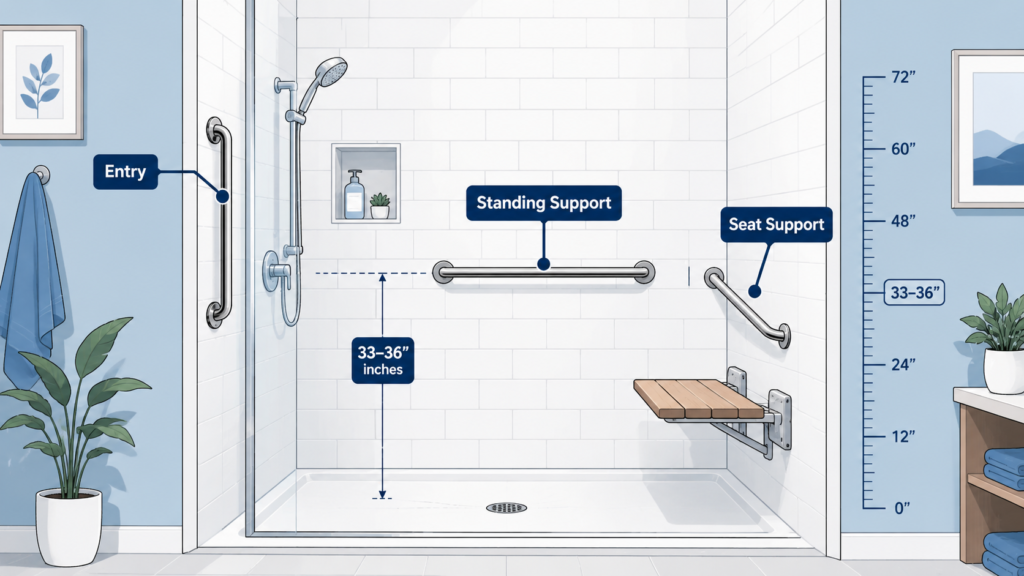
Quick Answer: Install a vertical grab bar at the shower entrance for stepping in and out, a horizontal grab bar along the wall you face while standing or washing, and an angled bar near any seat or back wall. Mount the top of horizontal bars 33 to 36 inches from the floor, anchored into wall studs or rated anchors—never into tile alone.
Table of Contents
According to the CDC, over 14 million older adults report falling every year, and home safety modifications like grab bars are one of the few interventions shown to reduce that risk—which is exactly why getting the placement right matters more than picking an expensive bar.
What You Need to Know
- Three zones matter: entry, standing wall, and seat/back wall—not one bar randomly placed.
- Height range: 33–36 inches from floor to the top of a horizontal bar is the standard most codes and manufacturers reference.
- Bar type follows the movement: vertical bars for stepping through, horizontal for standing support, and angled for sitting-to-standing transitions.
- Shower type changes the plan: a tub/shower combo, a curbless walk-in, and a corner shower each need different bar positions.
- Anchoring matters more than placement: a perfectly placed bar with no stud behind it can pull out of the wall under real weight.
Where Should Shower Grab Bars Be Installed?
A shower needs support at the three moments a body is most likely to lose balance: entering or exiting, standing in one spot, and sitting down or standing back up. Each moment calls for a different bar orientation, not one all-purpose bar stuck wherever the wall looks convenient.
Entry/Threshold Zone (Vertical Bar)
Most falls happen crossing the threshold, especially over a tub wall or shower curb. A vertical grab bar mounted just inside the entrance gives you a handhold at multiple heights during that single step, which is exactly the moment your grip position is hardest to predict.
Mount it so the bottom sits roughly at hip height and the bar runs upward 18 to 24 inches—tall enough to grab whether you’re stepping in or standing fully upright or bracing while lowering yourself over a tub wall.
Control/Standing Wall (Horizontal Bar)
This is the wall you face while washing, adjusting the water, or just standing under the spray. A horizontal bar here needs to run the length of your reach, not just a short stub by the faucet.
Standard placement: top of the bar 33 to 36 inches off the floor, running at least 24 inches, ideally 36 inches, along the wall you spend the most time facing.
Back Wall or Seat Zone (Angled Bar)
If there’s a bench, a fold-down seat, or you plan to add one, this is where an angled bar earns its keep. The diagonal orientation lets you pull yourself up from a seated position and lower yourself down with one continuous grip, instead of switching hand positions mid-motion.
Mount the low end near seat height and let the bar rise toward the standing-wall bar’s height, so the same hand path works for someone sitting or standing.
Shower Grab Bar Placement by Shower Type
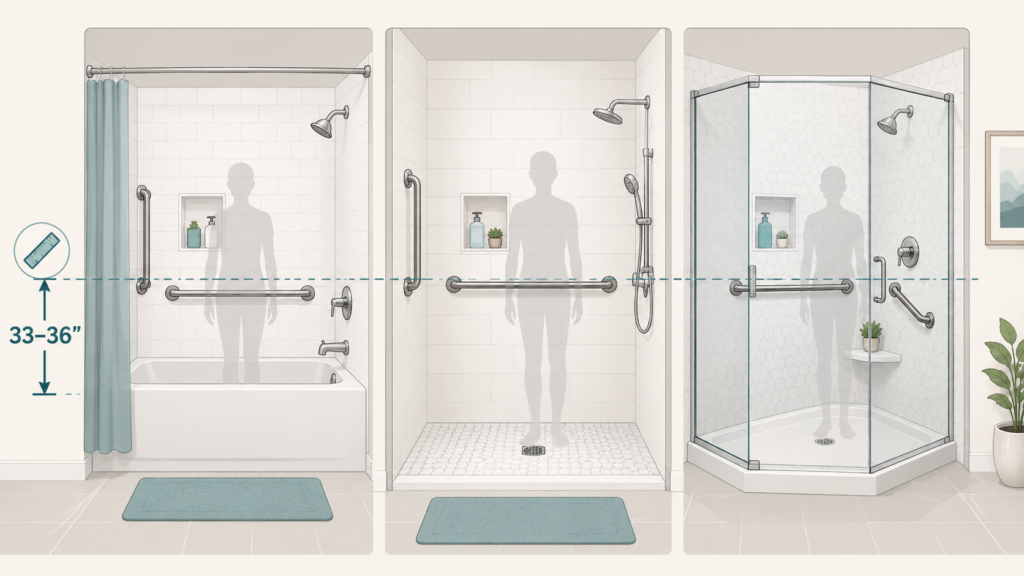
Generic advice treats every shower like the same rectangle. It isn’t. Here’s how the three zones map onto the shower types you’re actually working with.
| Shower Type | Entry Bar | Wall Bar | Seat Bar | Recommended Height |
|---|---|---|---|---|
| Tub/shower combo | Vertical, at the tub-wall edge nearest the faucet | Horizontal, along the long wall opposite the faucet | Angled, back wall if a bath seat is used | 33–36″ (adjust down for shorter tub-wall clearance) |
| Walk-in / curbless shower | Vertical, just inside the entry opening | Horizontal, on the control wall and often a second run on the opposite wall for larger stalls | Angled, adjacent to any built-in bench | 33–36″, consistent across all bars for one predictable reach pattern |
| Corner / neo-angle shower | Vertical, on the wall nearest the door swing | Horizontal, on whichever angled wall gets the most standing time | Angled, tucked into the corner nearest a fold-down seat if present | 33–36″, shortened bar lengths (18–24″) to fit the tighter wall segments |
Save or screenshot this shower-type placement table—it covers the three most common shower layouts in one reference, so you don’t have to guess which zone rules apply to your specific stall.
How High Should a Shower Grab Bar Be?
The standard height for a horizontal shower grab bar is 33 to 36 inches from the floor to the top of the bar, a range referenced by the 2010 ADA Standards for Accessible Design and the closely related ICC/ANSI A117.1 accessibility standard most bar manufacturers build to. According to the ANSI/ICC A117.1 standard, a transfer shower’s vertical bar must have its bottom edge positioned 3 to 6 inches above the horizontal bar on that same wall—a detail most placement guides skip entirely.
That range isn’t one-size-fits-all. A wheelchair user or someone who showers seated often does better with the bar closer to 33 inches. A tall adult who showers standing may prefer 36 inches or slightly above. Bars for children should sit lower — often 24 to 28 inches — and get swapped out as they grow, which is why many caregivers install two shorter bars instead of one long one.
If you’re installing for a specific person rather than general resale value, have them stand or sit in the shower and mark where their hand naturally lands. That mark beats any published number.
Vertical, Horizontal, or Angled—Which Do You Need?
Most showers need at least one of each, not a choice between them. Vertical bars serve the moment you’re stepping through a threshold; horizontal bars serve the moment you’re standing still; angled bars serve the transition between sitting and standing.
A single horizontal bar with no vertical support at the entry leaves the highest-risk moment—the step in or out—completely unaddressed. If budget or wall space forces a choice, prioritize the entry vertical bar first, since threshold crossing is where most documented bathroom falls occur.
Common Grab Bar Placement Mistakes
The single most common mistake is mounting a bar into drywall or tile with no stud or blocking behind it. A grab bar has to hold full body weight during a fall, not just light pressure, and standard drywall anchors aren’t rated for that kind of sudden load.
Other placement mistakes worth flagging:
- Splitting the difference on height. Installers who aim for “somewhere around 33 to 36 inches” often land a half-inch outside the range in either direction. Aim for the middle of the range—about 34.5 inches—so small measurement errors don’t push you out of spec.
- One bar covering two jobs. A single horizontal bar placed to catch both entry and standing support usually does neither well. Separate zones need separate bars.
- Ignoring obstructions. A bar mounted directly behind a shower caddy, soap dish, or where a shower door swings open becomes unreachable exactly when it’s needed.
- Ignoring the wall material. Fiberglass and acrylic shower surrounds flex differently than tile, and mounting hardware that works on tile can strip out of a fiberglass panel over time.
Installing Into Studs vs. Using Anchors
Wall studs are typically spaced 16 inches apart, which rarely lines up perfectly with where a grab bar needs to go. Two real options exist when a stud isn’t where you need it: add blocking behind the wall before the shower is finished, or use load-rated anchors engineered specifically for grab bars, which distribute weight across the wall panel instead of relying on a single stud.
Never substitute standard drywall or plastic anchors for grab-bar-rated hardware. Rated anchors are tested to hold several hundred pounds of sudden, off-angle force—the kind a body applies mid-fall, not the steady pull of hanging a towel.
If the shower is already tiled and finished, a licensed installer can locate blocking with a stud finder and, if none exists at the needed point, use anchors rated for the wall material. Guessing at this step is where DIY installations most often fail inspection or fail structurally.
Grab Bars on Fiberglass, Tile, or Acrylic Showers
Fiberglass and acrylic shower surrounds need extra care because the surface flexes slightly under pressure, unlike rigid tile backed by cement board. For a full breakdown of anchor types and mounting techniques specific to fiberglass stalls, see our guide on installing a grab bar for a fiberglass shower.
Tile generally offers the most reliable mounting surface when backed by proper blocking, since the rigid backer board holds anchors more predictably than a flexible fiberglass panel.
Get the Placement Checklist
If you’d rather have this mapped out on paper before you start marking the wall, our newsletter includes a free downloadable Grab Bar Placement Checklist that walks through each zone, height, and anchor check in order—sign up below and it lands in your inbox immediately.
FAQ
Which shower grab bar works best: straight or angled?
Both have a place. Straight horizontal bars support standing and washing; straight vertical bars support stepping through the entry; angled bars support the sit-to-stand transition near a seat. Most showers benefit from at least one of each rather than picking a single style for the whole space.
What are the common grab bar installation mistakes?
The biggest is mounting into drywall or tile with no stud or rated anchor behind it, which fails under real body weight. Others include splitting the height range instead of centering on 34.5 inches, using one bar to cover two functions, and mounting bars behind obstructions like soap dishes or door swings.
What height is best for shower grab bars?
The standard range is 33 to 36 inches from the floor to the top of a horizontal bar, per the ANSI/ICC A117.1 standard. Shorter users, seated users, or children often need the bar lower, around 24 to 33 inches, while taller users may prefer the upper end of the range.
What Guidelines Apply to Installing Grab Bars in Showers?
The ANSI/ICC A117.1 standard governs official code requirements, specifying horizontal bar height (33–36 inches) and, in transfer showers, that the vertical bar’s bottom sit 3 to 6 inches above the horizontal bar on the same wall. Home installations aren’t legally bound by this unless required by local code, but it’s the benchmark most manufacturers and installers follow.
How many grab bars does a shower need?
Most showers need a minimum of two: one vertical bar at the entry and one horizontal bar along the standing wall. Showers with a seat or bench often benefit from a third, angled bar near that seat for sit-to-stand support.
Can grab bars be installed on fiberglass or acrylic showers?
Yes, but the mounting approach differs from tile because fiberglass and acrylic panels flex under pressure. Anchors need to be rated for the specific wall material, and blocking behind the panel—added during installation or retrofitted—provides the most reliable long-term hold.
What to Do Next
Now that you know where each bar goes, the next question is usually how high to set it for your specific situation—our guide on shower grab bar height breaks down the exact numbers by user type. If you’re working with a fiberglass or acrylic stall specifically, jump to our fiberglass shower grab bar installation guide for anchor recommendations. And if you’re still deciding on a general bar location within a shower stall, see our best grab bar locations for shower stall breakdown.