
Your mother-in-law grabbed the towel bar to steady herself getting out of the shower last week, and it came half out of the wall. That’s the moment most people start researching grab bars, not before. Here’s what actually holds a person’s weight, how high to mount it, and what it should cost you.
Quick Answer: A grab bar is a permanently mounted safety bar, usually stainless steel or coated metal, installed near a shower, tub, or toilet to support balance and prevent falls. ADA-style bars must be 1¼–1½ inches thick, mounted 33–36 inches high, anchored into wall studs, and rated to hold at least 250 pounds of force.
Table of Contents
What You Need to Know
- Real grab bars mount into wall studs or rated anchors—never drywall alone.
- ADA specs call for a 1¼–1½ inch diameter, 33–36 inch mounting height, and a 250-pound minimum load rating.
- Horizontal bars grip stronger than vertical ones in an actual fall.
- Prices run from about $20 for a temporary suction bar to $100–$280 for a permanent, designer, or pivoting model.
- Homes aren’t legally required to meet ADA specs, but the numbers are still the safest reference point you have.
What Is a Grab Bar?
A grab bar is a fixed, load-rated bar mounted to a wall — typically in a shower, next to a bathtub, or beside a toilet — that gives someone something solid to hold onto while standing, sitting, or moving through a wet or unstable space. Its entire job is to bear real weight in an emergency, not just look reassuring. Unlike a towel bar, which is built to hold a few pounds of wet fabric, a code-compliant grab bar is rated to withstand more than 250 pounds of sudden force — the difference between a bar that saves someone and one that comes out of the wall with them.
Who Actually Needs a Grab Bar?
Grab bars aren’t only for people who use mobility aids full-time. More than one out of four adults age 65 and older falls every year, according to the CDC — and the bathroom, with its wet, hard, tight-quartered layout, is where a disproportionate share of those falls happen.
Three groups benefit most in practice:
- Older adults and caregivers managing balance, joint pain, or reduced strength
- Anyone recovering from surgery, injury, or illness who needs temporary but real support
- Homeowners planning ahead — installing bars before a fall happens, not after
None of these situations require a diagnosis or a permit. A grab bar is one of the cheapest, highest-leverage safety upgrades a bathroom can get.
What Types of Grab Bars Are There?
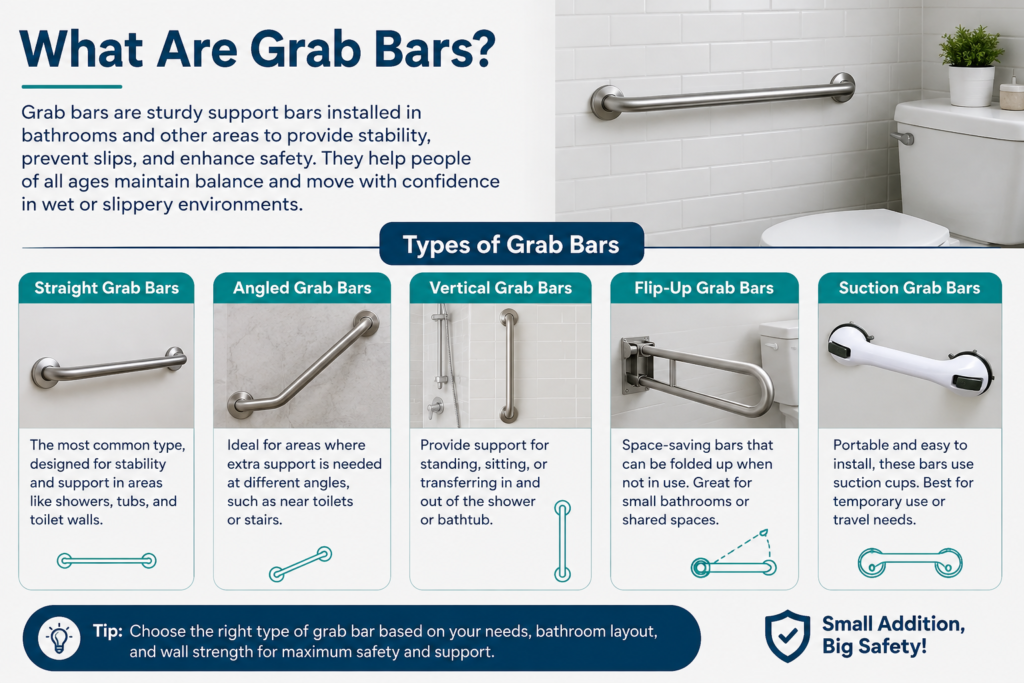
Six designs cover almost every bathroom situation:
- Straight bars — the standard horizontal or vertical bar, most common in showers and next to toilets
- Angled or L-shaped bars—combine a horizontal and vertical grip in one unit, which is useful where someone needs support both standing up and steadying themselves.
- Flip-up or fold-down bars—mount beside a toilet and fold out of the way when not needed
- Floor-to-ceiling security poles — tension-mounted between floor and ceiling, useful where wall studs aren’t accessible
- Corner-mounted bars — built for shower corners where two walls meet
- Suction-cup bars — temporary, no drilling required, and the weakest option on this list
Orientation matters more than most people assume: a study published in the journal Human Factors found that grip strength was significantly greater on a horizontal bar than a vertical one during a simulated fall, which is why horizontal placement is the default recommendation whenever a straight bar is an option.
The suction-cup option deserves an honest caveat: it’s genuinely useful for travel or a short-term rental, but it isn’t built to the same load standard as a mounted bar, and it can fail without warning as suction weakens over time. Treat it as a convenience item, not a safety device, for anyone with real fall risk.
What Are the ADA Height, Diameter & Load Specs for Grab Bars?
Homes don’t have to meet the ADA’s 2010 Standards for Accessible Design, but the ADA numbers are still the best safety benchmark available — they’re based on decades of accessibility research, not marketing copy.
Spec ADA Public Standard Typical Home Recommendation: Why It Matters Mounting height 33″–36″ above floor, top of gripping surface Same range, adjusted to the user’s height Too low or too high, a bar is out of reach exactly when it’s needed. Diameter 1¼”–1½” (circular cross-section) The same thinner bars are harder to grip with wet, weak, or arthritic hands. Wall clearance 1½” minimum, same Too tight pinches knuckles; too loose weakens grip. Load rating: Withstands 250+ lbs of force Same minimum, more for larger users. This is the number that separates a safety device from a towel bar. Wall anchoring into structural blocking or studs Studs, or rated toggle anchors if no stud is available. Drywall alone pulls out under real weight. Typical price N/A: $20 (temporary suction) to $100–$280 (permanent, premium, or pivoting). Sets a realistic budget before you shop
Save or screenshot this chart — it covers every number a contractor, occupational therapist, or DIYer needs before drilling a single hole.
Want it as a printable PDF instead of a phone screenshot? Subscribing gets you the free printable version, sized to tape inside a bathroom cabinet during install.
Where Do Grab Bars Go? Shower, Tub & Toilet
Placement is fixture-specific—a bar positioned for a wheelchair transfer sits in a completely different spot than one meant to steady someone standing to towel off.
The short version: showers typically need a horizontal bar at 33–36 inches plus a vertical bar near the entry; tubs usually need two bars on the back wall; toilets benefit from a bar on the wall closest to the seat.
For the full, fixture-specific breakdown—including stall showers, walk-in tubs, and combination units—see Shower Grab Bar Placement: The Complete Guide and, for stall showers specifically, Where Should Grab Bars Go in a Shower Stall?
What Are Grab Bars Made Of?
Most quality grab bars are stainless steel, nylon-coated mild steel, epoxy-coated aluminum, or ABS plastic. In any wet area, the material has to be genuinely waterproof, not just water-resistant—a coating that looks fine on the surface can hide corrosion happening underneath, which quietly weakens the mount long before anyone notices a problem.
Stainless steel is the most common choice for a reason: it resists rust indefinitely in a shower environment and comes in finishes—brushed nickel, matte black, and chrome—that don’t look institutional. Vinyl-coated and ABS plastic bars are lighter and often cheaper but generally carry lower load ratings, worth checking before assuming one is a drop-in substitute for another.
Do Grab Bars Need to Go Into Wall Studs?
Yes, in almost every case. Here’s the process:
1. Locate the studs. Use a stud finder to mark every stud within the bar’s mounting area. Studs typically run 16 or 24 inches on-center.
2. Position the bar so at least two mounting points hit solid wood. If the ideal ADA height doesn’t line up with a stud, it’s better to shift the bar’s position slightly than to mount it into open drywall.
3. No stud where you need one? Use rated toggle anchors, not standard drywall anchors. Toggle bolts rated to the bar’s full load rating (250+ lbs) can work in drywall alone, but they need to be sized and installed correctly — this is where a lot of DIY installs go wrong.
4. Test the bar under real weight before trusting it. Lean into it deliberately; don’t just tug it once.
Fiberglass and tile walls add another layer of complexity, since you’re drilling through a finished surface to find the framing underneath. Grab Bar for a Fiberglass Shower: 2 Proven Methods That Work walks through both approaches in detail.
How Do You Choose the Right Grab Bar?
Start with the user, not the catalog:
- For general household safety or aging-in-place planning — a straight or angled 24″–36″ stainless bar in a standard finish covers most needs.
- For someone recovering from surgery—prioritize a bar near the exact spot they’ll need support, often beside the toilet or tub entry, over a longer bar somewhere else.
- For a wheelchair or transfer situation — an angled or L-shaped bar usually supports both the sit-to-stand motion and lateral balance better than a single straight bar.
- For a tile, stone, or fiberglass wall — confirm stud access before choosing a bar length, since repositioning later means new holes.
Match the bar’s rated load capacity to the heaviest person likely to use it, with real margin—not to a generic “average adult” rating.
What Do Grab Bars Cost?
Expect real costs to run from about $20 for a temporary suction bar up to $280 for a premium, permanent, or pivoting model. Standard permanent stainless steel bars typically land between $100 and $210 depending on length and finish, while specialty options—pivoting security poles or toilet-rail combination units—can run $110–$280. Installation, if you’re hiring it out, is usually a separate line item on top of the hardware.
Common Mistakes People Make With Grab Bars
- Mounting into drywall or tile with standard anchors instead of studs or rated toggle bolts — the single most common cause of a bar failing under load.
- Installing at towel-bar height (often 42 inches or higher) instead of the 33″–36″ ADA range—a bar mounted for aesthetics instead of reach is a bar that won’t be there when someone actually slips.
- Treating a suction-cup bar as a permanent safety solution — fine for travel, not fine for daily fall risk.
- Buying a decorative bar with no published load rating — if a product page doesn’t list a weight capacity, that’s a red flag, not an oversight.
- Installing only a vertical bar when horizontal placement was an option—given the grip-strength research above, horizontal should be the default whenever the layout allows it.
When Should You Call a Professional?
If the wall is tile, stone, or fiberglass with no visible stud access, that’s the point to call a licensed contractor instead of guessing. The same goes for anyone unsure how to size toggle anchors to a bar’s full load rating.
For anyone with significant mobility loss or a recent fall, it’s also worth asking a doctor for a referral to an occupational therapist. They can assess the specific bathroom and recommend exact bar placement based on how that person actually moves, not a generic chart.
FAQ
Are grab bars required in a home?
No. According to the ADA’s 2010 Standards for Accessible Design, residential dwelling units are specifically exempted from mandatory grab bar installation as long as wall reinforcement is in place for future installation. Homeowners can install bars anywhere, in any configuration, without meeting public-facility code — though following the ADA numbers is still the safest default.
What’s the best grab bar for an elderly person?
It depends on the specific task. For general shower and toilet support, a horizontal stainless steel bar mounted at 33″–36″ covers most needs. For someone with significant balance issues, an angled or L-shaped bar plus a second bar near the tub or shower entry gives support at more points in the movement.
Where should bathtub grab bars go?
Most bathtub setups need two bars on the back wall—one at standard ADA height and a second, lower one closer to the tub rim for extra leverage getting in and out. Exact placement depends on tub shape and whether the user sits or stands; see the placement guide linked above for measurements.
What type of grab bar works best in a shower?
A horizontal bar at 33″–36″ for general balance, paired with a vertical bar near the entry to help with the step in and out. Corner-mounted bars work well in tight stall showers where a straight bar doesn’t fit cleanly.
Can I buy grab bars at Home Depot or similar stores?
Yes—major home improvement retailers, medical supply stores, and specialty bath-safety retailers all carry grab bars, ranging from basic straight bars to premium finished options. Availability and pricing vary by location and retailer, so it’s worth comparing load ratings and finishes across a couple of sources before buying.
Can grab bars go in a fiberglass shower?
Yes, but it takes a different mounting approach than drywall since you’re working through a finished, often curved surface. Two proven methods — reinforcing plates and direct stud-mounting — are covered step-by-step in the fiberglass shower guide linked above.
What height should a grab bar be installed at?
33 to 36 inches from the floor to the top of the gripping surface is the standard ADA range and the safest default for most adult users. For household-specific guidance, see What Height Is a Shower Grab Bar? 7 Essential ADA Rules You Must Know.
Are suction cup grab bars actually safe?
For short-term or travel use, they’re a reasonable convenience. For daily fall-risk situations, no—they aren’t rated to the same load standard as a mounted bar, and suction can weaken without warning. Anyone using one regularly should plan to replace it with a stud-mounted bar.
What to Do Next
Once the type and height are settled, the real work is placement and mounting. Start with Shower Grab Bar Placement: The Complete Guide for fixture-by-fixture measurements, check What Height Is a Shower Grab Bar? 7 Essential ADA Rules You Must Know to confirm the exact number for your household, and if you’re working with a fiberglass or acrylic shower, Grab Bar for a Fiberglass Shower: 2 Proven Methods That Work covers the mounting approach that works on curved, finished surfaces.