
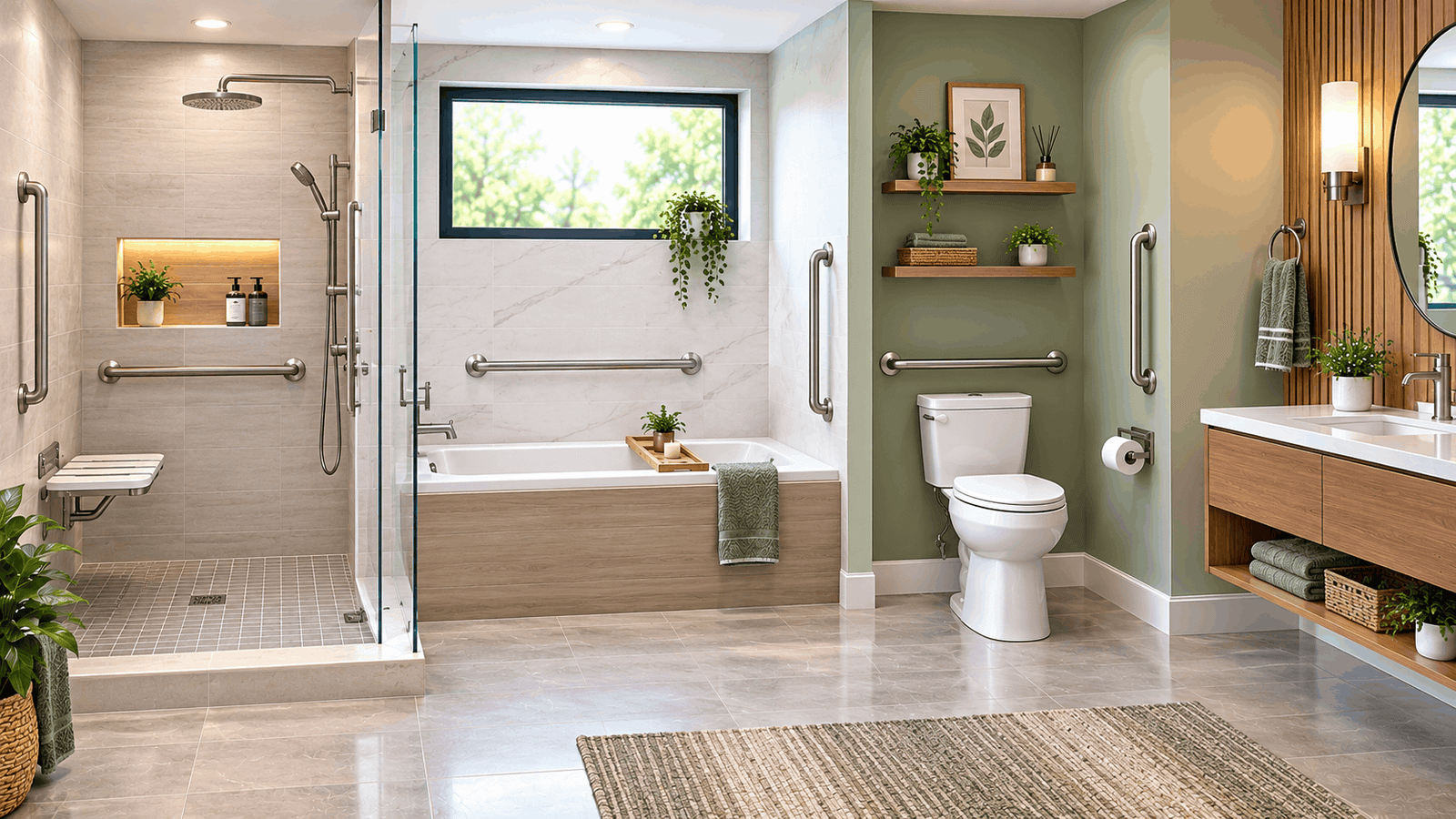
Choosing where to install grab bars can be frustrating when the toilet, bathtub, and shower all need different kinds of support. The right placement depends on how the person moves through the bathroom, the available wall space, and the applicable safety requirements.
Quick Answer: Place grab bars besides the toilet, on the rear toilet wall where appropriate, and on shower or bathtub walls where support is needed for standing, sitting, or transfers. For ADA-covered installations, the 2010 ADA Standards specify particular locations, heights, lengths, and clearances. Every bathroom layout requires its own assessment before installation.
Table of Contents
What You Need to Know
- Toilets: Side-wall and rear-wall grab bars serve different purposes and must follow the applicable layout requirements.
- Showers: Bar locations depend on the shower design, entry, seat, and intended movement.
- Bathtubs: Back-wall and end-wall placement depends on the tub configuration and transfer needs.
- Measurements: Height, bar length, wall clearance, and secure mounting all affect safe installation.
- ADA compliance: Federal accessibility standards do not automatically apply to every private residential bathroom.
Where Is the Best Place to Install Grab Bars in a Bathroom?
The most useful grab bar locations are the toilet side wall, the appropriate rear toilet wall, and the walls around the shower or bathtub where a person needs support. Choose each location according to the movement it must support, rather than installing bars at arbitrary positions around the room.
The main placement areas are:
- Besides the toilet: Provides a handhold when sitting down or standing up.
- Behind the toilet: Provides additional support where the toilet configuration and applicable requirements call for a rear-wall bar.
- Inside the shower: Supports standing, seated bathing, and movement through the shower.
- Along the bathtub: Provides a handhold during entry, exit, or bathing, depending on the user’s needs.
- Near a transfer area: May provide additional support when the location, mounting surface, and intended movement make it useful.
Before selecting a location, consider the person’s reach, dominant hand, balance, mobility, and the direction of movement. A bar that looks well positioned from the doorway may be difficult to reach during an actual transfer.
Where Should Grab Bars Be Placed Around a Toilet?
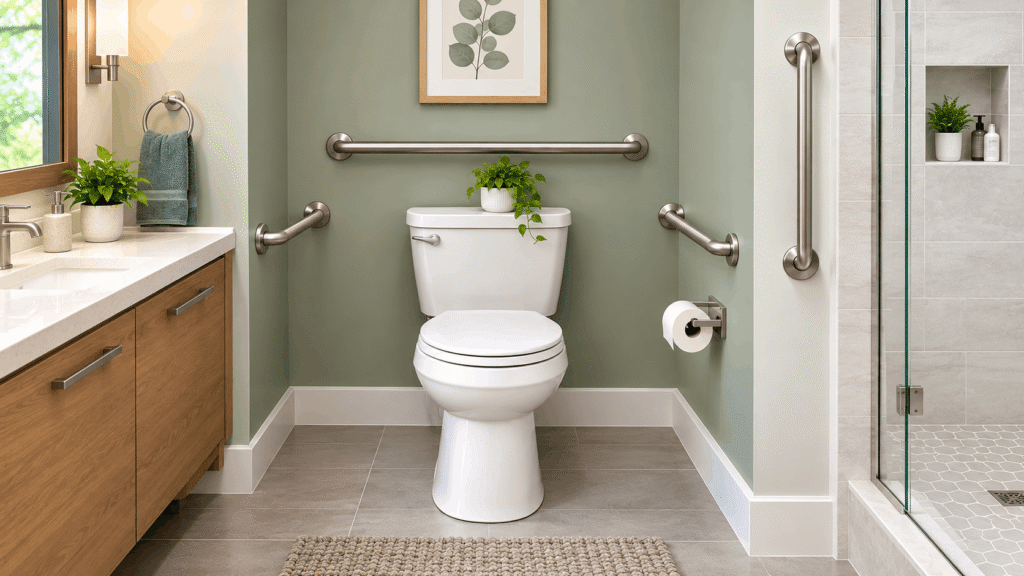
Grab bars besides and behind a toilet can provide support during sitting and standing. The required arrangement depends on the toilet layout and whether the installation must comply with an applicable accessibility standard.
Grab bars on the toilet side wall
A grab bar mounted besides the toilet provides extra support, helping users sit down and stand up with greater stability and confidence. In an accessible toilet layout, the side-wall bar’s position, length, and clearance are determined by the applicable standard.
Under Section 604.5.1 of the 2010 ADA Standards, the side-wall grab bar must be at least 42 inches long, with its rear end positioned within 12 inches of the back wall. wall, and the other end extending at least 54 inches from that wall. These are specific ADA toilet requirements, not universal dimensions for every home bathroom. Read the official 2010 ADA Standards.
Grab bars behind the toilet
A rear-wall grab bar can provide additional support, particularly when the user needs help repositioning or maintaining balance. Its placement must account for the toilet tank, flush controls, and available wall space.
According to Section 604.5.2 of the 2010 ADA Standards, the rear-wall grab bar in the required accessible toilet configuration must measure at least 36 inches in length and follow the specified placement and extension requirements. meeting the standard’s requirements.
Do not assume that installing a rear bar automatically makes a toilet area accessible. The complete arrangement must meet the relevant requirements.
What Is the Proper Position for Grab Bars Inside a Shower?
Install shower grab bars along the walls where users can easily reach them for balance and stability when stepping in, changing positions, standing, or using a shower seat. The correct locations depend on whether the shower is a transfer shower, a roll-in shower, a standard shower, or another configuration.
Grab bars on the shower back wall
A back-wall grab bar can help a person steady themselves while standing or using a shower seat. Its exact position depends on the shower design, the seat, and the applicable accessibility requirements.
For showers subject to ADA requirements, refer to Section 608 of the 2010 ADA Standards to determine the appropriate grab bar arrangement for the specific shower design.
Grab bars near the shower entrance and controls
The entry area deserves careful assessment because the user may need support while stepping into or out of the shower. A bar near the controls may also help with repositioning, but it must not obstruct the controls or interfere with movement.
Check the location from the user’s actual approach and transfer direction. Do not place a grab bar where it forces an awkward reach or conflicts with a shower door.
Shower grab bar placement pictures and examples
When comparing pictures, look for the shower type, seat position, door or opening, and the location of controls. These details explain why two bathrooms may require different arrangements.
A picture is a useful planning aid, but it cannot establish structural support or prove that a layout complies with a particular accessibility standard.
Where Should Grab Bars Be Placed Around a Bathtub?
Bathtub grab bars are commonly installed along the back wall and, where appropriate, an end wall to help with entry, exit, and bathing. The arrangement must match the bathtub configuration and the movement the grab bar is intended to support.
nyulangoneib.staywellsolutionsonline.com
Grab bars along the bathtub back wall
A back-wall grab bar can provide a handhold while a person changes position or baths. The ideal location depends on the tub rim, the user’s reach, any bathing seat, and the applicable installation requirements.
For ADA-covered bathtub installations, Section 607 of the 2010 ADA Standards specifies requirements that vary by bathtub type and seat configuration. Avoid treating a single residential photograph as a universal compliance template.
Grab bars on bathtub end walls
An end-wall grab bar may help during entry or exit, depending on the tub’s shape and the user’s movement. The faucet and control location, wall space, and the direction of transfer all affect the decision.
Do not install a bar solely because an empty section of wall is available. The position must allow a useful grip without creating an obstruction or requiring an uncomfortable reach.
Bathtub grab bar placement diagram
Use the following simplified diagram as a planning reference. It illustrates possible support locations, not a dimensionally accurate installation drawing.
Example bathtub layout
Back wall
Possible horizontal grab bar
Possible end-wall bar
Bathtub
Tub interior
Assess as needed.
Illustrative layout only. Final bar locations, dimensions, and orientations must be determined from the actual bathtub design and applicable requirements.
How High Should Bathroom Grab Bars Be?
Grab bar height depends on the fixture, the applicable accessibility standard, and the intended use. For ADA-covered installations, the required measurement must be taken from the specified reference surface and checked against the requirements for that particular fixture.
Do not assume that the same height is correct for a toilet, bathtub, and shower.
For detailed height measurements, use the existing bathroom grab bar height guide. It should be consulted alongside the applicable technical requirements, rather than using a general height recommendation as proof of compliance.
Height depends on the fixture and applicable standard.
Toilet, shower, and bathtub arrangements have different dimensional rules. The user’s reach and movement are also relevant to residential planning, provided that any applicable code requirements are still met.
Where accessibility compliance is required, follow the relevant standard instead of adjusting the installation based solely on a general recommendation.
Grab bar dimensions and wall clearance
Wall clearance is the open space between the wall and the gripping surface of a grab bar. Section 609.3 of the 2010 ADA Standards requires a minimum clearance of 1½ inches (38 mm) between the grab bar and the wall in the covered installations.
The specified clearance helps leave space for a person’s hand to grip the bar. It does not, by itself, establish that the bar’s height, length, mounting, or overall location complies with the standards.
For more dimensional detail, consult the ADA bathroom grab bar dimensions chart.
Can Grab Bars Be Installed on Any Bathroom Wall?
No. A bathroom wall is suitable for a grab bar only when the mounting arrangement can safely support the intended loads. The wall structure, compatible fasteners, mounting hardware, and manufacturer’s installation instructions all matter.
Wall support and secure mounting
Tiles, drywall, and decorative wall panels do not necessarily reveal the structure behind them. A visually solid surface should not be assumed to provide adequate support.
Before installation, identify the wall construction and the mounting method approved for the specific grab bar. Follow the manufacturer’s instructions, including any requirements for structural backing and fasteners.
A grab bar intended to support a person’s weight must not be treated like a towel rail. Decorative appearance and a tight-fitting screw do not prove that the mounting is secure.
When should you ask a qualified installer?
Seek professional assistance when the wall construction is uncertain, the wall is damaged, concealed plumbing or wiring may be present, or the required layout is difficult to achieve.
A qualified installer can assess the mounting surface and select an appropriate installation method. For an accessibility-regulated property, confirm that the completed installation meets the applicable requirements.
Do ADA Grab Bar Requirements Apply to Every Home?
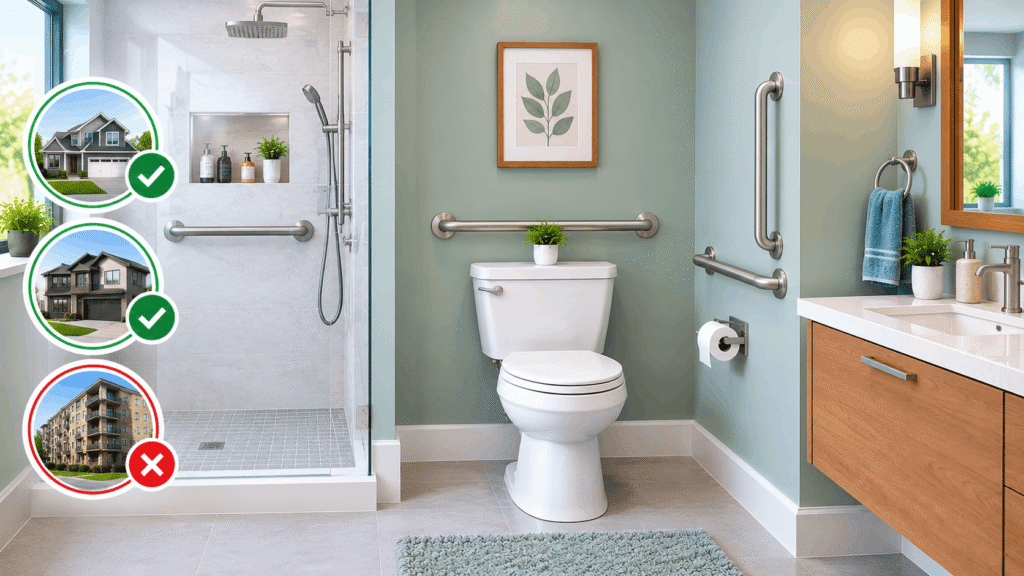
No. The federal ADA Standards apply to covered facilities and situations; they are not a universal specification for every private residential bathroom. The applicable legal requirements depend on the property, its use, and other relevant federal, state, and local rules.
Understanding the 2010 ADA Standards
The official 2010 ADA Standards contain technical requirements for accessible toilet rooms, bathtubs, showers, and grab bars.
Sections 604, 607, 608, and 609 address different aspects of these installations. The requirements vary according to the fixture and layout, so a single measurement cannot establish compliance across every bathroom type.
How to check applicable local requirements
For a regulated project, consult the applicable building code and the relevant authority having jurisdiction. State or local requirements may differ from the general recommendations used for an ordinary residential safety upgrade.
The U.S. Access Board’s bathing-room guidance is a useful official resource for understanding covered shower and bathtub arrangements.
What Are the Common Grab Bar Placement Mistakes?
Common mistakes include choosing a location based on appearance alone, overlooking wall support, and assuming one measurement fits every bathroom. A correctly selected grab bar must be reachable, securely mounted, and positioned for the movement it is intended to support.
Mistake 1: Confusing a towel bar with a grab bar
A decorative towel bar is not a substitute for a grab bar designed and mounted to provide support. Select suitable equipment and use the specified mounting method.
Mistake 2: Relying on the wall finish
Tile and drywall alone do not establish that the mounting can support the intended load. Verify the underlying structure and use compatible hardware.
Mistake 3: Copying another bathroom’s layout
A layout that works for one toilet or shower may not suit another. Fixture dimensions, entry direction, seats, controls, and applicable requirements can change the correct placement.
Mistake 4: Ignoring reach and obstructions
A bar can be securely mounted but poorly positioned if the user cannot comfortably reach it. Check access to controls, door movement, and the intended transfer route.
How to check a proposed grab bar location
- Identify the movement. Decide whether the bar will support standing, sitting, entry, exit, or a transfer.
- Check the fixture layout. Measure the available wall space and identify doors, seats, controls, and other obstructions.
- Verify dimensions. Check the required height, length, clearance, and orientation against the applicable standard or installation instructions.
- Confirm wall support. Establish that the mounting surface and hardware are suitable for the intended use.
- Arrange professional installation when needed. Ask a qualified installer to resolve uncertain wall construction or complicated mounting conditions before proceeding.
These checks help identify problems before installation. They do not replace a professional assessment or a required accessibility inspection.
Bathroom Grab Bar Placement Reference Chart
The following chart summarises the main placement decisions in one place. Use it to plan which fixture areas need attention before checking the detailed measurements.
Grab bar location decision chart
Toilet side wall Support when sitting or standing Required position, length, clearance, and wall support Toilet rear wall Additional support at the toilet Applicable layout, dimensions, and obstructions Shower back wall Support during standing or seated bathing Shower type, seat, height, and clearances Shower entry area Support during entry or exit Transfer direction, doors, controls, and reach Bathtub back wall Support during bathing and repositioning Tub design, seat, and applicable dimensions Bathtub end wall Support during entry or exit Access route, controls, and secure mounting
Save or screenshot this bathroom grab bar placement decision chart — it covers the main bathroom locations, their support purposes, and the checks needed before installation.
Where Can You Find More Detailed Grab Bar Placement Guidance?
If you have identified the main bathroom locations, the next step is to verify the dimensions and exact positioning for your fixture. Use the detailed placement and measurement guides to resolve the specific requirements rather than relying on a general chart alone.
The existing position of grab bars in a bathroom guide provides a related resource for checking positioning details. Compare it with the main placement guide to find the information most relevant to your bathroom.
A product recommendation is not necessary to answer the location question, and no commercial page was supplied for this article. The priority is to establish a suitable location and safe mounting approach before selecting equipment.
Frequently Asked Questions About Grab Bar Placement
1. Where should grab bars be placed on a wall?
Grab bars should be positioned on walls where a person needs support for a specific movement, such as sitting down, standing up, entering a shower, or getting out of a bathtub. The correct position depends on reach, fixture dimensions, wall construction, and applicable accessibility requirements. Before installation, verify the bar’s height, length, clearance, orientation, and mounting method rather than choosing a location based on appearance alone.
Where should grab bars be placed in a bathroom?
The main locations are besides the toilet, on the rear toilet wall where appropriate, and on the walls of the shower or bathtub where support is needed. Each location serves a different purpose, and not every bathroom requires the same arrangement. Consider the user’s movement and reach, the fixture layout, and the structural support available. If accessibility standards apply, follow the relevant requirements for that specific fixture.
Where should grab bars be placed in showers?
Shower grab bars are generally positioned on suitable walls where they can support standing, seated bathing, or movement through the shower. The exact arrangement depends on the shower type, seat, entrance, controls, and intended transfer direction. ADA-covered showers have specific requirements that vary by configuration. Review the applicable standard and verify secure mounting before installation. Pictures can help with planning, but they do not prove that a layout is compliant.
What is the correct bathtub grab bar placement?
Bathtub grab bars may be positioned along the back wall and an appropriate end wall, depending on the bathtub configuration and the user’s movement. Their locations should support the intended bathing or transfer activity without obstructing controls or access. For ADA-covered installations, Section 607 of the 2010 ADA Standards provides specific requirements for different bathtub arrangements. Always verify the applicable dimensions and mounting requirements rather than copying a generic diagram.
How high should a bathroom grab bar be installed?
There is no single height that automatically suits every bathroom grab bar. The appropriate measurement depends on the fixture, the applicable accessibility standard, and the intended installation. ADA-covered toilet, bathtub, and shower arrangements have specific requirements that should be checked individually. For detailed guidance, consult the bathroom grab bar height guide and verify the relevant standard before finalising the installation.
How much space should be between a grab bar and the wall?
Section 609.3 of the 2010 ADA Standards specifies a minimum clearance of 1½ inches (38 mm) between the gripping surface of a grab bar and the wall for covered installations. This space allows room for a hand to grip the bar. Other requirements still apply, including the bar’s position, dimensions, and mounting. Check the official standard and the installation instructions for the specific application before proceeding.
Can grab bars be installed without wall studs?
A grab bar should not be installed using an unverified mounting method simply because a wall stud is unavailable. The correct solution depends on the wall construction, the grab bar, its mounting hardware, and the manufacturer’s instructions. Some installations may require structural backing or a specifically engineered mounting system. If the underlying support cannot be verified, consult a qualified installer before using the bar for support.
Do all residential bathrooms have to follow ADA grab bar dimensions?
No. The 2010 ADA Standards do not automatically govern every private residential bathroom. Their applicability depends on the facility and circumstances, and state or local building codes may impose additional requirements. Homeowners can use accessibility guidance when planning a safer bathroom, but general recommendations should not be described as mandatory ADA rules. For a regulated project, confirm the applicable requirements with the relevant authority or a qualified professional.
What to Do Next
Once you have identified the appropriate grab bar locations, verify the detailed measurements before proceeding.
- Review the Bathroom Grab Bar Placement Guide for a broader overview of bathroom locations.
- Check the Grab Bar Height in a Bathroom Guide for height-related considerations.
- Consult the ADA Bathroom Grab Bar Dimensions Chart for the relevant technical specifications.
Want more practical bathroom safety guidance? If BathReviewHub offers an email newsletter, invite readers to subscribe for useful placement checklists, measurement guides, and bathroom safety planning tips. Add the subscription link or form at the end of the reference chart, where readers are most likely to want a reusable resource.