
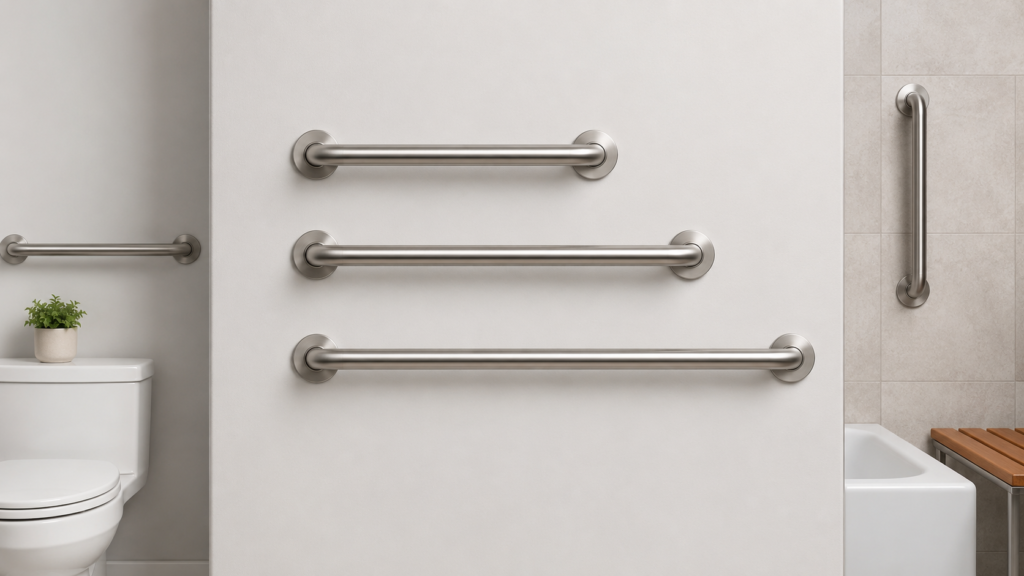
You’ve measured your shower wall, and the 24-inch grab bar at the hardware store suddenly looks too short for what you actually need. Length isn’t guesswork here—the ADA sets specific minimums by fixture, and this guide breaks down exactly which length fits your situation.
Quick Answer: Bathroom grab bars range from 12 to 48 inches. Anything 36 inches or longer counts as “long.” The ADA requires at least 36 inches on a toilet’s rear wall, 42 inches on the side wall, and a minimum of 24 inches at tub walls. Go longer for bariatric support, larger showers, or continuous handhold coverage.
Table of Contents
What You Need to Know
- Standard bars run 24–32 inches; 36 inches and up is considered “long.”
- The ADA sets different minimums for toilets (36–42″), tubs (24″), and showers (varies by shower type).
- A longer bar isn’t automatically rated for more weight — anchoring determines that, not length.
- Bars 42 inches or longer usually need to span two wall studs, not one.
- The ADA sets minimum lengths only. There’s no maximum—you can always go longer than code requires.
How Long Is a “Long” Grab Bar, Really?
A grab bar counts as “long” once it hits 36 inches. Anything shorter is standard length in the U.S. market.
A grab bar is a fixed horizontal or angled rail mounted to a wall, used to support balance while showering, bathing, or using the toilet. Manufacturers size them in set increments—12″, 16″, 18″, 24″, 32″, 36″, 42″, and 48″ are the common stops, with a few brands offering modular systems that connect shorter sections into a continuous run.
Thirty-six inches is the practical line between “standard” and “long.” Below that, a bar gives one fixed handhold. At 36 inches and up, it can support a person through more of a sit-to-stand or step-in motion instead of just one point of contact.
ADA Length Requirements by Location
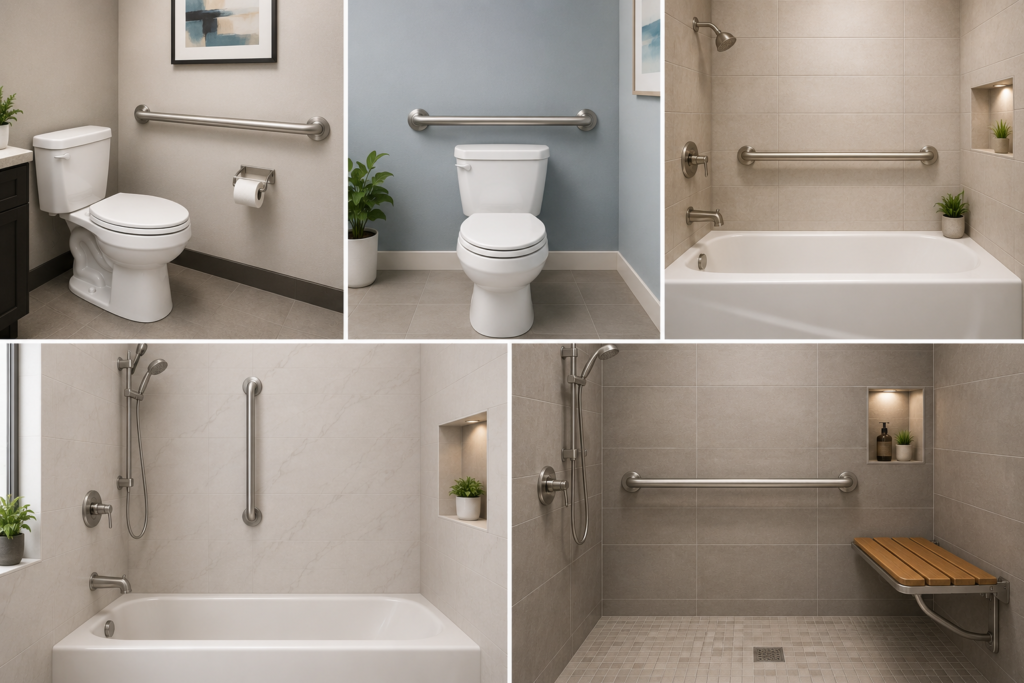
The length you need depends on where the bar is going, not on a single universal number.
Location | ADA Minimum Length Mounting Height Common Retail Lengths Size Up When… Toilet rear wall: 36″, 33–36″, 36″, 42″ Wall space allows it, or you want a combined towel bar. Toilet side wall: 42″, 33–36″, 42″, and 48″. Wheelchair transfer space is needed. Tub control wall 24″ 33–36″ 24″, 32″ — Tub back wall 24″ (or two bars) 33–36″ 24″, 32″ You’d rather have one continuous bar than two showers (vertical + horizontal). Varies by shower type: 33–36″ (horizontal) 18″–36″ Larger walk-in or curbless shower wall-to-floor No ADA minimum (residential add-on) Floor to ~36″–42″ tall, 30″–36″ tall. Standing-to-seated transfer support is needed.
Save or screenshot this length reference table—it covers every common bathroom fixture in one place.
These numbers are minimums, not maximums. According to the ADA’s 2010 Standards for Accessible Design, Section 609, code sets a floor for grab bar length and mounting height, not a ceiling—which is the detail most people miss when they assume a 36-inch bar is somehow “more compliant” than a 42-inch one.
When Do You Actually Need a Longer Bar?
Go longer than the ADA minimum when your situation calls for more than baseline support, not because longer automatically means safer.
Four scenarios where sizing up makes sense:
- Bariatric use. Bars rated for higher weight capacities are often built longer to distribute load across more anchor points.
- Larger or curbless showers. A bigger shower footprint means more distance to cover getting from entry to seat or showerhead.
- Full range-of-motion support. A 42-inch bar can support someone through the entire sit-to-stand sequence, where a 24-inch bar only supports the end position.
- Combined function. Some long bars double as a towel bar or shelf support, which is worth knowing about before you buy—our full grab bar buying guide covers the different types and configurations available.
Long Bar vs. Two Short Bars: Which Gives Better Support?
A single long bar generally beats two short bars for continuous support, but the wall layout decides which one actually works.
One continuous 42-inch bar gives an unbroken handhold through an entire motion—no gap to reach across mid-transfer. Two 24-inch bars cost less and install faster, but they create a dead zone between them where a hand has to let go and reposition.
The tradeoff is installation complexity, not safety in isolation. A long, straight bar needs a wall run with no obstructions (soap niches, valve trim, or corner seats) across its full length. When that run doesn’t exist, an L-shaped or wall-to-floor bar can deliver similar continuous coverage around a corner instead of a straight line.
Where to Mount a Long Grab Bar
Mounting height stays the same regardless of length—the ADA-preferred zone is 33 to 36 inches above the finished floor, measured to the top of the bar.
What changes with a longer bar is horizontal placement: it needs to clear fixed obstructions along its entire run, and it needs to align with where a person’s hand actually travels during the motion it’s supporting. Our guide on where to position grab bars in a shower walks through exact placement by shower type.
Materials and Weight Capacity for Long Bars
Length and weight rating are two separate specs—a 42-inch bar isn’t automatically stronger than a 24-inch one. Capacity comes from the material, the wall anchor, and how many studs the bar is anchored into, not from how long it is.
Stainless steel is the standard material for wet environments because it resists corrosion and holds up under repeated wet-hand grip. Our stainless steel grab bar buying guide covers gauge thickness and finish options in more depth.
Structural codes call for grab bars to withstand a minimum of 250 pounds of applied force—our breakdown of grab bar weight limits explains exactly how that number is tested and what it means for real-world use.
Installation Considerations for Extra-Long Bars
Longer bars raise the installation stakes because more length means more leverage on each anchor point.
- Locate every wall stud in the mounting zone. Studs typically sit 16 inches on-center. A 42-inch bar crosses at least two studs, sometimes three—mark each one with tape before drilling.
- Confirm solid blocking exists behind the wall, or add it. Showers framed without blocking can’t safely anchor a long bar into drywall or tile alone. This is the single most common reason long bars fail.
- Anchor at every mounting flange, not just the end points. A 42-inch bar typically has three flanges. Skipping the center flange concentrates all the load on the two ends.
- Seal every flange with silicone after mounting. This stops water from tracking behind the wall and loosening the anchor over months of use.
Common Mistakes with Long Grab Bars
- Mounting a long bar only at its two end caps and skipping the center flange, which is built to share the load.
- Assuming standard drywall anchors work past 24 inches—leverage forces multiply with length, and they don’t.
- Mixing mounting heights across bars in the same shower instead of keeping every bar within the 33–36 inch band.
- Choosing a finish or style first and checking the weight rating last.
- Confusing “long” with “bariatric-rated.” They’re separate specs, and a long bar isn’t automatically a high-capacity one.
When to Call a Professional Installer
Some wall types make DIY installation riskier than others. Tile over cement board, fiberglass tub surrounds, and plaster walls all behave differently than standard drywall when it comes to finding and anchoring into blocking.
For bariatric-rated installs, or any wall where you can’t visually confirm blocking behind the surface, a licensed contractor or ADA-specialist installer can verify the anchor points hold before anyone puts weight on the bar.
If you’d rather not measure every wall by hand, download our free ADA Grab Bar Length & Placement Cheat Sheet below — it puts the table above on one printable page.
FAQ
What length grab bar do elderly users need?
Most elderly users are well served by ADA-minimum lengths—36 inches at a toilet’s rear wall and 24 inches at tub walls—but anyone with reduced grip strength or a larger bathroom benefits from sizing up to 42 inches for continuous handhold coverage. The right length depends more on specific fall risk and bathroom layout than on age alone.
What are the best bathroom grab bars for elderly users?
Look for stainless steel construction, a 1¼-to-1½-inch diameter for a secure grip, and a length matched to the fixture rather than the longest bar available. A bar rated to at least 250 pounds of structural load, properly anchored into wall blocking, matters more than brand name or finish.
What’s the best long grab bar for a bathroom?
There’s no single “best” long bar—the right one depends on wall type, whether you need 36, 42, or 48 inches, and whether a straight bar or an L-shaped/wall-to-floor design fits your layout better. Match the length to the ADA table above before shopping by brand or finish.
How are grab bars installed for elderly safety?
Installation starts with locating wall studs, spaced roughly 16 inches on center; confirming solid blocking exists behind the wall; and anchoring every mounting flange, not just the end caps. For bars longer than 36 inches, this typically means anchoring into at least two studs, sometimes three.
What length grab bar do I need for a toilet?
The ADA specifies a minimum 36-inch bar on the rear wall and 42 inches on the side wall, both mounted 33 to 36 inches above the floor. Homes without ADA obligations often use 24-to-36-inch bars, but 42 inches gives more consistent support through the full sit-to-stand motion.
Are there designer long grab bars for showers?
Yes—brands like Smedbo, Invisia, and Ponte Giulio make long grab bars in brushed nickel, matte black, and wood-accented finishes that don’t look like medical equipment. Modular systems from these brands commonly offer sections from about 16 inches up to 45 inches, connected to build a custom continuous run.
How are grab bars installed in a shower?
Shower grab bars need silicone sealant at every mounting flange to stop water from reaching the wall anchors, and they should land within the ADA-preferred 33-to-36-inch height band for horizontal bars. Vertical bars near the shower entry are typically mounted separately, sized 18 to 24 inches.
What are the ADA requirements for toilet grab bars?
ADA Section 609 requires a minimum 36-inch bar on the rear wall and 42 inches on the side wall of a toilet compartment, both mounted 33 to 36 inches above the floor with 1.5 inches of clearance from the wall. These are minimums, not maximums—you can always go longer.
What to Do Next
Once you know the length you need, two things determine whether it holds up: where exactly it’s mounted and what it’s made of. Start with our guide to positioning grab bars in a shower, then check our stainless steel grab bar buying guide for material and finish options, and confirm the bar you’re considering meets the 250-pound weight standard before you buy