
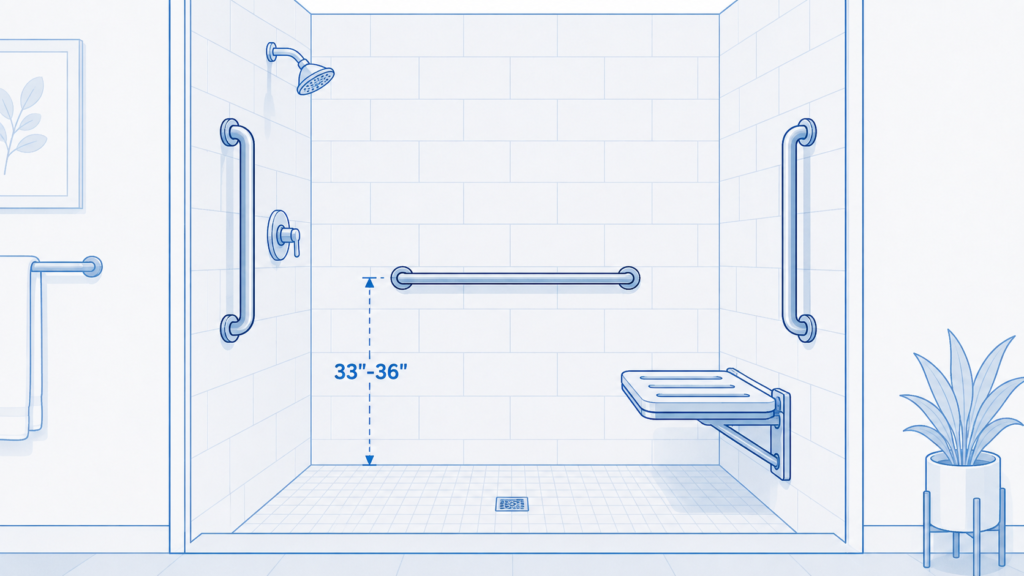
The position of grab bars in shower installations follows three simple zones — though most people only start searching for it after a slip on wet tile, a doctor’s note following a hip replacement, or a parent who’s started gripping the shower door frame for balance. You don’t need a contractor’s vocabulary to get this right. You need three zones, one height range, and a clear answer for your specific shower.
Quick Answer: Grab bars go in three zones — the entry/control wall, the back wall, and the seat wall if your shower has one. Mount them 33 to 36 inches above the floor, angled or oriented based on the movement they’re supporting (vertical for standing up, horizontal for steadying), with at least 1.5 inches of clearance between the bar and the wall.
Table of Contents
What You Need to Know
- Standard mounting height is 33–36 inches from the shower floor, regardless of orientation.
- Bars must anchor into wall studs or a solid-blocked backing — drywall anchors alone won’t hold a person’s full weight.
- A shower typically needs two to three bars: one near the entry/controls, one along the wall you stand or move against, and one near the seat if present.
- Vertical bars help with standing up and sitting down; horizontal bars help with steadying while upright; angled bars do a bit of both.
- Bars must clear the wall by at least 1.5 inches so a hand can wrap fully around them.
Where Should Grab Bars Go in a Shower?
The three placement zones are the entry/control wall, the back wall, and — if the shower has a built-in seat — the seat wall. Each zone supports a different movement: entering and exiting, standing while bathing, and transferring on and off a seat.
Most falls happen during a transition — stepping over the threshold, bending to reach the controls, or lowering onto a seat — not while someone is standing still. That’s why placement follows movement, not just wall space. A bar mounted where it “looks right” but doesn’t sit where the body actually moves is close to useless.
Grab Bar Placement Reference Chart
| Zone | Orientation | Height from Floor | Wall Clearance | Why |
|---|---|---|---|---|
| Entry / control wall | Vertical | 33–36″ (top of bar) | 1.5″ min | Steadies the step over the threshold and the reach to controls |
| Back wall (standard shower) | Horizontal | 33–36″ | 1.5″ min | Provides a running handhold while standing or moving |
| Back wall (transfer shower with seat) | Horizontal, 36″ long minimum | 33–36″ | 1.5″ min | Supports weight shifts while seated |
| Seat wall (adjacent to seat) | Vertical, 18″ long minimum | Extends 4″ above the horizontal bar | 1.5″ min | Assists standing up and sitting down at the seat |
Save or screenshot this Grab Bar Placement Reference Chart—it covers standard and seated/transfer showers in one table.
If you’re weighing your next step, your inbox doesn’t need another generic home-safety newsletter—it needs the one email that sends you a printable version of this exact chart, sized to tape inside a cabinet door.
Placement by Shower Zone
Entry / Control Wall
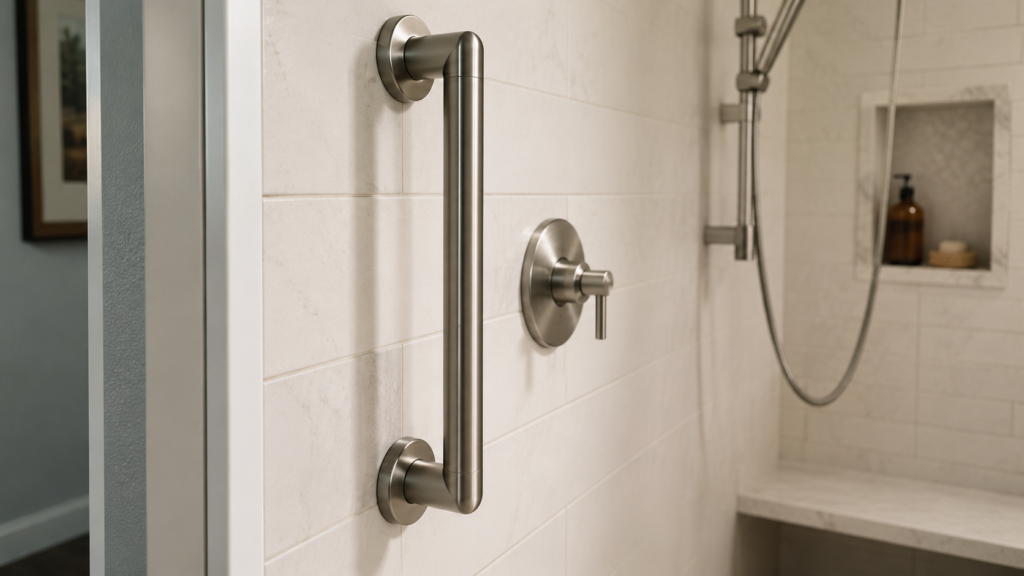
This is the wall nearest the shower entrance and the faucet controls. A vertical bar here does the most work, because entering and exiting involves a change in height—stepping up or down, shifting weight forward—not a steady standing position. Mount the bottom of the bar low enough to grip while stepping over the threshold and the top within reach while standing.
Back Wall
The back wall is where a horizontal bar earns its keep. Someone standing to shower needs a continuous, reachable grip point at a consistent height, not a single anchor point. In a standard walk-in shower, this bar should run at least 24 inches, though 36 inches gives more usable grip length for repositioning.
Seat Wall (Transfer Showers)
If the shower has a built-in or fold-down seat, the wall next to it needs a vertical bar, roughly 18 inches long, positioned so a person can grab it while lowering onto or rising from the seat. The Americans with Disabilities Act specifies this bar should extend about 4 inches above the horizontal back-wall bar, so both bars work together during the transfer motion, according to ADA.gov‘s Standards for Accessible Design.
Vertical, Horizontal, or Angled—Which Orientation Is Where
Orientation isn’t a style choice. Vertical bars support the up-and-down motion of standing, sitting, and stepping; horizontal bars support steadying while already upright; angled bars split the difference and work well for users who need help with both.
- Choose vertical at entry points and next to seats—anywhere the body changes height.
- Choose horizontal along the wall someone showers against—anywhere the body needs a steady, ongoing grip.
- Choose angled when one person uses the shower for multiple needs—for example, an aging parent who both steps in carefully and needs a handhold while washing.
There’s no single “correct” orientation for an entire shower. Most well-placed setups use at least two of the three.
Standard Height and Clearance Rules
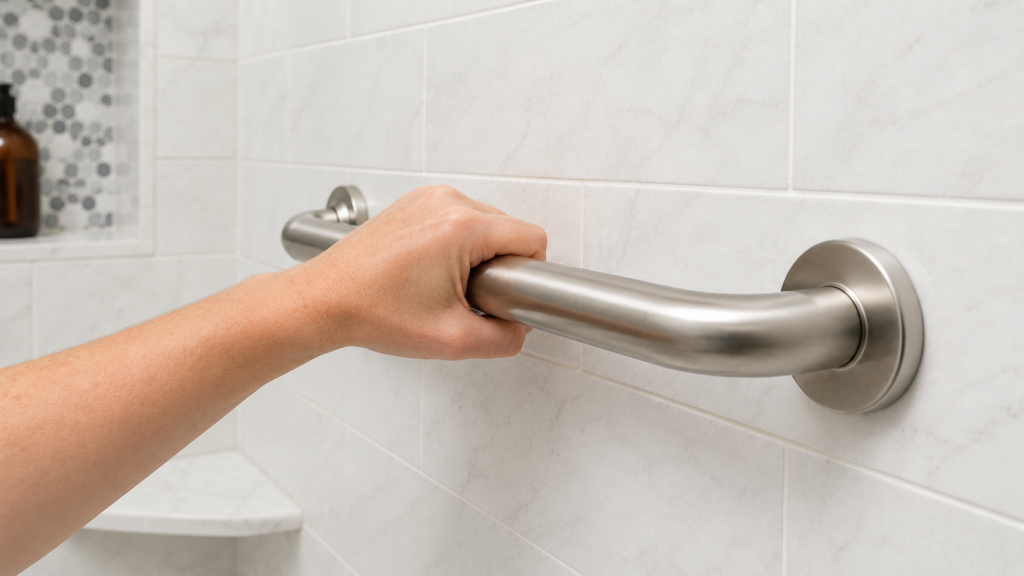
Every grab bar in a shower—regardless of orientation—mounts between 33 and 36 inches above the finished floor. This range comes from the Americans with Disabilities Act and is the reference standard even in homes where ADA compliance isn’t legally required.
Two numbers matter almost as much as height:
- Clearance: the bar must sit at least 1.5 inches off the wall so fingers can fully close around it.
- Diameter: the bar itself should measure 1.25 to 1.5 inches across—thin enough to grip, thick enough to bear weight.
A bar mounted at the right height but pressed too close to the wall is nearly as unsafe as one mounted at the wrong height. Hands can’t get a full grip on it under stress.
How Many Grab Bars Should a Shower Have?
Most showers need two to three bars: one at the entry/control wall, one along the wall used for standing support, and a third near the seat if one exists. A shower with no seat and a simple walk-in layout can function safely with two well-placed bars. Add a third whenever the user has significant balance or strength limitations—redundancy matters more than minimalism here.
Placement in a Standard Walk-In Shower vs. a Transfer/Seated Shower
A standard walk-in shower is built around movement—the two bars (entry and back wall) support someone who steps in, stands, and steps out. A transfer or seated shower is built around transitions between positions—sitting down, standing up, and shifting weight on the seat—which is why it needs the added vertical bar next to the seat that a standard shower doesn’t require.
If you’re not sure which category your bathroom falls into, the presence of a permanent or fold-down seat is the deciding factor. No seat, no third bar needed by default.
Common Placement Mistakes That Make Grab Bars Fail
The single most common placement mistake is mounting into drywall instead of a stud or blocking, which means the bar can pull loose exactly when someone puts their full weight on it during a fall—the worst possible moment for hardware to fail.
Other frequent errors:
- Mounting at a fixed height without adjusting for the actual user’s height and reach
- Placing only a horizontal bar in a shower with a seat, skipping the vertical assist bar entirely
- Positioning the bar too close to the wall, so it can’t be gripped with a full hand
- Choosing a suction-mounted bar as a permanent solution—these are rated for temporary, light-duty use only and are not a substitute for a stud-anchored bar.
When to Call a Professional Instead of DIY-ing Placement
Height and zone guidance can be followed by most confident DIYers. Locating studs behind tile, confirming the wall can bear a rated load, and anchoring hardware correctly is a different skill set. If there’s any uncertainty about what’s behind the wall—especially in a fiberglass or acrylic shower surround—a licensed installer or contractor should confirm blocking before anything gets drilled. Getting the position right on paper doesn’t help if the mounting underneath can’t hold.
FAQ
Should grab bars be angled or straight?
Angled bars work well when one person needs help with both standing up and steadying while upright, since the diagonal grip supports both motions. Straight vertical or horizontal bars are better when a shower’s users have one clear need—for example, only standing support, which calls for a straight horizontal bar instead.
Should Shower Grab Bars Be Mounted Vertically or Horizontally?
Vertical bars support standing, sitting, and stepping over the threshold. Horizontal bars support steadying while already upright and moving within the shower. Most showers benefit from at least one of each, placed in the zones where that specific motion happens.
At what height should shower grab bars be installed?
All grab bars, regardless of orientation, mount 33 to 36 inches above the finished shower floor. This range comes from ADA standards and applies whether the shower is a standard walk-in or a seated transfer type.
What are the common grab bar installation mistakes?
The top mistake is anchoring into drywall instead of a stud or reinforced blocking, which can cause the bar to fail under full body weight. Other mistakes include mounting too close to the wall, skipping the vertical bar near a seat, and relying on suction-mounted bars long-term.
What is the best position for a grab bar in a shower?
The best single position, if only one bar is possible, is a vertical bar at the entry/control wall, since most falls happen during the step in or out rather than while standing still. A fully equipped shower adds a horizontal back-wall bar and, if there’s a seat, a vertical seat-wall bar.
What are the rules for grab bars in showers?
The core rules are a 33–36 inch mounting height, 1.5 inches minimum wall clearance, a 1.25–1.5 inch bar diameter, and anchoring into studs or solid blocking rather than drywall alone. These come from ADA Standards for Accessible Design and apply as a strong reference even in private homes where they’re not legally mandated.
What to Do Next
Once placement is settled, the next question is usually how high to mount for your specific bathroom layout—see what height a shower grab bar should be for the full breakdown. If your shower has fiberglass or acrylic walls, check how to install a grab bar in a fiberglass shower before drilling anything. And before you buy hardware, confirm it can actually hold the weight