
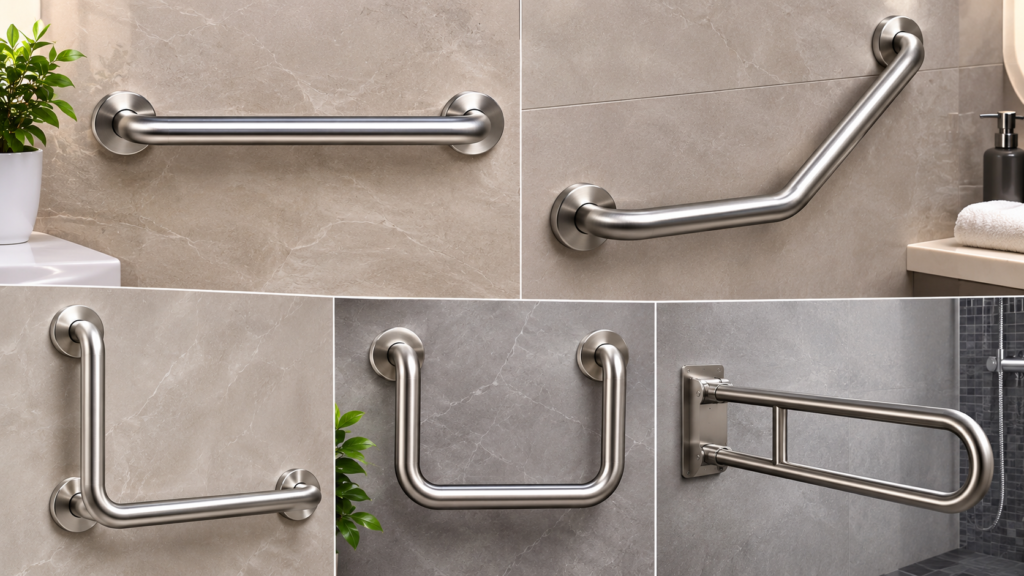
You’re staring at three grab bars labeled “stainless steel”—one costs $18, one costs $45, and none of the listings explain what actually separates them. The difference isn’t marketing fluff. It comes down to one metal grade, one clearance measurement, and one weight rating, and once you know what to check, picking the right bar takes about two minutes.
Quick Answer: A stainless steel grab bar is a wall-mounted safety bar made from corrosion-resistant steel, typically grade 304 or 316. ADA-compliant bars require a 1.25 to 1.5 inch diameter, 1.5 inches of wall clearance, and a minimum 250-pound load rating. Grade 304 handles most home bathrooms; grade 316 resists rust better in coastal or high-chlorine environments.
Table of Contents
What You Need to Know
- Stainless steel grab bars come in two common grades—304 and 316—and the difference is corrosion resistance, not strength.
- ADA rules require a 1.25 to 1.5 inch diameter, 1.5 inches of wall clearance, and a 250-pound minimum load rating. The words “stainless steel” alone guarantee none of this.
- Satin and peened finishes grip better wet than polished finishes do.
- Most residential bathrooms only need grade 304. Grade 316 earns its higher price in coastal homes or houses with water softeners.
- A magnet test can help you spot a fake — but it isn’t as reliable as most buying guides claim.
Is a Stainless Steel Grab Bar Actually Rust-Proof?
No — stainless steel resists rust far better than chrome-plated or coated steel, but “rust-proof” oversells it. No stainless steel is completely immune to corrosion; grade only determines how long it takes to start.
Stainless steel gets its resistance from chromium, at minimum 10.5 percent of the alloy, which forms a thin oxide layer on the surface. That layer heals itself when scratched, which is why a stainless bar shrugs off years of soap, water, and steam that would rust plain steel within months.
Under U.S. Access Board technical guidance, an ADA-compliant grab bar must support at least 250 pounds of force at any point along its length, regardless of finish or grade. The load rating and the corrosion resistance are two separate specs—a bar can meet one and fail the other.
304 vs. 316 Stainless: Which Grade Do You Actually Need?
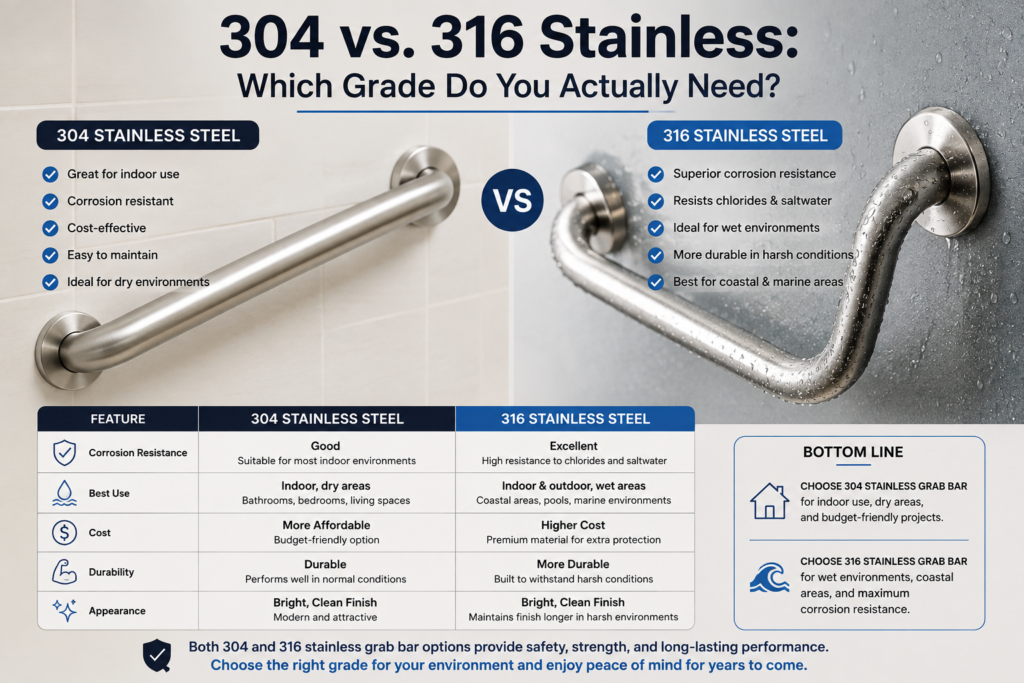
Grade 304 handles standard bathroom humidity and municipal tap water without issue. Grade 316 is built for saltwater, chlorinated pool decks, and homes on well water or water softeners where chloride exposure is constant.
The only meaningful difference between the two grades is molybdenum—316 contains 2 to 3 percent, and 304 contains none—and that single alloy is what stops chloride from pitting the surface over years of exposure, according to Reliance Foundry.
Grade 304, Grade 316: Chromium content ~18–20% or ~16–18%. Molybdenum content: None, 2–3% Corrosion resistance: strong, general-purpose Superior, chloride, and pitting resistant Typical price premium baseline About 40% higher Best for standard indoor bathrooms. Coastal homes, softened well water, pool-adjacent bathrooms
Save or screenshot this comparison — it covers every material decision you’ll make when shopping for a grab bar. Want the same specs as a printable checklist instead? That’s what BathReviewHub newsletter subscribers get first, before it’s posted anywhere else.
Satin vs. Polished vs. Peened: Which Finish Grips Best?
Satin and peened finishes grip better when wet; polished finishes look sleek but turn slippery the moment soap residue builds up. Grip matters more than shine in a shower.
A satin finish has a soft, low-glare texture from fine brushing, and it’s the most common choice for bathroom grab bars because it hides water spots and fingerprints. A peened finish adds a slightly dimpled, textured surface for maximum grip, often specified in commercial and bariatric-rated installations. A polished, mirror-style finish looks the most decorative but offers the least traction when wet.
ADA Specs: Diameter, Clearance, and Load Rating
ADA-compliant stainless grab bars must have a circular diameter between 1.25 and 1.5 inches, sit at least 1.5 inches from the wall, and support a minimum of 250 pounds. A bar that fails any one of these three specs isn’t ADA-compliant, no matter what the label says.
The 1.5-inch wall clearance exists so a hand can wrap fully around the bar without knuckles hitting the tile. The mounting height for most bathroom applications runs 33 to 36 inches above the floor—for the full breakdown by fixture type, see What Height Is a Shower Grab Bar? 7 Essential ADA Rules You Must Know.
Stainless vs. Nylon vs. Powder-Coated: Is Stainless the Best Material?
Stainless steel outperforms nylon and powder-coated steel on long-term corrosion resistance, but it isn’t automatically the right call for every bathroom. Powder-coated steel can match stainless on grip and cost less, but it fails first at any scratch or chip that exposes bare metal underneath.
Material: Rust resistance Relative cost is best for stainless steel. Excellent mid-high Most bathrooms, long-term installs Nylon-coated steel Good while coating is intact: low to medium. Budget installs and color matching. Powder-coated steel Good while the coating is intact. Low decorative, indoor-only use
Nylon and powder coatings can look identical to solid metal in a product photo, and both perform fine — until the coating is nicked during installation or use, at which point the steel underneath starts corroding from that single point.
How to Tell If a “Stainless” Bar Is Really Solid Stainless
Check the grade stamp first, then the weight, then the magnet — in that order, since the magnet test alone is less reliable than most buying guides suggest.
- Look for a grade stamp on the flange or packaging. Genuine stainless hardware is usually marked “18/8” (an 18% chromium, 8% nickel composition equivalent to 304) or directly as “SUS304” or “SUS316. “No stamp at all isn’t proof of a fake, but it’s worth asking the seller directly before buying.
- Check the weight against the diameter. A solid stainless tube has a predictable weight for its size. A bar that feels unusually light for a 1.25-inch diameter may be chrome-plated mild steel or a thin-wall tube, cutting costs through less material rather than a cheaper alloy.
- Run the magnet test, but don’t trust it alone. Both 304 and 316 are austenitic stainless steels, which means they’re naturally close to non-magnetic. Here’s the counterintuitive part: surface contamination picked up during manufacturing or welding can make a genuinely solid stainless bar weakly magnetic anyway, so a partial magnet stick doesn’t actually prove the bar is fake.
- Ask for a mill certification on commercial or bulk orders. Commercial suppliers can typically provide a mill test report confirming the exact alloy composition. Residential retailers rarely offer this, but it’s standard practice for contractor and healthcare-facility orders.
Where It Goes and How High (Quick Recap)
Grab bar placement depends on the fixture — shower, tub, or toilet — and each one carries its own height and clearance rules. Getting the material right doesn’t matter if the bar goes in the wrong spot.
For the complete placement rules by fixture type, see Shower Grab Bar Placement: The Complete Guide and Where Should Grab Bars Go in a Shower Stall? If your shower walls are fiberglass or acrylic specifically, the anchoring method changes — see Grab Bar for a Fiberglass Shower: 2 Proven Methods That Work.
Cleaning and Maintaining a Stainless Grab Bar
Wipe stainless bars with mild soap and water, and dry them after use rather than letting water sit on the surface. Bleach and chlorine-based cleaners are the single most common cause of premature pitting on grade 304 bars.
Chloride ions in bleach attack the passive oxide layer directly, and repeated exposure can cause visible pitting even on a genuine, correctly rated bar. Skip steel wool and abrasive pads too—they can embed tiny particles of carbon steel into the surface, which then rust and make the stainless bar itself look like it’s failing.
Common Mistakes When Buying a Stainless Grab Bar
Assuming “stainless steel” on the label means ADA-compliant is the single most common and costly mistake—material and compliance are separate specs, and a bar can be genuine stainless steel while still failing the diameter, clearance, or load requirements.
Other frequent mistakes: choosing a polished, mirror-finish bar for a walk-in shower floor area where slip risk is highest; skipping the 1.5-inch wall-clearance check because the bar “looks” far enough from the tile; and mounting any grab bar, stainless or not, without confirming there’s a stud or a properly rated anchor behind the wall. The metal grade is irrelevant if the mounting point can’t hold 250 pounds.
Frequently Asked Questions
What’s a heavy-duty stainless steel grab bar rated for?
Heavy-duty or bariatric-rated stainless grab bars are typically load-tested well beyond the ADA’s 250-pound minimum, often to 500 pounds or more, using a thicker-wall tube and a reinforced flange. They’re specified for commercial installations, healthcare facilities, and homes where a higher-capacity bar is medically recommended.
Are stainless steel grab bars safe for showers?
Yes. Stainless steel is one of the most shower-appropriate materials available because it tolerates constant moisture without degrading, unlike coated or painted finishes that can chip and expose bare steel underneath. Choose a satin or peened finish for grip, and confirm the diameter and wall clearance meet ADA specs before buying.
What’s the best stainless steel grab bar for elderly or bariatric use?
For elderly or bariatric use, prioritize a 1.25 to 1.5 inch diameter for a secure grip; a peened or satin finish for wet-hand traction; and a load rating above the 250-pound ADA minimum—many bariatric-rated bars are tested to 500 pounds. Grade 304 is sufficient unless the home has heavy chloride exposure.
Will a stainless steel grab bar rust?
It can, though far more slowly than uncoated steel. Rust typically shows up as small surface pits where chloride from bleach, salt air, or softened water has broken down the protective oxide layer over time, especially on grade 304 in high-chloride environments.
Can I install a stainless grab bar myself?
Most homeowners can install a stainless grab bar themselves if they can locate wall studs or use load-rated anchors correctly, since the installation method matters more than the material. If the wall is fiberglass, tiled over cement board, or you’re unsure where the studs are, professional installation reduces the risk of the bar failing under load.
How much does a stainless steel grab bar cost?
Standard grade 304 bars typically run from around $15 to $50 depending on length and finish, while grade 316 or bariatric-rated bars usually cost more due to the added molybdenum content and reinforced construction. Custom or angled bars cost more than straight bars of the same length.
What to Do Next
Now that you know which grade and spec to look for, the next step is placement. Start with Shower Grab Bar Placement: The Complete Guide to map out where each bar goes and confirm the exact mounting height in What Height Is a Shower Grab Bar? 7 Essential ADA Rules You Must Know, and if your shower walls are fiberglass or acrylic, check Grab Bars for a Fiberglass Shower: 2 Proven Methods That Work before you drill.