
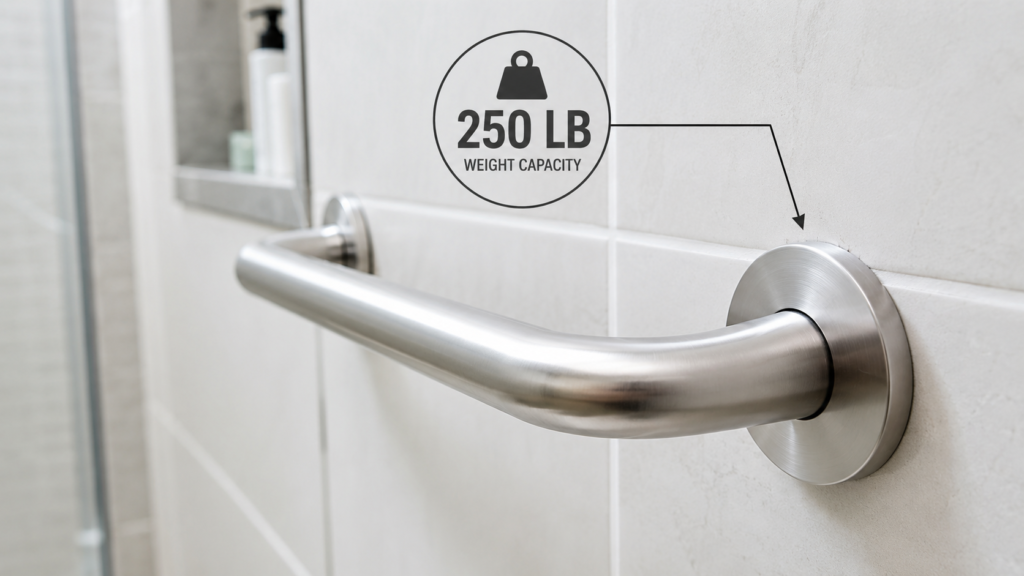
Grab bar strength is the exact thing on your mind right now, whether you’re standing in the shower aisle or staring at a bar that’s already on your wall. The question is simple: will this actually hold if someone puts full weight on it during a fall? That’s not paranoia—it’s the right question, and the answer has a specific number behind it, not a guess.
Quick Answer: Grab bar strength is measured by a 250-pound structural test—a properly installed bar must withstand that much force applied at any point on the bar, its fasteners, or the wall structure behind it, under U.S. building code and ADA guidance. That rating only holds true when the bar is anchored into wall studs or reinforced blocking—not into drywall alone, and not for suction-mounted bars, which aren’t held to this standard at all.
Table of Contents
What You Need to Know
- Grab bar strength starts at 250 pounds—the minimum structural test load required by ADA and most U.S. building codes. It’s a floor, not a ceiling.
- The number only applies to bars mounted into studs or reinforced backing. Drywall-only mounts drop real capacity far below the rating.
- Suction and adhesive grab bars are not covered by this standard, and their actual holding power varies by product.
- Grab bar diameter matters too: code calls for a 1.25″ to 2″ circular grip, or a non-circular bar with a 4″ to 4.8″ perimeter.
- A bar rated at 250 pounds isn’t a personal weight limit for the heaviest person in the house—treat it as a minimum, not a target.
The 250-Pound Standard, Explained
Grab bar strength comes down to one number: 250 pounds, applied at any point on the bar, not just its middle. The U.S. Access Board’s ADA Standards for Accessible Design require that a grab bar withstand a vertical or horizontal force of 250 pounds applied at any point on the bar, the fastener, the mounting device, or the supporting wall structure—not just the bar itself. That’s the detail people miss: the bar can be rated fine and still fail if what’s behind it isn’t.
Model building codes used across most states, including the International Building Code structural load requirements adopted state by state, repeat this same 250-pound figure for grab bars, shower seats, and accessible benches. It’s not a manufacturer marketing number—it’s a structural design load written into code, and it’s the baseline every grab bar strength claim gets measured against.
Some manufacturers advertise bars rated for 300 to 500 pounds, built with heavier-gauge metal or reinforced mounting flanges. Those exceed the code minimum, but they still need to be anchored the same way — into studs or blocking — to actually deliver that number in real use.
Grab Bar Mounting Type vs. Real-World Weight Capacity
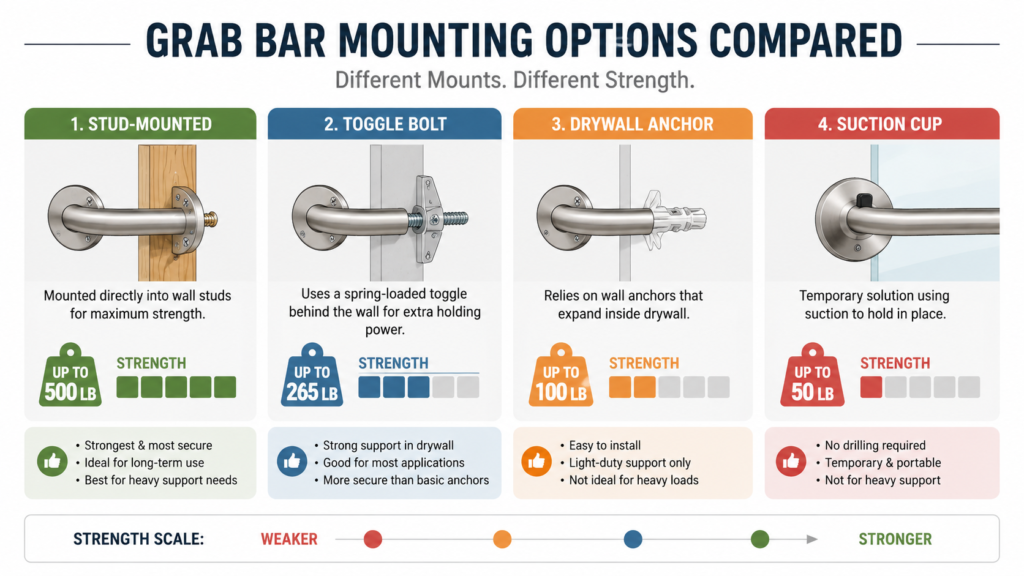
Grab bar strength on the box only means something if the installation matches it. Here’s how the common mounting methods actually compare.
| Mounting Type | Typical Real Capacity | Meets 250 lb Code Standard | Best Use | Key Risk |
|---|---|---|---|---|
| Stud-mounted (screwed into wood studs) | 250–500 lbs | Yes | Standard installs where studs align with bar placement | Studs don’t always land where you need the bar |
| Toggle bolts into reinforced blocking | 250–500 lbs | Yes | New construction or remodels with blocking added behind the wall | Requires planning before the wall goes up |
| Drywall anchors, no blocking | Well under 100 lbs, often far less | No | Not recommended for full-weight support | Anchor pulls out of drywall under real load |
| Suction-cup mount | Manufacturer-specific, often under 50 lbs and drops over time | No | Travel or temporary, low-weight-bearing use only | Suction can release without warning, especially on textured tile |
| Adhesive-mount | Manufacturer-specific, typically low | No | Light touch-support, not fall-arrest use | Bond weakens with heat, moisture, and time |
Save or screenshot this mounting comparison—it covers the difference between a bar that’s rated for safety and one that just looks like a grab bar.
Are Suction Grab Bars Strong Enough?
No suction grab bar is held to the 250-pound structural standard that stud-mounted and blocked bars must meet. Suction bars work by creating a vacuum seal against a smooth, clean surface—tile, fiberglass, or acrylic—and that seal can degrade with soap film, humidity, temperature swings, or a slightly textured surface.
Some suction bars include a visual “safety lock” indicator that shows green when the seal is secure. That’s useful for daily monitoring, but it’s not a substitute for a code-rated structural test. Suction bars are reasonable for light, temporary support—travel, a rental, or steadying yourself while reaching for a bottle—but they’re not the right choice for someone who needs to catch their full body weight during a fall.
Does Capacity Change for Heavier Users?
The 250-pound figure is a minimum test load, not a personal weight ceiling—but it’s also not a big margin for a heavier user. A 250-pound-rated bar being used by someone who weighs 220 pounds has little cushion left for the extra force generated during a sudden slip, which can exceed static body weight.
For households where a user weighs more, or where a caregiver is also bracing against the bar during a transfer, look for bars rated 300 to 500 pounds for extra grab bar strength. The installation requirement doesn’t change—studs or blocking either way—but the higher-rated bar and its hardware are built with a larger safety margin.
What Size and Shape Grab Bar Is Strongest?
Diameter and shape affect grip and code compliance, not just comfort. Code specifies a circular grab bar between 1.25″ and 2″ in diameter, or a non-circular bar with a perimeter of 4″ to 4.8″ and a maximum cross-section of 2″. Bars must have rounded edges and can’t rotate within their wall fittings—a bar that spins under pressure is a fall risk on its own.
The bar also needs a 1.5″ clearance from the wall—enough for a full hand grip without pinching knuckles. For where to actually mount a bar at that diameter, see our guides on shower grab bar placement and the best location for grab bars in a shower stall.
Common Mistakes That Undercut Grab Bar Strength
A grab bar’s rated strength is only as good as what’s behind the wall, and that’s where most installs go wrong.
- Mounting into drywall alone. The bar itself might be rated for 250 pounds, but drywall anchors typically fail well below that under sideways force.
- Skipping a stud finder before drilling. Studs are usually 16″ apart, and missing them by even an inch means the fasteners are biting into nothing but drywall paper and gypsum.
- Assuming “ADA-compliant” packaging means installed correctly. The bar can meet spec and still be unsafe if it’s screwed into the wrong material behind the tile.
- Ignoring cracked grout or loosening tile around an older bar. That’s often the first visible sign the mounting point is failing structurally, well before the bar itself feels loose.
- Choosing a suction bar for full-weight, daily fall support. It’s the wrong tool for that job, even if it feels sturdy when you first press it on.
Signs a Grab Bar No Longer Meets This Standard
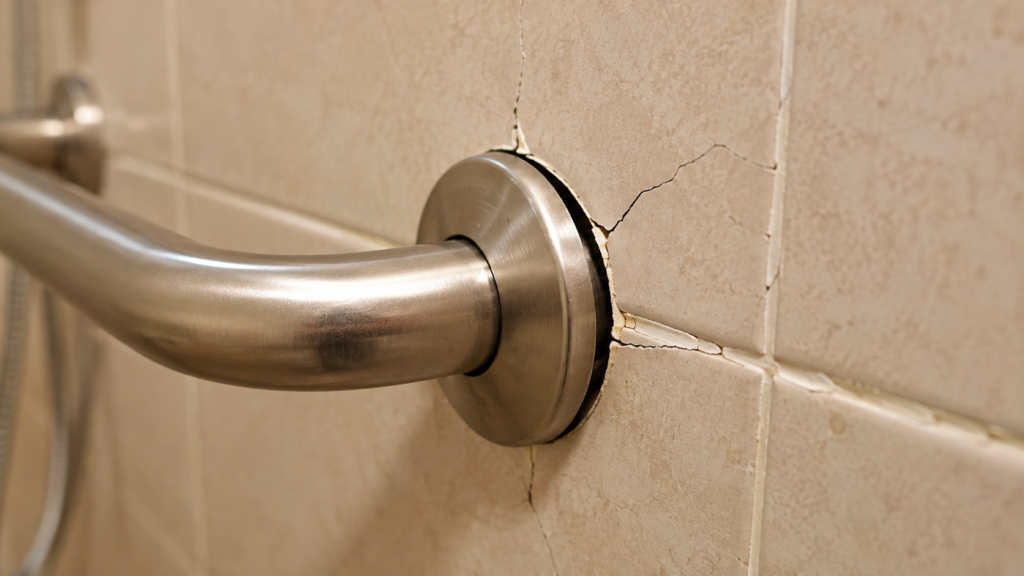
A bar that wiggles, even slightly, when you push on it has already lost some of its structural margin. Hairline cracks in the tile or caulk ring around the mounting plate are a warning sign the fasteners are working loose from the wall structure. Rust or corrosion on the fasteners themselves, common in older bathrooms, weakens the exact hardware the 250-pound rating depends on.
If you see any of these signs, this article can tell you what the standard requires, but it can’t tell you whether your specific wall still meets it. That’s a job for a contractor or occupational therapist who can physically test the mount, not something to diagnose from a blog post.
FAQ
How Much Weight Can a Bathroom Grab Bar Safely Support?
A code-compliant grab bar must withstand 250 pounds of force at any point on the bar, its fasteners, or the wall structure, according to ADA Standards and most U.S. building codes. That’s a minimum requirement, not a maximum — some bars are rated higher, up to 300–500 pounds, for extra safety margin.
Are suction grab bars strong enough?
Suction grab bars aren’t held to the 250-pound structural standard that applies to stud-mounted bars, and their real holding power depends entirely on surface condition and seal quality. They’re reasonable for light, temporary support but not recommended as a primary fall-safety bar for full body weight.
What are the specifications for a grab bar?
Code requires a circular grab bar 1.25″ to 2″ in diameter, or a non-circular bar with a 4″ to 4.8″ perimeter, mounted with 1.5″ clearance from the wall. It must have rounded edges, resist rotating in its fittings, and withstand 250 pounds of force at any point.
What size grab bars are best?
A 1.25″ to 1.5″ diameter circular bar suits most adult hands for a secure, full grip without straining the fingers. Larger diameters up to 2″ are still code-compliant but can be harder to grip fully for users with smaller or weaker hands.
Does grab bar weight capacity change for heavier users?
The 250-pound rating is a minimum, and a heavier user leaves less safety margin, especially since a sudden slip generates more force than static body weight. Households with heavier users should look for grab bars rated 300 to 500 pounds, installed the same way — into studs or reinforced blocking.
Do all grab bars sold in stores meet the 250-pound standard?
Not automatically—the rating only applies when the bar is properly installed into studs or reinforced blocking, and suction or adhesive bars aren’t held to this standard at all. Check the packaging for a stated structural rating and confirm the bar is designed for permanent, anchored installation if fall support is the goal.
What to Do Next
Now that you understand grab bar strength and what a bar actually needs to hold, the next question is usually where to put it. Our guide to shower grab bar placement and our breakdown of what height a shower grab bar should be mounted at cover exactly that.
If your shower has a fiberglass or acrylic surround, mounting method matters even more—see our guide on grab bars for fiberglass showers before you drill.