
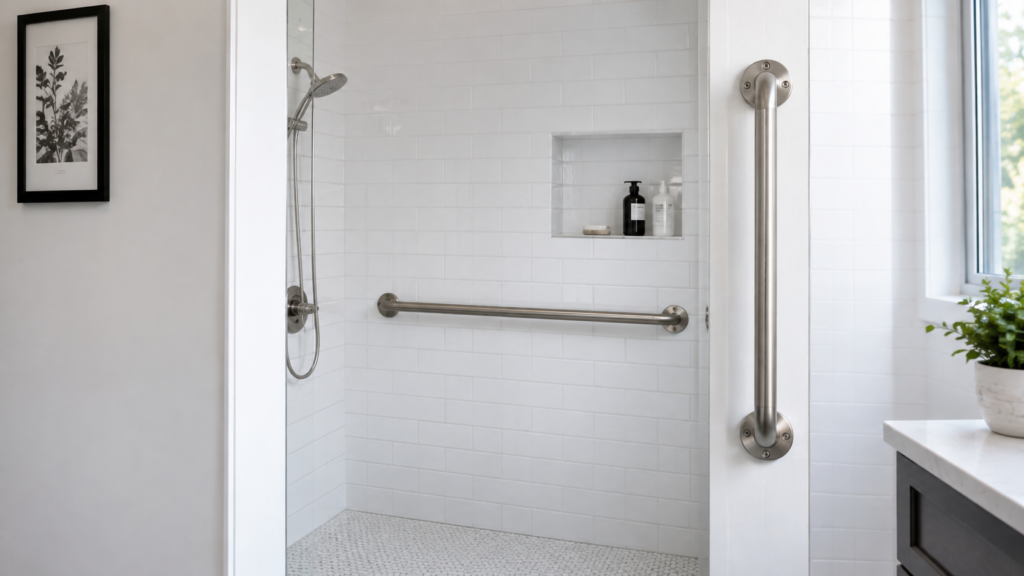
Where to put shower grab bars comes down to three zones—and if you’ve just had a close call in the shower, or someone you love has, you’re probably standing there right now trying to figure out exactly where the bar needs to go so it does its job. The good news: there’s a well-tested formula for this, backed by federal accessibility standards, and it takes less time to apply than it does to second-guess yourself.
Table of Contents
Quick Answer: Shower safety bars work best in three areas: a vertical bar beside the entrance for safe entry and exit, plus a horizontal bar across the primary shower wall at 33–36 inches from the floor, and a third bar (angled or horizontal) on the back wall if there’s a seat. All bars must anchor into wall studs.
What You Need to Know
- Height matters more than most people think: 33–36 inches from the floor is the standard range, per the ADA.
- A shower needs at least two bars, sometimes three—one bar alone rarely covers entry, standing, and sitting.
- Bars must be anchored into studs or engineered blocking. Drywall alone will not hold a person’s weight.
- Placement changes depending on whether you have a tub-shower combo, a curbless walk-in shower, or a shower with a built-in seat.
- A grab bar rated for 250 pounds minimum is the baseline—check the packaging, not just the price tag.
Why Proper Grab Bar Positioning Is More Important Than the Bar Itself
A grab bar in the wrong spot is barely better than no grab bar at all. The bar has to be where the body actually loses balance—not where it’s easiest to drill. Most falls happen during the transition moments: stepping over the tub wall, shifting from standing to sitting, or reaching for a control mid-shower.
Where to Put Shower Grab Bars by Bathroom Type
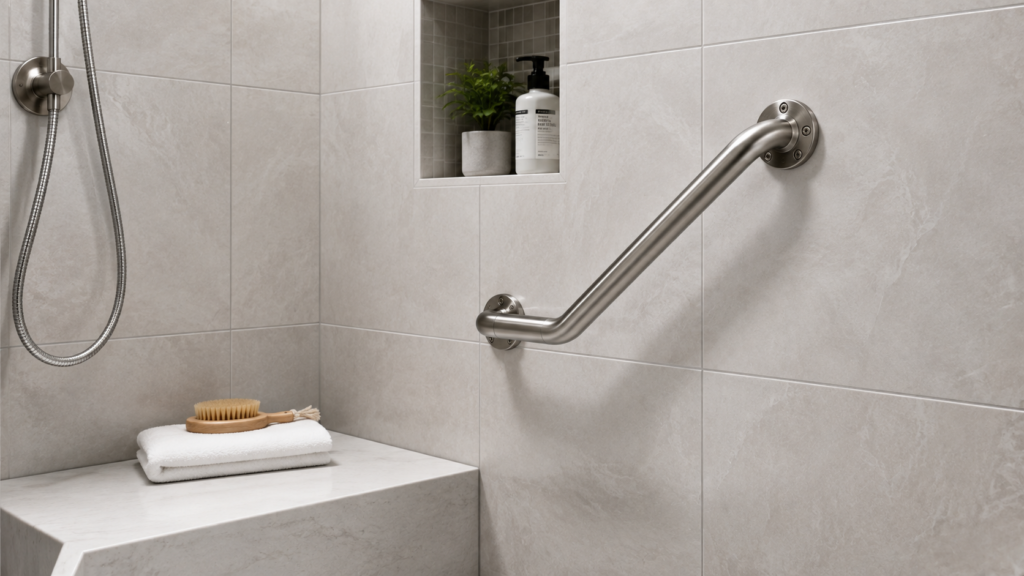
Placement isn’t one-size-fits-all. A tub-shower combo, a curbless walk-in, and a shower with a seat each ask for a slightly different layout. Here’s the placement reference table you can save and use for your own bathroom.
| Bathroom Type | Bar Location | Orientation | Height from Floor | Typical Length |
|---|---|---|---|---|
| Tub-shower combo | Entry/exit point (tub wall edge) | Vertical | 33–36″ (bar spans that range) | 18–24″ |
| Tub-shower combo | Long wall, inside the tub | Horizontal | 33–36″ | 24–36″ |
| Walk-in / curbless shower | Just outside the entry | Vertical | Positioned so the top of the bar sits around 36″ | 18–24″ |
| Walk-in / curbless shower | Main shower wall | Horizontal | 33–36″ | 24–36″ |
| Shower with built-in seat | Back wall, near the seat | Angled or horizontal | About 9″ above the seat height | 24–36″ |
| Shower with built-in seat | Side wall, near the seat | Vertical | Positioned roughly 18″ from the back wall | 12–18″ |
| Toilet area (adjacent to shower) | Side wall | Horizontal | 33–36″ | 36–42″ |
Save or screenshot this placement table—it covers tub-shower combos, walk-in showers, and seated showers in one reference, so you’re not hunting through three different pages to find your setup.
If you want more granular sizing guidance once you know your zones, our guide on what size grab bar is best for a bathroom breaks down exactly how bar length should match each of these placements.
Should Shower Grab Bars Be Vertical, Horizontal, or Angled?
The orientation depends entirely on the motion the bar needs to support. A vertical bar supports the up-and-down motion of standing and sitting; a horizontal bar supports side-to-side balance while stationary.
- Vertical bars work best at entry points and next to a seat, where the main risk is losing balance while shifting body position.
- Horizontal bars work best along a wall someone stands next to for the duration of the shower — they give a steady, continuous grip.
- Angled (diagonal) bars combine both. They’re a common choice near a seat because they support both the sitting motion and a stable hold once seated.
There’s no universal “better” orientation — the motion at that exact spot decides it.
How High Should Shower Grab Bars Be?
For most adults, shower grab bars should sit 33 to 36 inches above the finished floor, measured to the top of the bar. According to the ADA Standards for Accessible Design, this range applies to horizontally mounted bars and is the baseline used across most U.S. building codes for accessible bathrooms.
That said, this is a range, not a single number. A taller household member may be more comfortable at the top end (36″), while someone in a wheelchair or shorter in stature may need the bar closer to 33″ or slightly below. If you’re placing a bar for one specific person rather than a general household, measure that person’s elbow height while standing or seated and use that as your anchor point instead of defaulting blindly to 34″.
How Many Grab Bars Does a Shower Need?
Most showers need at least two grab bars — one at the entry and one along the main wall. A third bar becomes necessary if there’s a seat, a second entry point, or if the household includes someone with significant mobility limitations.
Skimping to one bar is one of the most common placement mistakes, because a single bar can’t cover both the entry transition and the in-shower standing support at the same time. Two zones of risk need two separate points of support.
Do Shower Grab Bars Need to Go Into Studs?
Yes. Grab bars must be anchored into wall studs or engineered blocking, not just drywall or tile. Per the International Residential Code, grab bars and the reinforcement behind them need to be able to resist a minimum of 250 pounds of force applied in any direction.
Suction-cup bars and adhesive-mounted bars don’t meet this standard. They’re marketed as no-drill conveniences, but suction seals degrade with soap residue, temperature changes, and time — which means the bar can fail at the exact moment someone puts their full weight on it. If a stud doesn’t line up where you need the bar, the fix is steel blocking or a mounting plate rated for the same load, not a suction-cup workaround.
Common Grab Bar Placement Mistakes
The mistakes below account for most of the “the bar didn’t help” complaints found in accessibility forums and home safety reviews — not because the bar itself was bad, but because of where and how it went in.
- Mounting too high or too low. Anything above 36″ or below 30″ reduces how much support the bar actually provides during a fall — the body’s centre of gravity won’t be near the bar when it matters.
- Skipping the stud check. Drilling into drywall alone is the single most common reason a “properly installed” bar comes loose or fails.
- Installing only one bar. As covered above, one bar rarely covers both the entry and the in-shower standing zone.
- Ignoring the seated transfer zone. Households that add a shower seat later often forget to add a second bar to support the sit-to-stand motion.
- Placing the bar too close to the shower control. A bar mounted right where someone reaches for the water handle turns a support point into an obstacle.
What to Check Before You Buy
Once you know where each bar is going, the two remaining decisions are size and weight rating — and getting either wrong undermines the placement work you just did. Our guide to how much weight bathroom grab bars can hold walks through how to match a bar’s load rating to the people actually using it, which matters more than most buyers realise going in.
When to Call a Professional Installer
DIY installation is realistic for someone comfortable finding studs and using a level — but it’s unforgiving of guesswork. Misjudging stud location, using the wrong anchor for tile or fibreglass, or mounting at the wrong height are all mistakes that don’t show up until the bar is under real load.
If you’re not confident locating blocking behind tile, or the household includes someone with a recent fall or surgery, a professional installer or an occupational therapist doing a home safety assessment is worth the cost. They’ll also catch placement needs specific to that person’s mobility pattern — something a general placement guide like this one can’t fully replace.
If you want a running reference as you plan out your own bathroom, it’s worth bookmarking this page or saving the placement table above before you start marking up the wall.
FAQ
What are the most common grab bar installation mistakes?
The most common mistakes are mounting the bar too high or too low, drilling into drywall instead of a stud, installing only one bar when the shower needs two, and placing the bar too close to shower controls. Each of these reduces how much support the bar provides exactly when it’s needed.
Should grab bars be angled or straight?
It depends on the motion at that spot. Vertical (straight) bars support standing and sitting motions at entry points and seats. Horizontal bars support steady side-to-side balance along a wall. Angled bars combine both and are common near shower seats.
How many grab bars should you have in a bathroom?
Most bathrooms need at least three total: two in the shower or tub (entry and main wall) and one near the toilet. A shower with a built-in seat typically needs a third bar inside the shower itself.
Where should grab bars be placed in a shower?
At minimum, one vertical bar at the entry point and one horizontal bar along the main shower wall at 33–36 inches from the floor. Add a third bar near a seat if one is present.
How much weight should a shower grab bar hold?
A properly installed grab bar should support a minimum of 250 pounds, based on IRC and ADA reference standards. Some bars on the market are rated higher, up to 500 pounds, for households needing extra margin.
Can grab bars be installed in a fibreglass or tile shower?
Yes, but the bar still needs to anchor into a stud or engineered blocking behind the fibreglass or tile — not just into the surface material itself. This usually means locating studs before tiling or using specialised anchors designed for tile-over-stud installation.
What to Do Next
Now that you know where to put shower grab bars for your specific bathroom, the next two questions are how long each bar should be and how much weight it needs to hold — check bar sizing here and check weight capacity here before you buy anything. If you’re planning bathroom-wide placement beyond just the shower — toilet and sink zones included — that’s covered separately in our broader bathroom grab bar placement guide.