
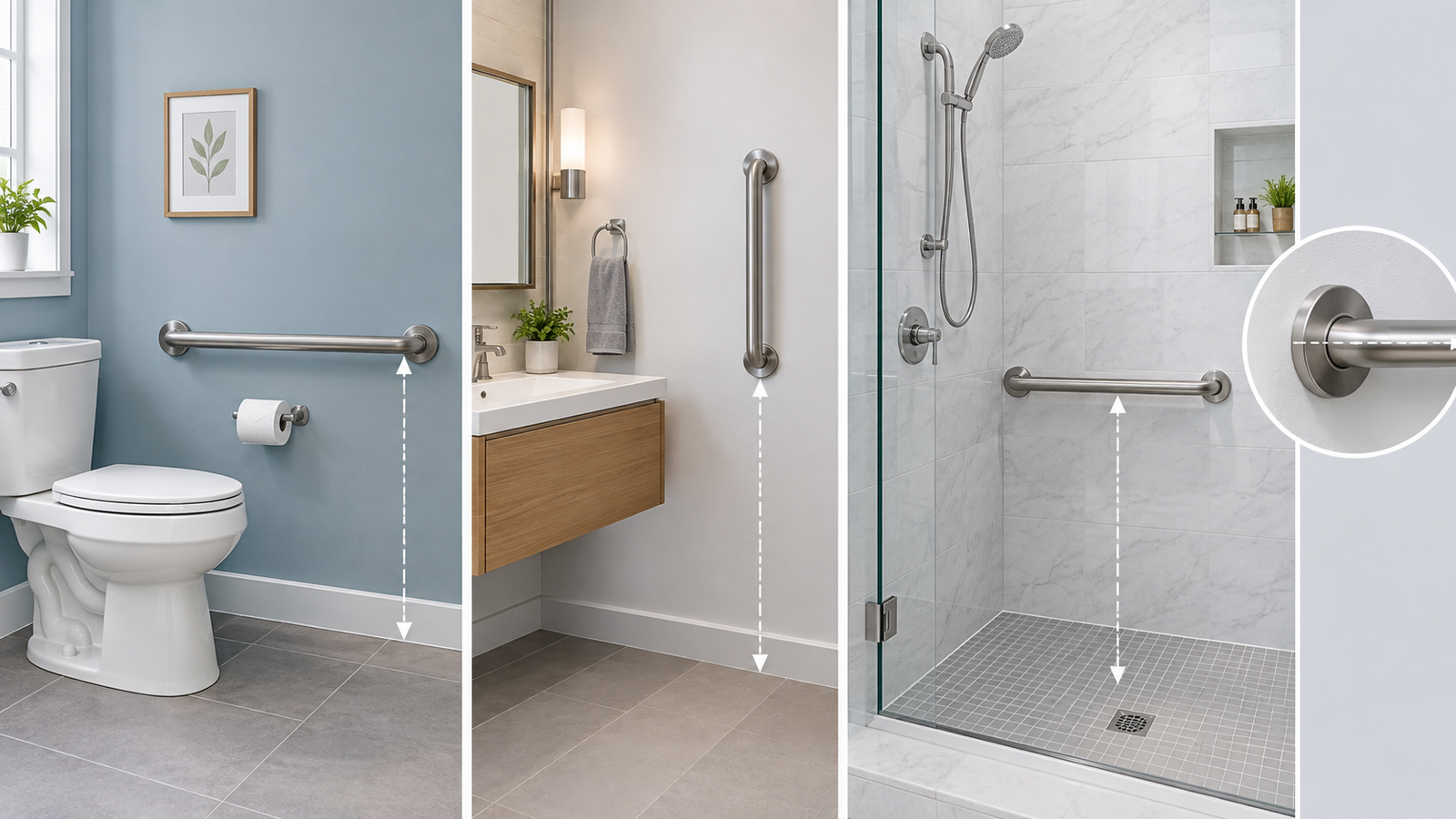
You’re standing in the bathroom with a stud finder in one hand and a grab bar in the other, and the box just says “mount at a comfortable height.” That’s not a measurement. Here’s the exact number, plus every location it changes for.
Quick Answer: The standard grab bar height is 33 to 36 inches above the finished floor, measured to the top of the gripping surface. This range covers toilet, shower, and tub grab bars under the ADA Standards for Accessible Design. A secondary tub bar, when used, sits lower—8 to 10 inches above the tub rim.
Table of Contents
What You Need to Know
- Every bathroom grab bar—toilet, shower, and tub—mounts in the same 33″–36″ band above the floor.
- Height is measured to the top of the gripping surface, not to a screw, bracket, or flange.
- Tubs get a second, lower bar: 8″–10″ above the tub rim, for the step-in, step-out motion.
- ADA numbers are law in public buildings only. In a private home, they’re a strong recommendation, not a requirement.
- Wheelchair users often do better at 33″–34″; taller, standing adults often prefer 36″.
Standard Grab Bar Height at a Glance
Every grab bar in a home bathroom sits somewhere between 33 and 36 inches above the floor—what changes between locations are length and position, not height. The one exception is a tub’s secondary bar, which sits much lower.
Location Height Measured To Toilet—rear wall 33″–36″ Top of gripping surface Toilet—side wall 33″–36″ Top of gripping surface Shower—primary bar 33″–36″ Top of gripping surface Tub — primary bar (back/side wall) 33″–36″ Top of gripping surface Tub—secondary (lower) bar 8″–10″ above the tub rim Tub rim vertical bar (where used) Starts above the horizontal bar, 1.5″ min. clearance bottom of bar Toilet, ages 3–4 (kids, optional) 18″–20″ Top of gripping surface Toilet, ages 5–8 (kids, optional) 20″–25″ Top of gripping surface Toilet, ages 9–12 (kids, optional) 25″–27″ Top of gripping surface
Save or screenshot this height chart—it’s the only reference you’ll need for every fixture in the bathroom, cross-checked against the U.S. Access Board’s own ADA guides.
Grab Bar Height for Toilets (Back Wall & Side Wall)
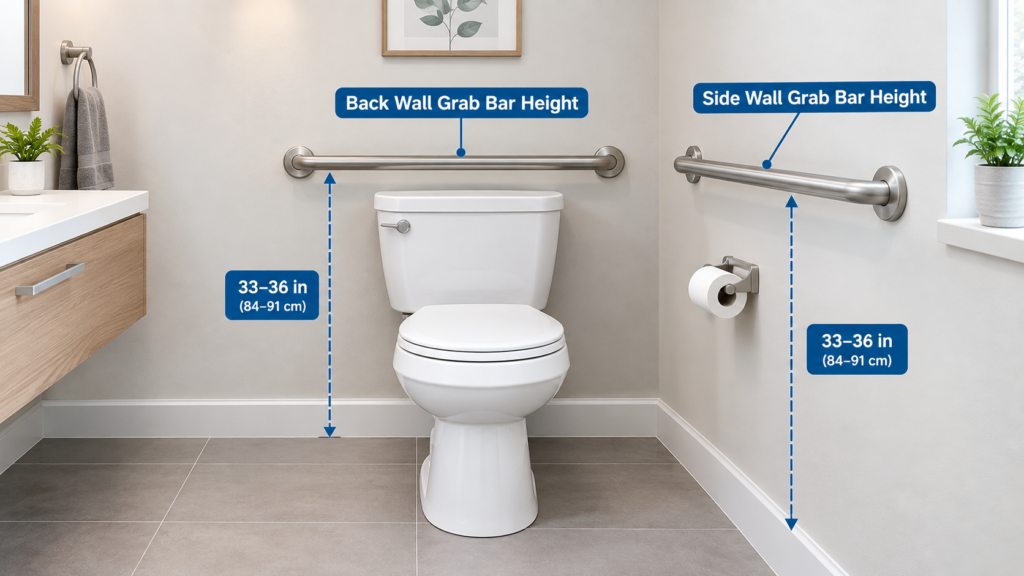
The rear and side grab bars at a toilet both mount 33 to 36 inches above the floor—what changes is how long each bar is and where it sits.
The rear wall bar needs to be at least 36 inches long, extending 12 inches to one side of the toilet’s centerline and 24 inches to the other. The side wall bar needs to be at least 42 inches, mounted no more than 12 inches from the rear wall, and extend forward at least 54 inches. Toilet seat height itself runs 17 to 19 inches, for reference.
Here’s the part almost nobody expects: according to the U.S. Access Board’s ADA guide, the rear and side bars don’t actually have to match height exactly. It’s advisable, but not required—showerheads are the fixture where matching bar height across walls is mandatory, not toilets.
For the full clearance map around the toilet—how far the bar sits from the wall, the seat, and the flush handle—work through our Grab Bar Dimensions guide.
Grab Bar Height for Showers and Tubs
Shower and tub grab bars mount in the same 33-to-36-inch range as toilet bars, with one addition: tubs typically get a second bar positioned lower.
A shower’s primary horizontal bar goes 33 to 36 inches above the shower floor, on whichever wall or walls the layout calls for. A tub’s primary bar follows the same range, measured from the tub floor. The secondary tub bar sits 8 to 10 inches above the tub rim, giving a lower handhold for swinging a leg over the edge. If more than one bar is installed on shower walls, the Access Board’s standard requires them at the same height—unlike toilets, consistency here matters because someone may be sliding a hand along the wall between bars.
Adding a bar with a built-in shelf doesn’t change any of these numbers—see our grab bar with shelf guide for where the shelf itself should sit.
What About Vertical Grab Bars?
A vertical grab bar isn’t required by the ADA at all—it comes from a separate standard, and its placement is looser than the horizontal bars.
The ICC A117.1 standard, referenced by many building codes, calls for an 18-inch minimum vertical bar at showers, tubs, and toilets. It’s positioned above the horizontal bar with at least 1.5 inches of clearance between the two. Exact starting height varies by manufacturer, but it typically lands somewhere in the high 30s to low 40s in inches. For a full breakdown of when you actually need one and where it goes, see Do You Need a Vertical Grab Bar in Your Shower?
Is ADA Height Required in a Home?
In a private, single-family home, the ADA’s 33-to-36-inch rule isn’t the law—it becomes a legal requirement only in public accommodations, commercial buildings, and government facilities.
Most homeowners install at ADA height anyway. It’s a tested range, it’s what installers already default to, and it works across the widest range of body types and abilities. You’re free to shift a few inches inside—or occasionally outside—that band for one specific person’s needs, something covered further down. For the full regulatory language, see the U.S. Access Board’s Bathing Rooms guide.
How to Measure Grab Bar Height Correctly
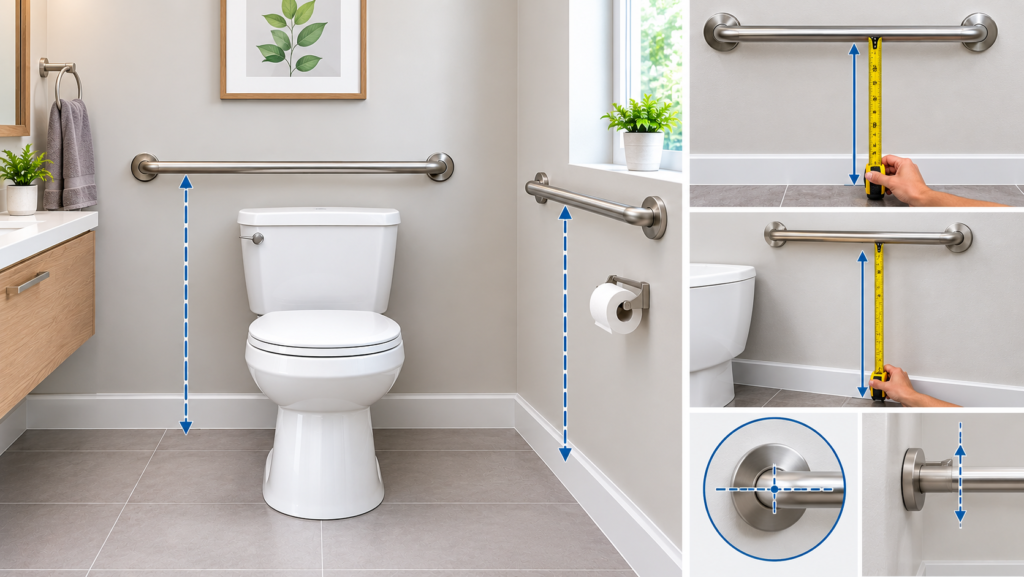
Height is measured from the finished floor to the top of the bar’s gripping surface—not to a screw, not to the mounting flange, not to the center of a bracket.
- Find your zero point. Measure from the finished floor—the tile or vinyl surface—not the subfloor underneath it.
- Mark the band. Put two pencil marks on the wall, one at 33 inches and one at 36 inches, where the bar will go.
- Measure to the grip, not the hardware. The number you land on should be where a hand actually rests on top of the bar. Brackets, screws, and flanges don’t count.
Some installation guides describe measuring “to the mounting flange” instead. That’s not what the U.S. Access Board’s own Toilet Rooms guide specifies—the standard is the top of the gripping surface, full stop, and it’s worth getting right before you drill.
Adjusting Height for the Person Using It
The 33-to-36-inch range exists precisely because one height doesn’t fit everyone—where you land inside it should match who’s using the bar.
Wheelchair users and shorter adults often do better near 33 to 34 inches, since it’s a closer, easier reach from a seated position. Taller adults, or anyone using the bar while standing, often prefer closer to 36 inches. If the bathroom is primarily used by a child, the reference chart above has age-specific numbers, though these are optional guidance rather than a requirement. Once height is settled for the person who’ll actually use it, Modern Grab Bars covers how to keep the look you want without compromising the safety numbers.
Common Grab Bar Height Mistakes
- Measuring to the wrong point. Screws, flanges, and brackets aren’t the reference point—the top of the gripping surface is.
- Buying a towel bar instead of a grab bar. A compliant grab bar has to withstand 250 pounds of force in any direction, according to the U.S. Access Board’s standard. A decorative towel bar isn’t rated for that and can pull straight out of drywall under real weight.
- Skipping the second tub bar. The 33″–36″ bar helps with balance. The 8″–10″ bar is what actually helps someone get their leg over the tub wall.
- Guessing at wall blocking. A bar mounted at the perfect height is still only as strong as what’s behind the drywall. Confirm a stud or blocking before committing to a spot.
- Assuming a rental has to match commercial ADA numbers exactly. A private home has room to move within — or slightly outside — the standard range for one specific person.
FAQ
What is the standard grab bar height in a shower?
Shower grab bars mount 33 to 36 inches above the shower floor, measured to the top of the gripping surface. That’s true for the primary horizontal bar, whether it’s on the back wall or a side wall. If a tub is part of the same fixture, a second bar typically sits lower — 8 to 10 inches above the tub rim, not the shower floor — to help with stepping over the edge.
What is the standard grab bar height in inches?
The standard grab bar height is 33 to 36 inches, measured from the finished floor to the top of the bar’s gripping surface. This range comes from the ADA Standards for Accessible Design and applies to toilet, shower, and tub grab bars alike. It’s a 3-inch window, wide enough to let installers favor 33 inches for wheelchair users or 36 inches for taller, standing adults.
What is the grab bar height for a handicapped toilet?
A wheelchair-accessible toilet needs two grab bars, both mounted 33 to 36 inches above the floor: a rear bar at least 36 inches long and a side bar at least 42 inches long positioned within 12 inches of the rear wall. The U.S. Access Board’s standard doesn’t require both bars to be the exact same height, though matching them is common practice for a cleaner look.
What is the grab bar height for a toilet?
For any toilet—accessible or standard residential—a grab bar mounted 33 to 36 inches above the floor works for most adults. Homes aren’t legally required to follow this number, but it’s the height installers default to because it’s been tested across a wide range of body types. Adjust a few inches lower for a household member who uses a wheelchair.
How high should a vertical grab bar be?
There’s no single ADA-mandated height for a vertical grab bar, because the ADA doesn’t require one at all. The ICC A117.1 standard, used by many building codes, calls for an 18-inch minimum length positioned above the horizontal bar with at least 1.5 inches of clearance between them. In practice, that usually puts the bottom of the bar somewhere in the high 30-inch range, though exact placement varies by manufacturer.
Is ADA grab bar height required in a private home?
No. The ADA’s 33-to-36-inch requirement legally applies to public accommodations, commercial buildings, and government facilities—not private, single-family homes. Most homeowners install grab bars at ADA height anyway, since it’s a well-tested range that works for the widest number of people. You’re free to adjust it for a specific household member’s height or mobility needs.
What is the standard grab bar height for a child?
For a toilet grab bar sized for a child, the U.S. Access Board’s advisory guidance suggests 18 to 20 inches for ages 3 and 4, 20 to 25 inches for ages 5 through 8, and 25 to 27 inches for ages 9 through 12. These numbers are optional, not mandatory, and should match the primary child using the bathroom rather than a mix of ages.
When to Call a Professional
A tape measure and this chart handle height. They don’t handle everything. If your walls don’t have blocking where you need it, if the person using the bar has an unusual reach range, or if you’re not confident finding a stud, bring in a contractor or an occupational therapist before you drill. A bar rated for 250 pounds is only as strong as what it’s screwed into.
What to Do Next
Height is one piece of the placement puzzle. For exact distances from walls, toilets, and tub edges, work through the Grab Bar Dimensions guide. If the bathroom needs support for standing up from a shower seat, the vertical grab bar guide covers where that second bar goes. And once safety is locked in, Modern Grab Bars shows how to keep the style you want.