
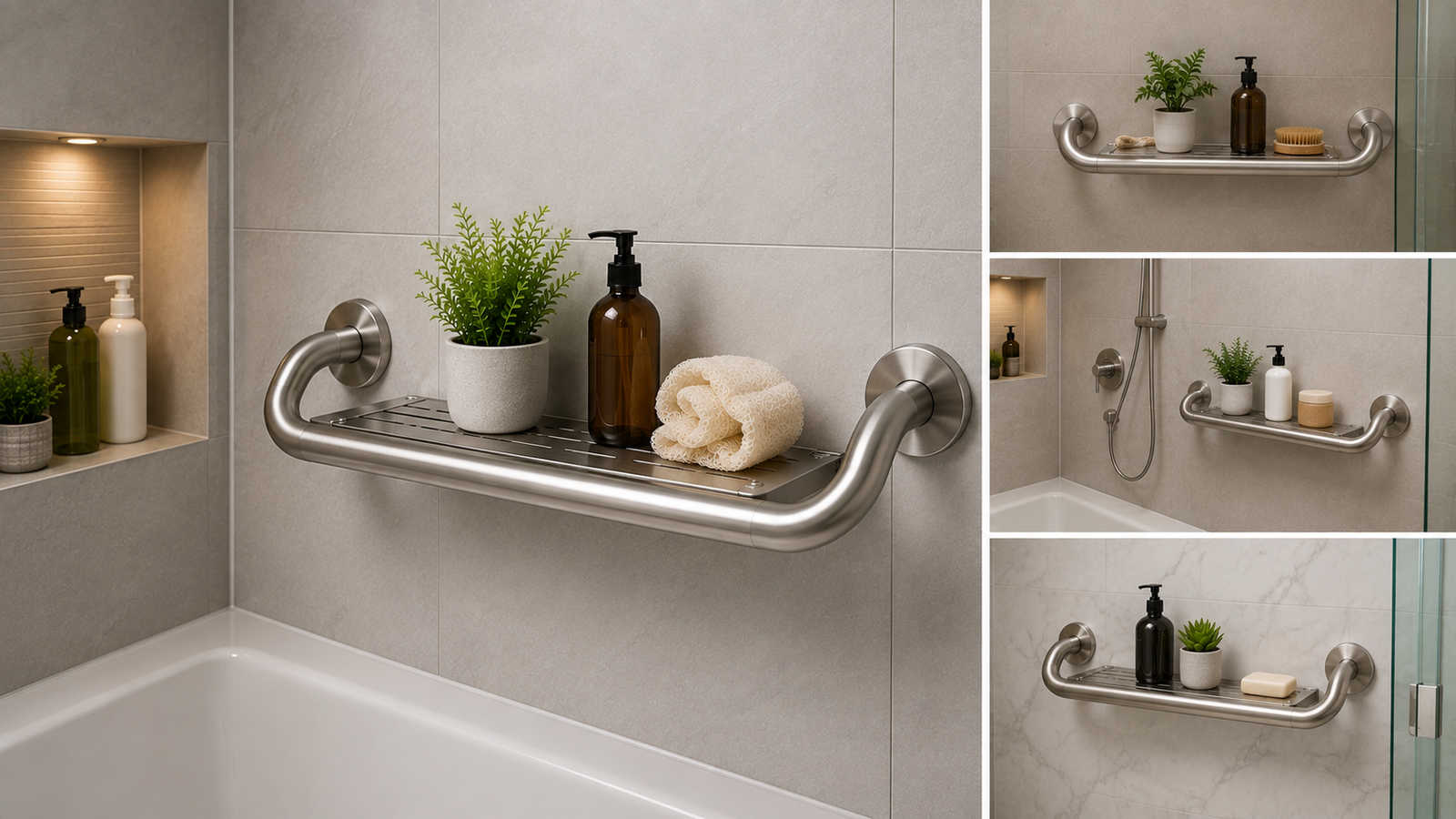
You just watched someone slip reaching for the shampoo bottle, or you’re the one who’s started gripping the tile wall a little too often. Now you’re looking at grab bars that double as a shelf, wondering if the shelf part is a smart two-for-one or a compromise that weakens the safety part.
Quick Answer: A grab bar with a shelf combines a wall-mounted support bar with an attached storage ledge, usually rated to hold 250–500 pounds depending on the manufacturer and mounting. Most models are ADA-conforming only when the shelf doesn’t intrude on the required 1.5-inch wall clearance and the bar itself meets ADA’s grip-diameter and mounting-height rules—the shelf is a convenience add-on, not a compliance feature.
Table of Contents
What You Need to Know
- A grab bar with a shelf has two separate functions on one bracket: structural support and storage—they are not always rated the same way.
- Weight capacity ranges from roughly 250 to 500 pounds, but the shelf attachment can lower the bar’s rated load compared to a plain bar from the same line.
- ADA compliance depends on clearance and mounting, not on the shelf existing—some shelf models fail ADA specs, and others don’t.
- Corner-mounted shelf bars fit tighter shower stalls; straight-wall models give a longer, single gripping surface.
- Installation still requires wall blocking behind the mounting points — a stud finder is not enough on its own.
What Is a Grab Bar With Shelf?
A grab bar with a shelf is a bathroom safety bar that has a small ledge or basket built into or bolted onto its body, so it functions as both a handhold and a place to set shampoo, soap, or a razor. The two most common styles are a corner shelf bar, which spans two adjoining walls, and a straight bar with an integrated tray, which mounts on a single wall.
The core trade-off is this: the shelf adds convenience and reduces clutter, but it also adds torque and moisture exposure at the mounting point, which is why manufacturers often rate shelf-equipped bars slightly lower than their plain equivalents—commonly in the 250 to 500-pound range rather than the 500-plus pounds some plain stainless bars carry.
Is a Grab Bar With a Shelf ADA Compliant?
Compliance depends on clearance and mounting, not on the presence of a shelf itself. The Americans with Disabilities Act, through the U.S. Access Board’s ADA/ABA Accessibility Guidelines, requires a minimum 1.5-inch clearance between a grab bar and the wall behind it, along with specific mounting heights and grip diameters.
A shelf that sits below or beside the bar — rather than replacing that clearance space — can still meet this standard. A shelf that’s molded directly into the gripping surface, narrowing the hand space, typically doesn’t. If you’re outfitting a rental unit, medical facility, or any space with an ADA requirement, check the manufacturer’s compliance sheet for that exact model rather than assuming the category is safe by default.
How Much Weight Can It Hold?
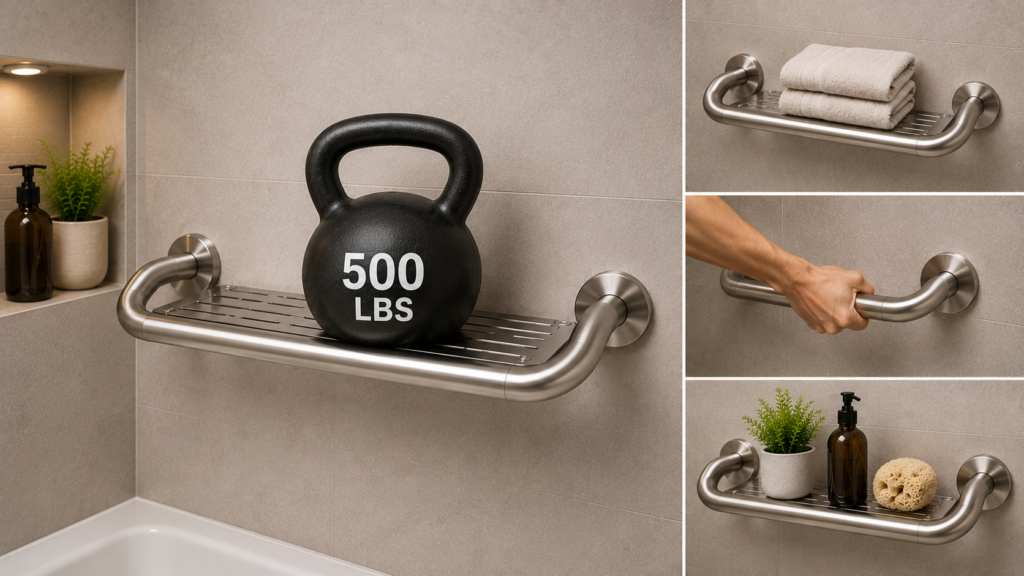
Rated capacity varies by material, mounting hardware, and whether the shelf is load-bearing or purely decorative. Here’s a reference range pulled together from typical manufacturer spec sheets in this category:
Bar Length, Shelf Style, Typical Rated Load, Minimum Wall Clearance, ADA Note: 12 in. on the corner shelf, 250–300 lbs, 1.5 in. Check shelf overlap of 18 in. Straight w/ tray: 300–400 lbs, 1.5 in. Usually compliant, 24 in. straight w/ tray, 350–500 lbs, 1.5 in. common ADA size, 32–36 in a corner or straight. 400–500 lbs, 1.5 in. Verify grip diameter.
Save or screenshot this reference table — it covers the size, load, and clearance numbers you’ll need when comparing listings side by side.
What Size Do You Need?
Length depends on your reach and how the bar is mounted relative to the tub or shower floor, not just personal preference. The 24-inch length is the single most searched and most commonly stocked size in this category, since it balances grip length with fitting inside a standard shower stall corner. If you’re unsure how length translates to actual usability, our guide on how long a bathroom grab bar should be breaks down sizing by shower type and user height.
Where to Install It: Corner vs. Straight Wall
Corner-mounted shelf bars work best in enclosed shower stalls where two walls meet close to shoulder height, since the shelf tucks into the corner instead of jutting into the walking space. Straight-wall models suit tub-shower combos where there’s a long, unbroken wall for both the bar and the shelf to sit flat against.
Either way, placement relative to the entry point, seat, and controls matters more than the shelf style itself. Our full breakdown of grab bar positioning in a shower covers the standard placement zones OT professionals typically recommend.
Grab Bar With Shelf vs. Separate Bar and Shelf
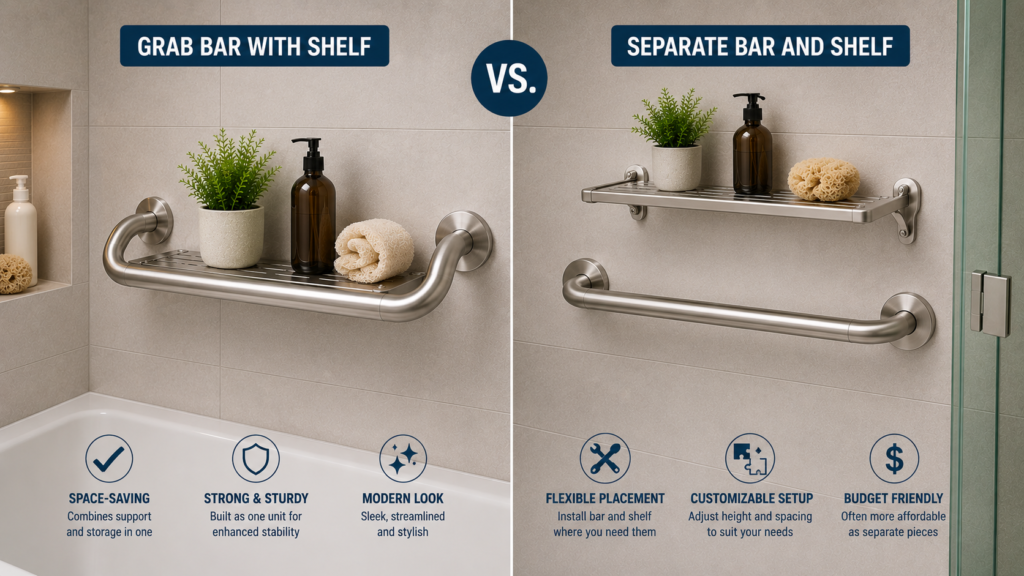
A combined unit is one mounting job instead of two, which means fewer wall penetrations to seal against water — a genuine advantage in a wet-tile shower. The trade-off: if the shelf ever needs replacing or breaks, you’re often replacing the whole unit rather than swapping a $15 shelf. A separate bar and separate shelf give you independent weight ratings and independent replacement at the cost of two sets of holes in your tile.
Common Mistakes
Mounting into tile without hitting the stud or blocking behind it. A grab bar with a shelf still needs to anchor into wall framing or dedicated blocking—the added shelf weight and leverage make this more important, not less, compared to a plain bar.
Assuming the shelf’s weight capacity matches the bar’s rating. Manufacturers sometimes publish one number for the bar’s grip-load and a separate, lower number for the shelf’s static load. Check both before you count on it to hold a full shampoo bottle lineup plus body weight.
Ignoring the clearance, the shelf eats it up. If the shelf pushes your hand’s actual usable grip space below 1.5 inches from the wall, you’ve lost ADA compliance even if the bar itself is rated correctly.
When to Call a Professional Installer
If your shower walls are tile-over-drywall with unknown blocking, or you’re installing in a rental or facility that requires ADA documentation, bring in a licensed installer rather than guessing. According to the U.S. Access Board’s ADA/ABA Accessibility Guidelines, grab bar mounting must resist a specific rotational and shear load—verifying that in an existing wall isn’t a job for a stud finder alone. The CDC’s data on older adult falls also underscores why a bar that’s improperly anchored is arguably worse than no bar at all—it gives a false sense of support.
FAQ
Is a grab bar with a shelf as strong as a regular grab bar?
Not always. The shelf attachment can lower the bar’s rated load compared to a plain bar from the same product line, typically into the 250–500 pound range instead of 500+. Always check the specific model’s spec sheet rather than assuming parity with a standard bar.
Can I find a grab bar with a shelf near me at a local store?
Big-box hardware and medical supply stores carry a limited selection in-store, but the widest range of lengths, finishes, and shelf styles is typically only available online, where you can also compare rated load and ADA documentation before buying.
What’s the best 24-inch grab bar with shelf?
The best option for a 24-inch model depends on your wall type and whether you need ADA documentation — prioritize a published weight rating over finish or price, since that’s the number that protects you.
Is a grab bar with a shelf for shower use different from one for a bathtub?
Shower versions are more often corner-mounted to fit stall geometry, while tub versions tend to be straight-wall bars mounted along the tub’s outer edge—the mounting height and angle differ between the two settings.
Do I need a stud finder to install one?
A stud finder helps locate framing, but it doesn’t confirm the wall can bear the required load—blocking behind drywall or tile is often necessary, and a stud finder alone can’t tell you if that blocking exists.
Does adding a shelf reduce ADA compliance?
It can, if the shelf reduces the required 1.5-inch clearance between the grip surface and the wall. Whether it does depends on the specific model’s design, not on the shelf category as a whole.
What to Do Next
Once you’ve settled on a weight rating and ADA status, the next decisions are length and placement. Start with how long your grab bar should be, then confirm where to position it in your shower. If the institutional look is a concern, our guide to modern grab bar styles covers finishes that don’t look clinical.