
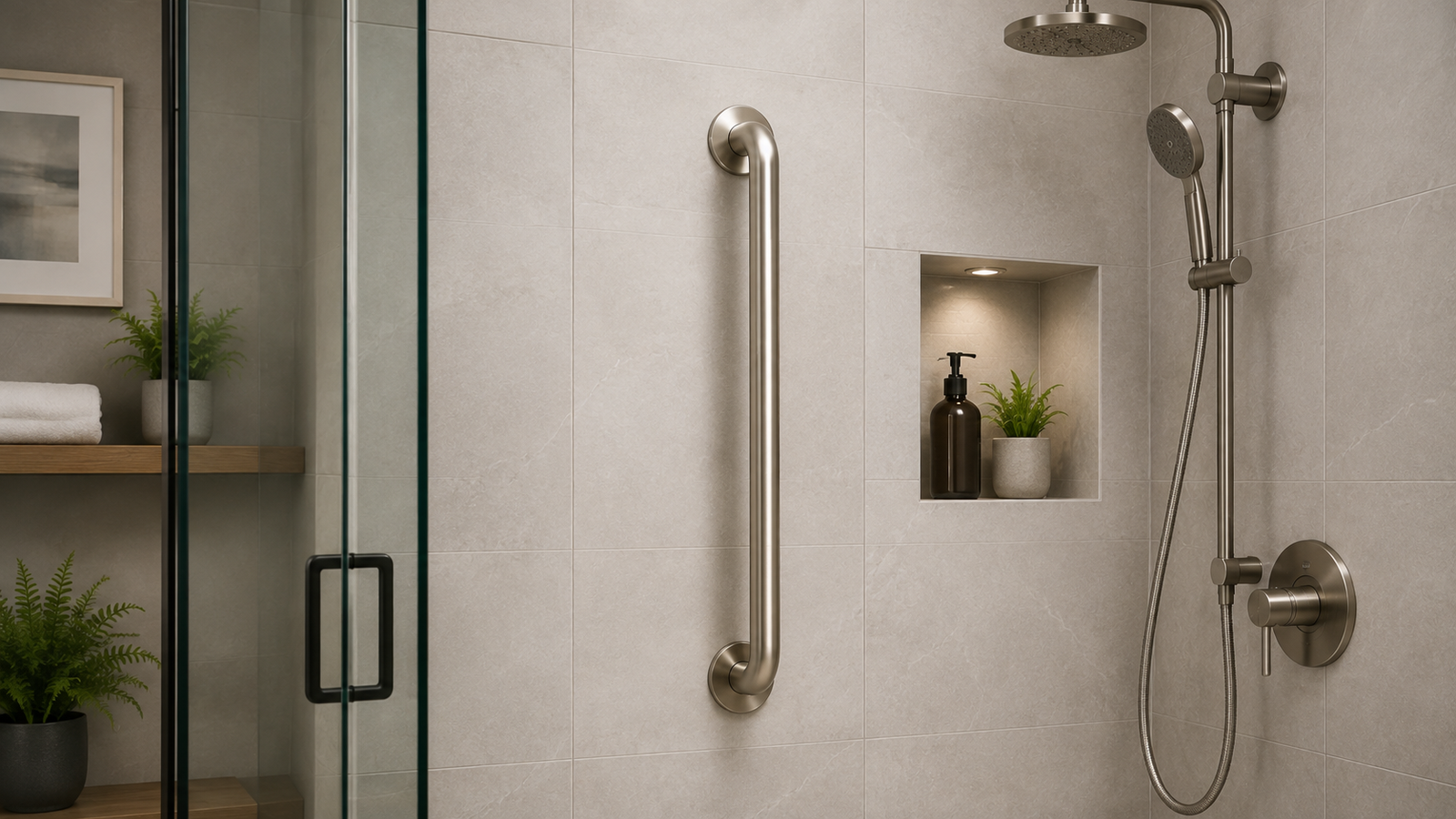
You’re standing at the shower entrance, one foot already over the threshold, and there’s nothing at hand height to grab onto. A vertical grab bar fixes exactly that gap—and the numbers below tell you whether you actually need one and where it goes if you do.
Quick Answer: A vertical grab bar isn’t required by ADA in a residential shower, but it’s still the single most useful bar for stepping in and out safely. Mount it near the entrance with the base around 36 to 41 inches off the floor, extending up to about 55 inches, anchored into a wall stud.
Table of Contents
What You Need to Know
- ADA does not require a vertical grab bar in a shower — ICC A117.1 does, but only in commercial transfer showers.
- Residential installs typically run 36–41″ at the base, up to about 55″ at the top.
- Position it 4–6″ inward from the entrance or door jamb, on the same side as the shower controls.
- It must anchor into a wall stud or engineered blocking—drywall anchors alone will not hold under real load.
- A vertical bar handles entry and exit. You still want a horizontal bar for standing support.
What a Vertical Grab Bar Actually Does
A vertical grab bar is a wall-mounted safety bar installed top-to-bottom rather than side-to-side, used for pulling yourself up or steadying your weight while stepping over a threshold. Its job is entry and exit, not standing support—that’s a horizontal bar’s role.
Think about the motion your hand makes stepping over a tub wall or through a shower door: it reaches up and pulls down, not sideways. A vertical bar matches that motion; a horizontal bar, mounted along a side wall, matches the motion of steadying yourself while you stand and wash.
Most bathroom falls happen during a transition—getting in, getting out, sitting, or standing—not mid-shower. That’s why the entry bar gets singled out as the most important bar in the room.
Do You Need One? ADA vs. ICC A117.1 Requirements
No — not by law, if you’re in a private home. According to the U.S. Access Board, the ADA Standards do not require a vertical grab bar at a shower or bathtub at all. Vertical bars are considered helpful, not mandatory.
The requirement most people are thinking of comes from a different code. ICC A117.1, referenced by the International Building Code, requires an 18-inch minimum vertical bar in commercial transfer showers, positioned 3 to 6 inches above the horizontal bar. That’s a commercial rule, and residential bathrooms are generally exempt from both ADA and ICC A117.1 fixture requirements in the first place.
So installing one at home isn’t a legal checkbox—it’s a judgment call based on who uses the shower, which is why the numbers below are guidance, not code.
How High Should a Vertical Grab Bar Be?
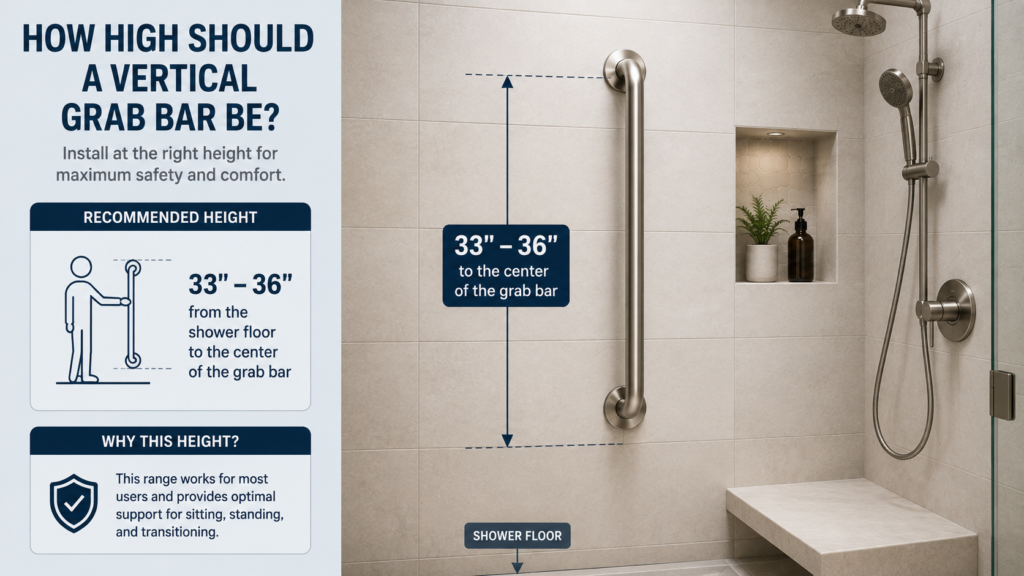
Most residential installs put the base between 36 and 41 inches off the floor, extending up to about 55 inches—high enough to grab while stepping up and low enough to still reach once inside.
Setting Standard Vertical Bar Specs for Any Building, ADA Scope U.S. Access Board / ADA Standards No vertical bar requirement Commercial transfer shower ICC A117.1: 18″ minimum length, mounted 3–6″ above the horizontal bar. Residential shower (typical) Occupational therapist / installer guidance Base ~36–41″, top ~50–55″, bar length 18–24″
Save or screenshot this table — it covers the three numbers people mix up most when comparing “requirements” they’ve read in different places. If you’d rather have charts like this land in your inbox instead of hunting this page down again, that’s exactly what a sign-up to our newsletter is for.
Where to Position It at the Shower Entrance
Position the bar 4 to 6 inches inward from the entrance or door jamb, on whichever side matches how you actually step in—usually the same side as the controls, since that’s the side people reach toward out of habit.
For the full breakdown of every bar position in a shower, see Where to Position Grab Bars in a Shower: Full Guide. The quick version for the entry bar:
- Stand where you actually step in and notice which hand reaches first—that’s your side.
- Mark a spot 4 to 6 inches from the jamb, centered on that reach.
- Locate the stud before drilling. No stud there? Use anchors rated for the bar’s full load, not standard drywall anchors.
- Test the height by standing in place, rather than drilling to a chart number without checking your own reach.
If the shower has openings on both sides, install a bar on both rather than guessing which one you’ll use months from now.
What Length and Weight Rating Do You Need?
Most vertical entry bars run 18 to 24 inches long—enough to cover the reach range without overlapping the horizontal bar’s territory. Go longer, up to 36 inches, only if the bar needs to reach low enough for a shower seat or wheelchair transfer.
Don’t buy anything rated under 250 pounds, regardless of the user’s actual weight. That number accounts for the force of catching a fall, not just leaning on the bar—a bar can fail well under its static rating when it takes a sudden, full-body grab.
For sizing logic across every bar in the bathroom, see How Long Should a Bathroom Grab Bar Be?
Mounting: Studs, Tile, and Fiberglass
A vertical grab bar has to anchor into a wall stud or code-rated blocking—tile, fiberglass, or drywall alone will not hold it under real load. The wall surface changes the drilling method, not whether the stud is optional.
On tile, drill through into the stud behind it using a masonry or diamond bit to avoid cracking the glaze. On fiberglass or acrylic surrounds, locate the stud first, then drill through the panel. If a stud doesn’t line up where the bar needs to go, toggle-style anchors engineered specifically for grab bars can work — but only when rated for the bar’s full weight capacity.
If your shower walls went in without blocking for grab bars, common in older homes, that’s a job for a licensed contractor, not a weekend fix.
Vertical vs. Horizontal: Do You Need Both?
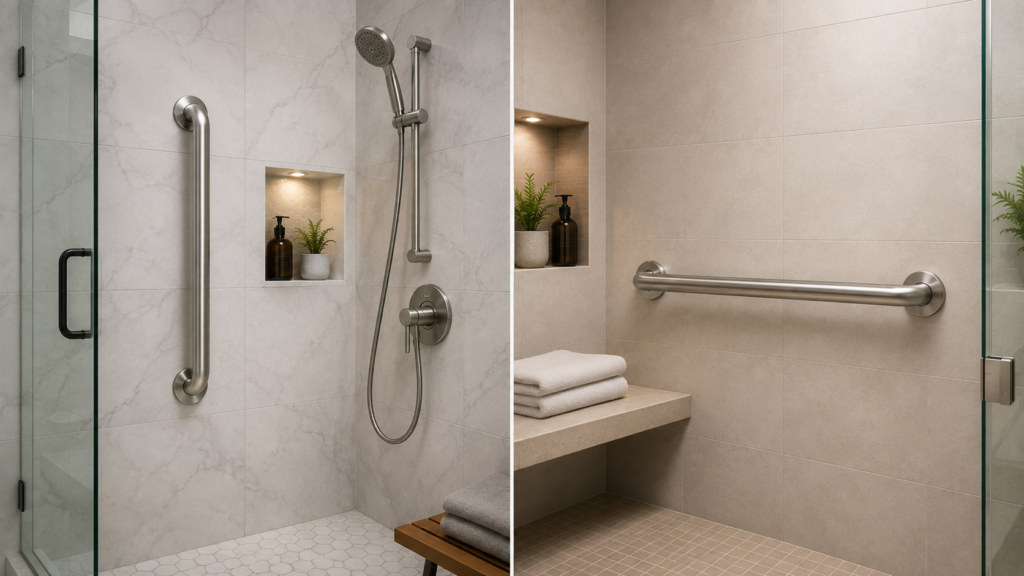
In almost every shower, yes—a vertical bar and a horizontal bar are doing two different jobs, not competing for the same one. A vertical bar alone won’t help much once you’re standing under the water. A horizontal bar alone won’t help you catch yourself stepping over a wet threshold.
Vertical Bar, Horizontal Bar Best for entering and exiting Standing, washing, and balance Typical position: shower entrance Side wall, back wall Typical height base is ~36–41″ or 33–36″.
Once the number and position of bars are settled, finish and material become a style decision more than a safety one. Modern Grab Bars: How to Choose Style Without Losing Safety and Stainless Steel Grab Bars: The Complete Buying Guide cover that part.
Common Mistakes with Vertical Grab Bars
The most common mistake is treating a suction-cup bar as a permanent fixture instead of a temporary one. Suction bars lose grip on wet, textured, or temperature-cycled tile and aren’t rated for the sudden, full-body load of a real fall—they’re a different category of product from a bolted, stud-anchored bar, not a lighter-duty version of it.
Other patterns worth avoiding:
- Mounting into drywall only — most drywall anchors hold a fraction of what a grab bar needs.
- Buying a bar too short for the reach range, forcing an awkward stretch when balance matters most.
- Skipping the stud finder, then finding the stud is two inches off from where the bar needs to be.
- Installing only one bar total, when most bathrooms benefit from a vertical entry bar and a horizontal standing bar together.
Frequently Asked Questions
What is the best vertical grab bar for a shower?
It depends more on wall material and user height than brand. Look for a bar rated for at least 250 pounds, 18 to 24 inches long, made from solid stainless steel rather than a hollow or coated tube. For style options, our guide to modern grab bars covers matching safety hardware to a bathroom’s design.
What are the requirements for a vertical grab bar in a shower?
There’s no ADA requirement for one in a residential shower—the U.S. Access Board is explicit that ADA standards don’t mandate it. The only code specifying vertical bar dimensions is ICC A117.1, which applies only to commercial transfer showers: an 18-inch minimum bar set 3 to 6 inches above the horizontal bar. For a home, these are reference numbers, not legal requirements.
What height should a vertical grab bar be in a shower?
Most residential installs position the base between 36 and 41 inches above the floor, extending up to roughly 50 to 55 inches. That range comes from installer and occupational-therapy guidance, not a legal code, since residential bathrooms fall outside ADA and ICC A117.1 requirements. Adjust based on the user’s height and natural reach.
Are heavy-duty suction grab bars safe for a shower?
Even “heavy-duty” suction bars aren’t a substitute for a stud-anchored bar in daily use. Grip weakens on wet, textured, or temperature-changing tile, and they aren’t built for the sudden force of a real fall the way a bolted bar is. They can work for travel, but a shower you rely on daily calls for a permanently mounted bar.
Do you need both a vertical and a horizontal grab bar?
In most showers, yes. A vertical bar supports stepping in and out; a horizontal bar supports standing and balance while washing—two different problems, not duplicate solutions. One vertical bar at the entrance plus one horizontal bar on a side or back wall covers the two moments when most bathroom falls happen.
What weight can a vertical grab bar hold?
Look for a bar rated to hold at least 250 pounds, regardless of the user’s actual weight—that rating accounts for the force of catching a fall, not just leaning on the bar. The rating only matters in practice if the bar is mounted into a stud or engineered blocking rather than drywall alone.
What to Do Next
Once the vertical bar’s position is settled, the next decision is everything else in the shower — how many bars total, and where each one sits. Where to Position Grab Bars in a Shower: Full Guide walks through the complete layout, and How Long Should a Bathroom Grab Bar Be? will size every bar you add from here, not just the entry one.