
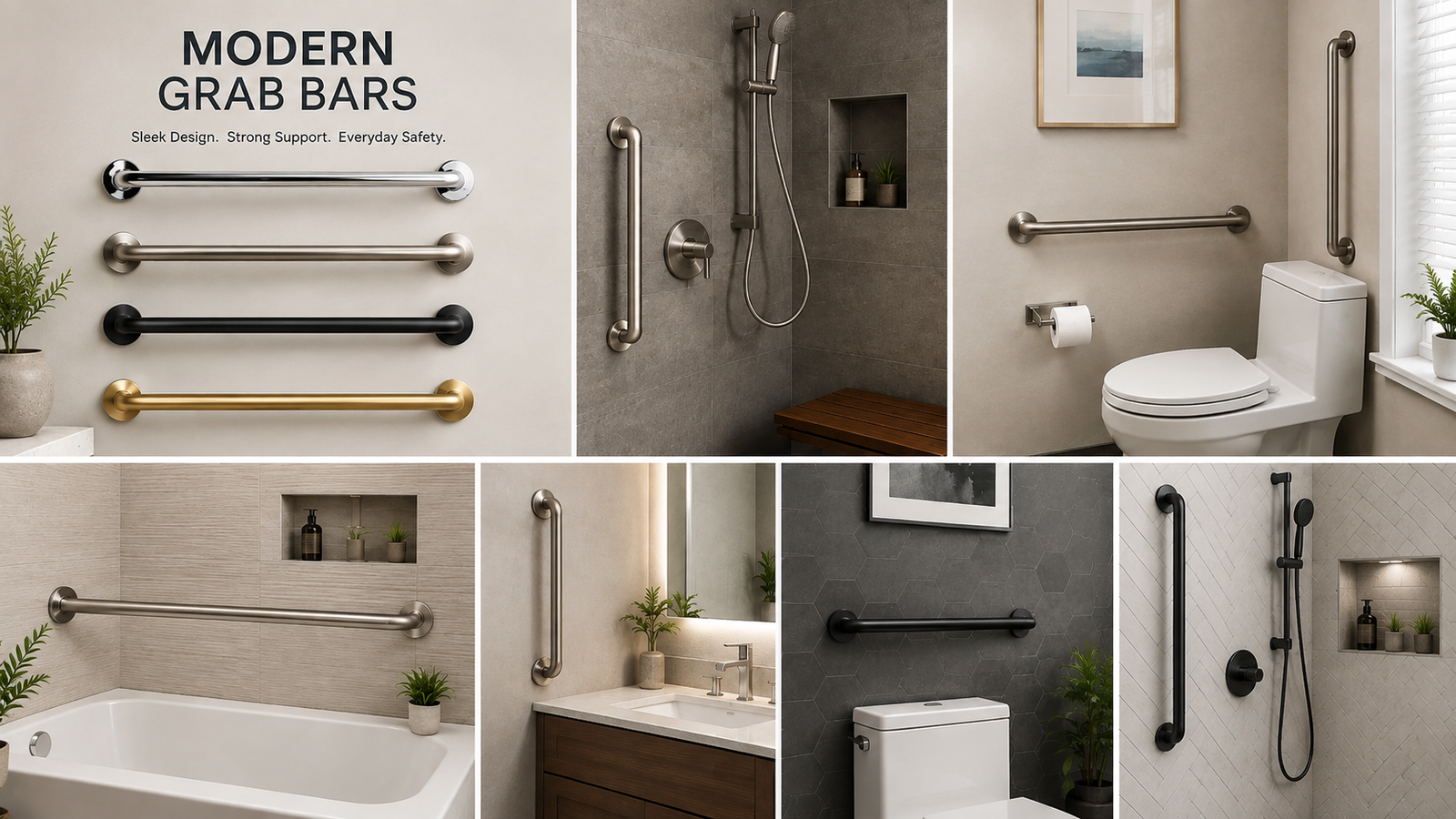
You’re standing in a bathroom showroom or scrolling a hardware site, and every grab bar you find looks like it belongs in a hospital room. You want something that works with your matte black faucet or brushed nickel hardware, not against it. The good news: grab bars stopped being purely institutional years ago, and you can get one that meets code and looks like it was designed on purpose.
Quick Answer: Modern grab bars use a slim 1¼”–1½” diameter bar, concealed or low-profile mounting flanges, and finishes like matte black, brushed nickel, and champagne bronze instead of chrome or stark white. They can still meet ADA and ICC A117.1 requirements—the code governs grip diameter, wall clearance, and load capacity, not appearance.
Table of Contents
- Modern grab bars meet the same ADA/ICC A117.1 specs as institutional bars—style doesn’t override code.
- Diameter must stay between 1¼” and 1½” for the gripping surface, regardless of finish.
- Matte black, brushed nickel, stainless, and champagne bronze are the most common modern finishes.
- A designer grab bar typically costs 2–4 times more than a standard chrome bar, mostly for finish-matching and mounting hardware.
- Blocking behind the wall matters more than the bar’s style — a beautiful bar mounted into drywall alone will fail under load.
What Makes a Grab Bar “Modern”?
Modern grab bars are defined by slim proportions, minimal hardware visibility, and finishes that match plumbing fixtures instead of standing out from them. Older institutional bars used thick chrome tubing with bulky round flanges bolted directly onto the wall in full view. Modern versions narrow the visible flange, sometimes concealing the mounting screws entirely under a decorative escutcheon, and swap chrome for matte black, brushed nickel, polished nickel, or bronze tones.
The shape has changed too. Straight bars are still common, but angled bars, wave-profile bars, and bars that double as a towel bar or shampoo shelf now show up regularly in bathroom remodels — giving the fixture a second job so it reads as decor rather than medical equipment.
Are Modern Grab Bars Still ADA Compliant?
Yes—a grab bar’s finish and shape don’t affect ADA or ICC A117.1 compliance, but the diameter, mounting, and load rating still have to meet code regardless of how it looks. The Americans with Disabilities Act and the ICC A117.1 accessibility standard set requirements for gripping-surface diameter (1¼” to 1½”), clearance from the wall (1½”), and structural load capacity—not for color or finish.
That means a matte black or brushed bronze bar can be just as compliant as a plain chrome one as long as the manufacturer built it to those dimensions and it’s anchored into blocking or a load-rated wall anchor system. Some ultra-thin “designer” bars marketed for aesthetics fall outside the 1¼”–1½” range—those aren’t code-compliant no matter how good they look, so check the spec sheet before buying, not just the finish swatch.
Modern vs. Traditional Grab Bars: Side-by-Side
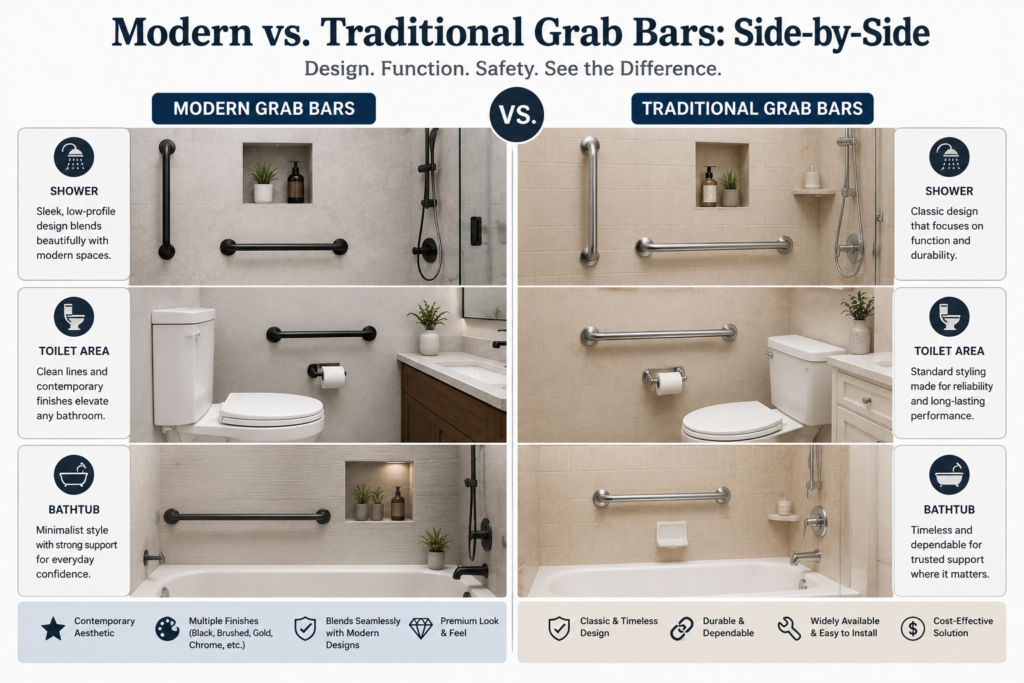
Feature: Traditional Grab Bar, Modern Grab Bar Typical finishes: polished chrome, white Matte black, brushed nickel, champagne bronze, stainless Flange style: visible round flange, exposed screws Low-profile or concealed-mount flange Diameter 1¼”–1½” (code minimum) and 1¼”–1½” (same code minimum). Shape options: Straight bar only Straight, angled, wave, combination towel/grab bar Price range: $15–$40; $60–$400+ depending on the brand and finish. Visual intent function-first, medical appearance Blends with fixtures and hardware finish
Save or screenshot this comparison table — it covers the core differences buyers ask about before choosing a style.
Finish Options: Matte Black, Brushed Nickel, and Beyond
The most common modern grab bar finishes are matte black, brushed nickel, polished nickel, champagne bronze, and satin or polished stainless steel, chosen to match existing faucet and cabinet hardware rather than to stand alone. Matte finishes hide water spots and fingerprints better than polished chrome, which shows every drip.
Grip performance doesn’t change much by finish—the diameter and any knurled or textured grip pattern matter far more than color when hands are wet. A smooth polished finish in any color is more slippery when soapy than a bar with a lightly textured or knurled surface, so if slip resistance is the priority, ask about grip texture, not just finish name.
Shower, Tub, and Toilet: Where Style Choices Differ
Shower and tub grab bars see the most style variation because they’re the most visible, while toilet-area bars are usually chosen for function first. In showers, angled and wave-shaped bars are popular because they follow the natural motion of standing up or lowering into a seat, and they read as an intentional design element rather than an add-on.
Toilet-area bars tend to stay simpler—straight bars or combination towel-bar/grab-bar units—since that space is smaller and less of a design focal point. For exact height and placement guidance by fixture, the positioning details are covered in Where to Position Grab Bars in a Shower: Full Guide.
How Long Should Yours Be?
Length affects both function and how “busy” a wall looks, and it’s a common point of confusion when shopping by style alone. A bar that’s too short for the intended reach doesn’t help much no matter how well it matches the tile. The full breakdown of recommended lengths by location is in How Long Should a Bathroom Grab Bar Be?
How Much Weight Can a Designer Bar Hold?
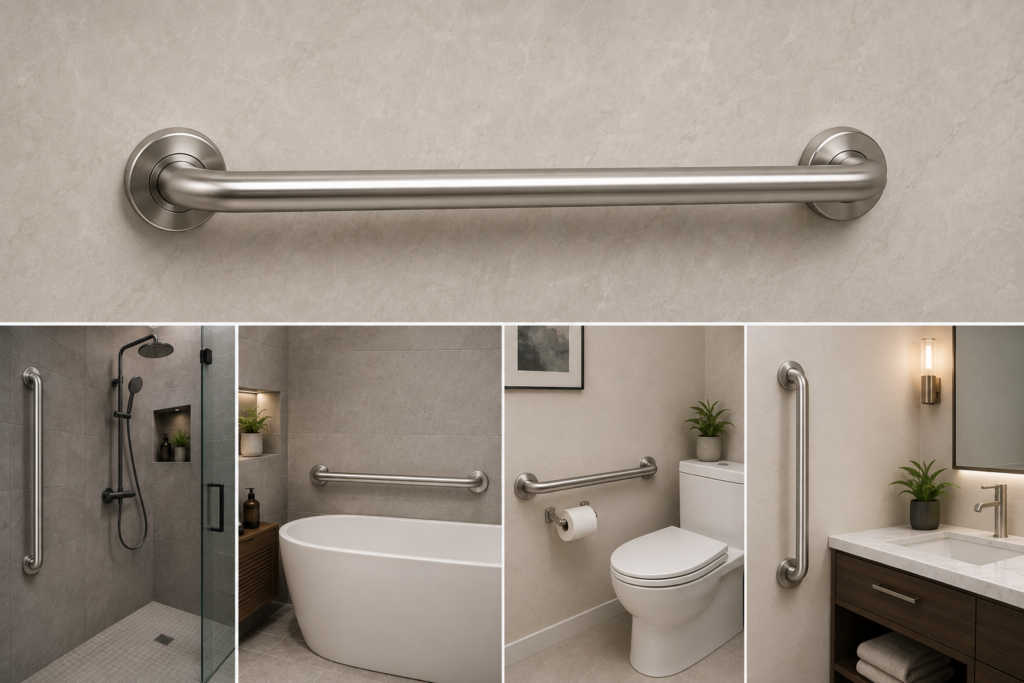
A stylish finish doesn’t mean a lower load rating—reputable modern grab bars are built to the same structural standard as plain ones. What actually determines how much weight a bar can hold is the anchoring method and wall structure behind it, not the bar itself. The specifics of that rating are covered in Grab Bar Strength: The Proven 250 lb Weight Limit.
Installing a Modern Grab Bar the Right Way
- Locate wall blocking or use a rated anchor system. Studs or blocking behind the drywall are the strongest option; where none exist, a manufacturer-rated toggle-bolt anchor system rated for the bar’s load is the next best choice.
- Confirm the bar’s diameter is 1¼”–1½”. Measure before installing, especially with thin “designer” bars that may fall outside code minimums.
- Set mounting height and clearance. Standard placement keeps the bar 33″–36″ above the floor with 1½” of clearance from the wall, adjusted for the specific fixture and user.
- Use the manufacturer’s mounting hardware, not generic screws. Designer bars often ship with finish-matched screws and anchors engineered for that bar’s specific load rating.
- Torque and test before full use. Tighten fully, then apply firm downward and outward pressure to check for any wall flex before relying on the bar.
For the full positioning and mounting reference by fixture type, see Where to Position Grab Bars in a Shower: Full Guide.
[CONTENT GAP: No dedicated finishes/materials guide exists yet—the next section below leans on the stainless steel article as the closest available resource.]
Common Mistakes
The most frequent mistake is buying a grab bar based on finish alone without checking the diameter or the wall behind it. A bar that looks perfect next to a matte black faucet is useless if it’s mounted into drywall with plastic anchors or if its gripping surface falls outside the 1¼”–1½” range.
Another common error is mismatching finishes across the bathroom — pairing a champagne bronze bar with chrome fixtures reads as accidental rather than designed, so matching the dominant metal finish in the room avoids that mismatch. For more on finish-specific durability and maintenance, Stainless Steel Grab Bars: The Complete Buying Guide covers one of the most common modern material choices in more depth.
When to Call a Pro Instead of DIY-Installing
Locating blocking, cutting into tile or a fiberglass shower surround, or working around plumbing lines behind the wall are all situations where a licensed installer is worth the cost. Getting the anchor wrong on a grab bar isn’t a cosmetic mistake — it’s a safety failure waiting to happen, so any uncertainty about what’s behind the wall is a reason to bring in a professional before drilling.
FAQ
What are the best grab bars for elderly bathroom users?
The best option combines a 1¼”–1½” diameter bar, a knurled or textured grip surface, and mounting into wall blocking or a rated anchor system. Style matters less here than secure anchoring and a grip that stays reliable when wet—matte finishes with light texture tend to perform best for older hands with reduced grip strength.
Where can I find designer grab bars for a shower?
Designer shower grab bars are sold by plumbing fixture brands and specialty accessibility retailers, typically in finishes matched to shower systems like matte black, brushed nickel, or champagne bronze. Look for ADA/ICC A117. 1. Compliance listed in the product specs, not just the marketing description, before buying.
What makes a grab bar look modern instead of institutional?
A modern grab bar has a slimmer visible profile, a low-profile or concealed mounting flange, and a finish like matte black or brushed nickel instead of polished chrome. Shape variety — angled, wave-profile, or combination towel-bar designs — also separates modern bars from the plain straight bars typical of older installations.
How do I install a grab bar for a shower safely?
Locate wall blocking or use a manufacturer-rated anchor system, confirm the bar diameter meets the 1¼”–1½” code range, and mount at 33″–36″ from the floor with 1½” of wall clearance. Test the installed bar with firm pressure in multiple directions before relying on it, and hire a professional if there’s any uncertainty about what’s behind the shower wall.
Are matte black grab bars harder to grip when wet?
No — grip performance comes from the bar’s diameter and surface texture, not its color or finish. A smooth polished bar in any finish is more slippery when wet than a textured or knurled bar, so texture matters more than whether the finish is matte black, chrome, or bronze.
Can a grab bar double as a towel bar without violating code?
Yes, as long as the combination unit still meets the 1¼”–1½” diameter and load-rating requirements for its designated use as a grab bar. Manufacturers sell combination towel-bar/grab-bar and shampoo-shelf/grab-bar units specifically rated for both purposes—a plain towel bar not rated for it should never be used as a grab substitute.
How much more do modern grab bars cost than standard ones?
Standard chrome grab bars typically run $15–$40, while designer or modern-finish bars range from roughly $60 to $400+ depending on brand, finish, and shape complexity. The added cost mostly covers finish-matching, mounting hardware engineered for that finish, and in some cases longer manufacturing lead times
What to Do Next
Once the style question is settled, the next decisions are practical: get the length right using How Long Should a Bathroom Grab Bar Be?, confirm placement with Where to Position Grab Bars in a Shower: Full Guide, and verify the weight rating with Grab Bar Strength: The Proven 250 lb Weight Limit. If stainless is on the shortlist, Stainless Steel Grab Bars: The Complete Buying Guide breaks down finish durability in more depth.