
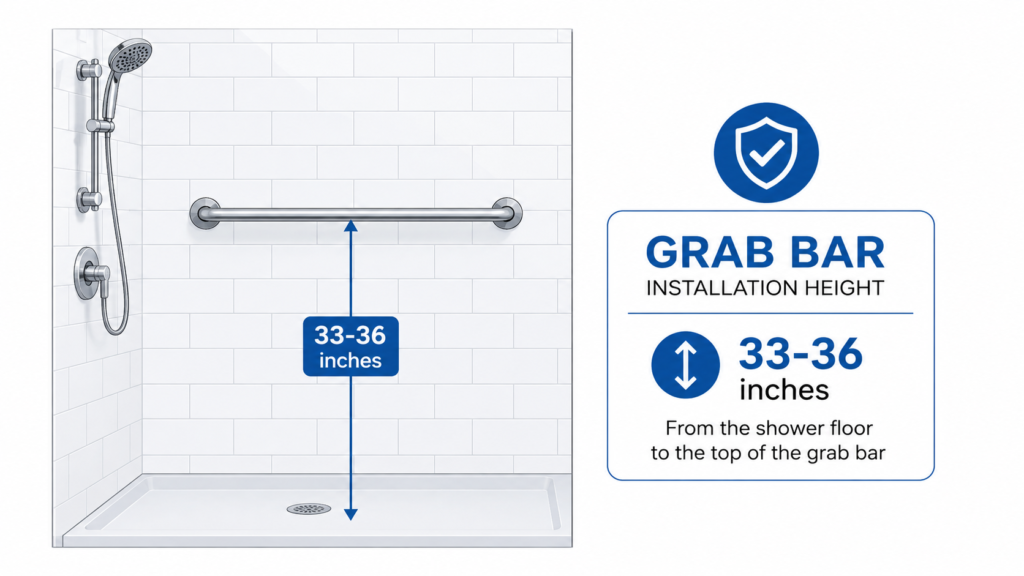
What height is a shower grab bar supposed to be mounted at? If you’re standing in the shower with a tape measure or about to drill into tile, you need one number before you commit. Getting this wrong means a bar that’s useless in a fall or a hole in your tile that has to be patched. Here’s the exact height, straight from the standard.
Quick Answer: The correct height for a shower grab bar is 33 to 36 inches above the finished floor, measured to the top of the gripping surface. This is the ADA standard height for horizontal grab bars in showers, bathtubs, and near toilets. Vertical bars and bars for seated or wheelchair-user showers follow different placement rules, covered below.
Table of Contents
What You Need to Know About Shower Grab Bar Height
- Standard shower grab bar height: 33–36 inches from the shower floor to the top of the bar, per ADA guidelines
- The measurement point matters: it’s to the top of the gripping surface, not the centerline of the bar.
- Vertical grab bars in transfer-style showers require different positioning—the lower end of the bar should sit 3–6 inches from the seat wall.
- Grab bar height doesn’t change based on the user’s personal height—it’s a fixed accessibility standard, not a custom-fit measurement.
- All horizontal bars in the same shower should sit at the same height for consistency.
What Height Is a Shower Grab Bar? The Short Answer
The correct height for a shower grab bar is 33 to 36 inches above the finished floor. According to the 2010 ADA Standards for Accessible Design, Section 609, this range applies to horizontal grab bars in showers, tub/shower combos, and at toilets, and the measurement is taken to the top of the gripping surface — not the bar’s centerline, which is a distinction a lot of DIY guides skip.
This 33–36 inch window isn’t arbitrary. It’s built around the average hip height of an adult standing or transferring, which gives the most stable leverage point for pulling up, steadying, or catching a fall.
Shower Grab Bar Height Requirements Under ADA Code
Every horizontal grab bar governed by ADA Section 609 lands in the same 33–36 inch band, but where the bar sits on the wall changes by fixture. In a shower stall, the back-wall bar and side-wall bar are both mounted 33–36 inches above the shower floor. At a toilet, the same height range applies to both the rear-wall bar and the side-wall bar, so a wheelchair user transferring between fixtures doesn’t have to reach for a different height each time.
Residential vs. Commercial Grab Bar Height Rules
The ADA technically governs public accommodations—hotels, gyms, and commercial buildings—not private homes. But most residential building codes, including guidance referenced by the International Code Council, adopt the same 33–36 inch range voluntarily, because it’s the tested, safest number. If you’re renovating a private bathroom, you’re not legally bound to ADA, but there’s no safety reason to deviate from it.
Does Shower Grab Bar Height Change for Seated Showers or Different Users?
The correct shower grab bar height stays fixed at 33–36 inches regardless of who’s using the bathroom — what changes is bar type and position, not the number itself. A common misconception is that grab bar height should be customized to the individual’s height, like a towel bar or shelf. It shouldn’t. The standard is built around leverage and stability during a fall or transfer, not reaching comfort.
Grab Bar Height for Wheelchair Users
For transfer-type showers used by wheelchair users, a vertical grab bar at least 18 inches long is required in addition to the horizontal bars. According to ADA Section 609, that vertical bar mounts with its bottom edge 3 to 6 inches from the seat wall, extending at least 4 inches above the horizontal bar it pairs with.
Grab Bar Height for Children
Children’s water closets and fixtures use a separate, lower range — grab bars for child-height fixtures mount 18 to 27 inches above the floor. This applies to designated children’s facilities, not a standard family bathroom.
Vertical vs. Horizontal Shower Grab Bars—Does Orientation Change the Height?
Horizontal bars follow the standard shower grab bar height of 33–36 inches; vertical bars are positioned by their bottom edge and extension length instead of a single height number. A horizontal bar gives you a steady pull-up point at hip height — this is the primary fall-prevention bar and the one most people mean when they ask what height a shower grab bar should be. A vertical bar, mounted at a shower entry or transfer point, helps with balance while stepping in or out and is measured by where its bottom starts, not a flat height range.
Most bathroom safety experts recommend installing both types together rather than relying on one bar alone — a horizontal bar for steadying and a vertical bar for the entry/exit motion, which is when most bathroom falls actually happen.
Shower Grab Bar Height Quick-Reference Chart
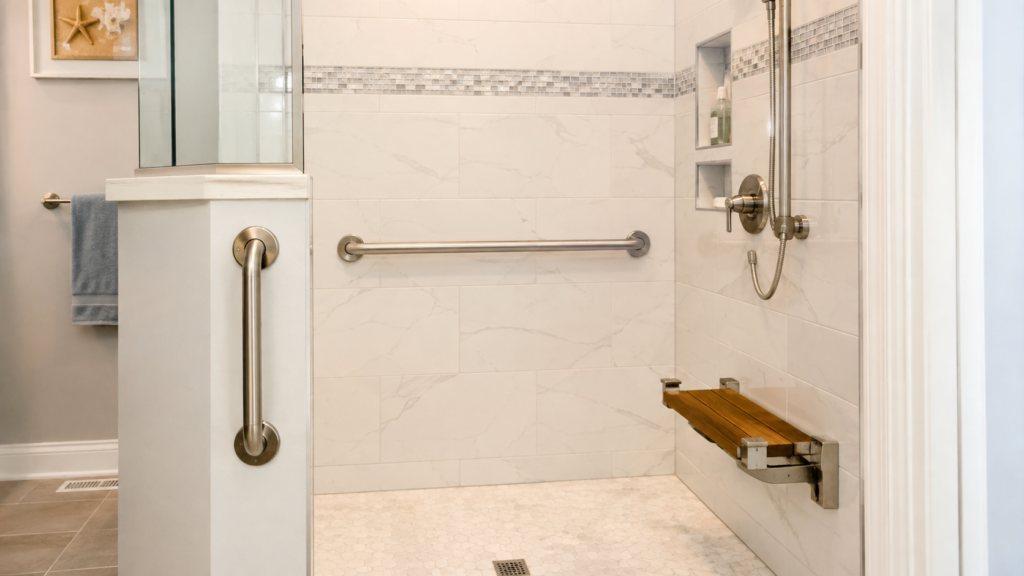
| Location | Bar Type | Height Above Floor |
|---|---|---|
| Shower back wall | Horizontal | 33–36 inches |
| Shower side wall | Horizontal | 33–36 inches |
| Toilet rear wall | Horizontal | 33–36 inches |
| Toilet side wall | Horizontal | 33–36 inches |
| Transfer shower entry | Vertical | Bottom 3–6 inches from seat wall |
| Children’s fixtures | Horizontal | 18–27 inches |
Suggested image here: a labeled diagram of a shower wall with a measuring line marking 33–36 inches. Alt text: “Bathroom grab bar height diagram illustrating 33 to 36 inches measured above floor.”
Save or screenshot this chart — it covers the correct shower grab bar height for every common location in a residential or commercial bathroom.
Where to Place the Bar (Not Just How High)
Height is only half the equation — position on the wall matters just as much. If you’re still working out exactly where each bar should go relative to the shower entry, seat, or controls, where to put shower grab bars walks through wall-by-wall placement, And proper bathroom grab bar placement addresses the entire room layout, not only the shower area.
Choosing the Right Bar Once You Know the Height
Once the shower grab bar height is set, the bar itself needs to match the job. Length and weight capacity both depend on where and how it’s mounted — what size grab bar is best for a bathroom breaks down sizing, and how much weight bathroom grab bars can hold explains the weight ratings you should check before buying. A bar mounted at the perfect height still fails if it’s rated for less than it needs to hold, so treat sizing as the next step, not an afterthought.
Common Mistakes When Installing a Shower Grab Bar at the Right Height
Mounting to drywall alone instead of a stud. A grab bar rated for 250+ pounds is only as strong as what it’s anchored into — drywall anchors alone will pull out under real weight during a fall.
Measuring to the bar’s centerline instead of the top. ADA measures to the top of the gripping surface. Measuring to the center of a 1.5-inch-thick bar can put your actual grip height an inch low.
Assuming taller or shorter users need a different height. As covered above, shower grab bar height doesn’t scale to individual height — it’s fixed at 33–36 inches for a reason.
When to Call a Professional Installer
This article covers the height standard, not the installation itself. If you’re not confident locating wall studs, working with tile, or verifying weight capacity, a licensed installer or contractor should handle the mounting — a grab bar installed incorrectly can give a false sense of security, which is more dangerous than no bar at all. The National Institute on Aging also recommends a professional home safety assessment for anyone installing bathroom safety equipment after a fall.
FAQ:
How high should a handrail be in a shower?
A shower handrail (grab bar) should be mounted 33 to 36 inches above the finished floor, measured to the top of the gripping surface. This matches ADA Section 609 and applies to both back-wall and side-wall bars in a standard shower stall.
What requirements apply to shower grab bars?
ADA guidelines specify horizontal grab bars positioned 33–36 inches above the floor along the back and side walls of showers, with bars designed to support at least 250 pounds. Transfer-type showers also require a vertical bar near the entry, and all bars must anchor into studs or reinforced blocking.
Should shower grab bars be installed vertically or horizontally?
Both, ideally. Horizontal bars at 33–36 inches provide the primary fall-prevention grip at hip height, while vertical bars near the shower entry assist with the stepping motion, which is when most falls happen. Installing only one type leaves a gap in coverage.
Where to place grab bars in shower for elderly?
For elderly users, place a horizontal bar on the back wall and side wall at 33–36 inches, plus a vertical bar near the entry point for stepping in and out. If the shower has a seat, an additional bar within reach of the seated position adds support for sitting down and standing up.
Does grab bar height change for a seated shower?
No — the 33–36 inch standard for horizontal bars stays the same whether the shower has a built-in seat or not. What changes is that an additional bar is often added within reach of the seat for extra support during transfers.
What height should a grab bar be next to a toilet?
The same 33–36 inch range applies at a toilet as in a shower, measured on both the rear-wall and side-wall bars. Consistent height across fixtures helps wheelchair users and anyone relying on muscle memory for balance.
What to Do Next
Once your shower grab bar height is confirmed, the next step is nailing down exact placement on the wall — see where to put shower grab bars for wall-by-wall guidance. After that, what size grab bar is best for a bathroom will help you pick a bar that’s actually rated for the job.