
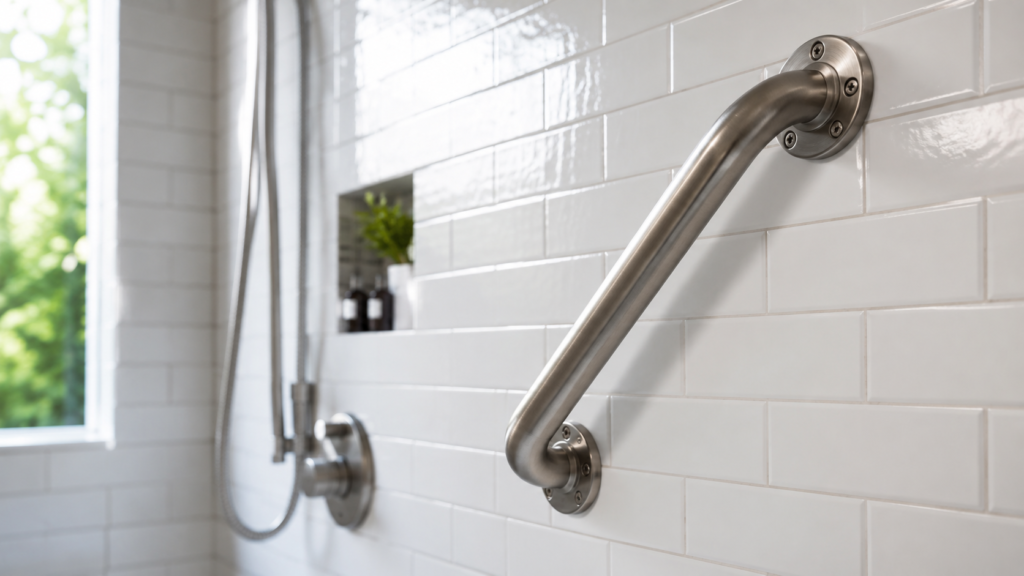
So you’re wondering how much weight bathroom grab bars can hold—especially the one by your shower or next to the toilet. That’s not a small question; it’s the difference between a bar that saves someone during a fall and one that fails at the worst possible moment.
Quick Answer: How much weight can bathroom grab bars hold? Under ADA standards, a properly installed grab bar must support at least 250 pounds of force. Real-world capacity ranges from 250 to 500+ pounds depending on the bar and, more importantly, how it’s mounted. A bar screwed into wall studs can hold far more than the same bar anchored into hollow drywall.
Table of Contents
What You Need to Know
- The ADA requires grab bars to withstand 250 pounds of force without permanent bending—that’s the minimum, not the ceiling.
- Installation method changes how much weight a grab bar can hold more than the bar itself does: stud-mounted bars can hold up to 500 pounds; hollow-wall anchors typically cap out around 250–300 pounds.
- Suction-cup grab bars are not ADA-compliant, and many don’t reliably hold anywhere close to 250 pounds.
- A sudden grab during a real fall applies force differently than steady, standing weight—which changes how much weight a grab bar effectively needs to hold in practice.
- Heavier users need a bar rated well above the 250-pound minimum, installed into structural blocking.
How Much Weight Can Bathroom Grab Bars Hold? The ADA Standard, Explained
The core rule: grab bars and their mounting hardware must withstand 250 pounds of force at any point without permanently deforming. This comes from Section 609.8 of the 2010 ADA Standards for Accessible Design, the federal source that defines exactly how much weight a grab bar has to hold to be considered compliant.
That 250-pound figure is a force rating, not a simple static weight limit. It’s tested by applying vertical or horizontal pressure at any point along the bar, including the ends, where someone is most likely to grab during a fall. A bar that passes this test won’t bend or pull loose under that load.
This standard is legally required in public and commercial restrooms. In private homes, it isn’t mandated by law, but following the same 250-pound benchmark is the difference between a decorative safety feature and one that actually works when someone needs it. According to the CDC’s fall-prevention research, most bathroom injuries among adults are caused by falls—which is exactly why this number matters so much.
How Much Weight Do Different Grab Bar Types Hold?
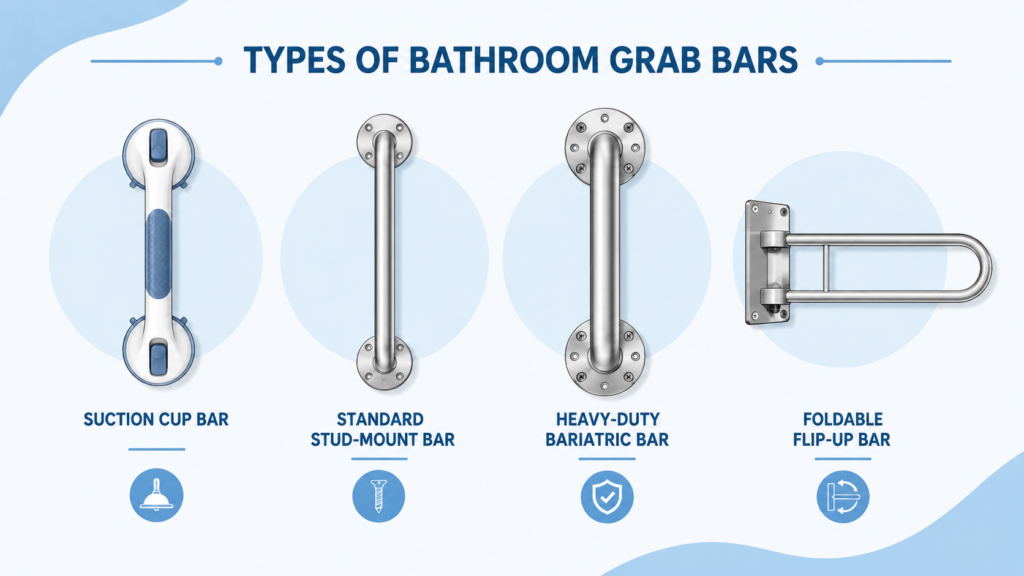
Not every grab bar is built or installed the same way. Here’s how much weight each common type can realistically hold:
| Grab Bar Type | Typical Weight Capacity | Requires | Best For |
|---|---|---|---|
| Suction-cup (temporary) | 100–250 lbs (unreliable) | Smooth, non-porous surface | Light balance assistance only — not fall prevention |
| Standard ADA stud-mount | 250–500 lbs | Wall studs or blocking | Everyday bathroom safety, most households |
| Heavy-duty / bariatric | 500–800+ lbs | Reinforced blocking, wider mounting | Users over 250 lbs, high-risk transfer zones |
| Flip-up / foldable | 250–400 lbs | Floor or wall structural mount | Small bathrooms, toilet-side support |
Save or screenshot this chart—it answers how much weight bathroom grab bars of each type can hold, so you can match a bar to your actual needs in seconds.
Why Installation Changes How Much Weight a Grab Bar Can Hold
A grab bar rated for 500 pounds is only as strong as what it’s screwed into. This is the single most overlooked factor in grab bar safety, and it’s the real answer to how much weight bathroom grab bars can hold in practice—not just on the box.
Grab bars anchored directly into wall studs, or into blocking installed specifically for this purpose, can reliably hold the bar’s full rated capacity. Bars mounted into hollow drywall using anchors, even heavy-duty ones, typically top out around 250 to 300 pounds, regardless of what the bar itself claims to hold.
If your bathroom walls don’t line up with stud spacing where you need the bar, adding blocking (a horizontal board installed inside the wall cavity) before drywall goes back up is the fix contractors use. For more detail on getting the position right the first time, see our guide on where grab bars should be placed in a bathroom.
Are Suction Cup Grab Bars Strong Enough to Hold Real Weight?
Short answer: not for fall prevention. Suction-cup grab bars are not ADA-compliant, and many don’t reliably hold the 250-pound minimum, despite packaging claims of 200–400 pounds.
The problem isn’t just raw capacity—it’s reliability. Suction seals weaken with humidity, temperature swings, and surface texture over time, and they can fail without warning. That’s a serious issue for a device whose entire job is to be there during a sudden loss of balance.
Suction bars can be reasonable for light, temporary balance assistance—travel, a rental bathroom, or occasional steadying. They shouldn’t be relied on as a primary safety device for anyone with real fall risk.
How Much Weight Can Grab Bars Hold During an Actual Fall?
Here’s the part most articles skip: a grab bar’s rated capacity is usually tested under steady, controlled pressure—not the sudden, sideways, off-angle grab that happens during a real fall.
When someone loses their balance and grabs a bar suddenly, the force applied can momentarily exceed their body weight, because it includes the force of stopping a fall in progress, not just holding up standing weight. That’s part of why the ADA’s 250-pound minimum includes a safety margin, and why manufacturers rating bars well above that minimum aren’t being excessive—they’re accounting for a scenario a simple weight number doesn’t fully capture.
Do You Need a Grab Bar That Holds More Weight?
If the primary user weighs more than roughly 250 pounds, or the bar will be used for full weight-bearing transfers rather than occasional steadying, look at bars rated for 400–800 pounds, mounted into structural blocking rather than standard anchors. Bariatric-rated bars cost more but close a real safety gap that a standard ADA-minimum bar leaves open.
Common Mistakes That Reduce How Much Weight a Grab Bar Can Hold
Assuming “installed” means “installed correctly.” A grab bar mounted into drywall alone, without hitting a stud or a load-rated anchor, can pull loose under far less than 250 pounds, regardless of the bar’s own rating.
Mistaking a towel bar for a grab bar. Towel bars are designed to hold a few pounds of wet fabric, not a person’s body weight. They aren’t rated for load-bearing use and shouldn’t be treated as a safety fixture, even in an emergency.
Trusting suction bars for real support. As covered above, these are best treated as light-touch balance aids, not fall-prevention equipment.
Ignoring wall type. Tile, fiberglass, and drywall all require different anchoring approaches. A method that works on drywall may not hold on fiberglass, and vice versa.
Placement matters just as much as capacity—our article on grab bar placement in the bathroom covers the ideal positions near the toilet, shower, and tub.
Before you finalize your setup, grab our free Grab Bar Weight & Placement Checklist—a printable page covering capacity, mounting, and positioning in one place.
FAQ: How Much Weight Can Bathroom Grab Bars Hold?
What is a good size grab bar for a shower?
Most showers work well with a 1.25–1.5 inch diameter bar, which meets ADA grip standards, in lengths of 24–36 inches depending on the wall space. Longer bars give more flexibility for grip position during different tasks.
Are suction grab bars strong enough?
Generally, no, for reliable fall prevention. Suction grab bars are not ADA-compliant and often fail to consistently hold even 250 pounds due to suction seal degradation from moisture and temperature changes.
How many lbf (pound-force) is the maximum bending stress of grab bars?
The ADA standard requires grab bars, along with their fasteners and mounting structure, to withstand 250 lbf applied at any point without permanent deformation. This is a minimum requirement—many manufacturers rate their products well above it.
How many grab bars do you need in a bathroom?
A fully accessible bathroom typically needs at least three: two near the toilet (rear wall and side wall) and one or two in the shower or tub area. Household needs vary based on mobility level.
Can a towel bar be used as a grab bar?
No. Towel bars are built to hold a few pounds and aren’t anchored or rated for body-weight loads. Using one for support during a fall risks pulling it, and potentially the wall surface, loose.
Does a heavier person need a special grab bar?
Yes, if body weight regularly exceeds around 250 pounds, or the bar will be used for full weight-bearing transfers. Bariatric-rated bars (400–800+ pounds) installed into structural blocking close the gap a standard ADA-minimum bar leaves.
What to Do Next
Once you know how much weight a bathroom grab bar can hold, the next question is placement. See our full guide on where grab bars should go in a bathroom for exact height and positioning by fixture.
From there, most people want to know which specific bar to buy for their situation or how to install one without missing the stud—both worth researching before you purchase.